
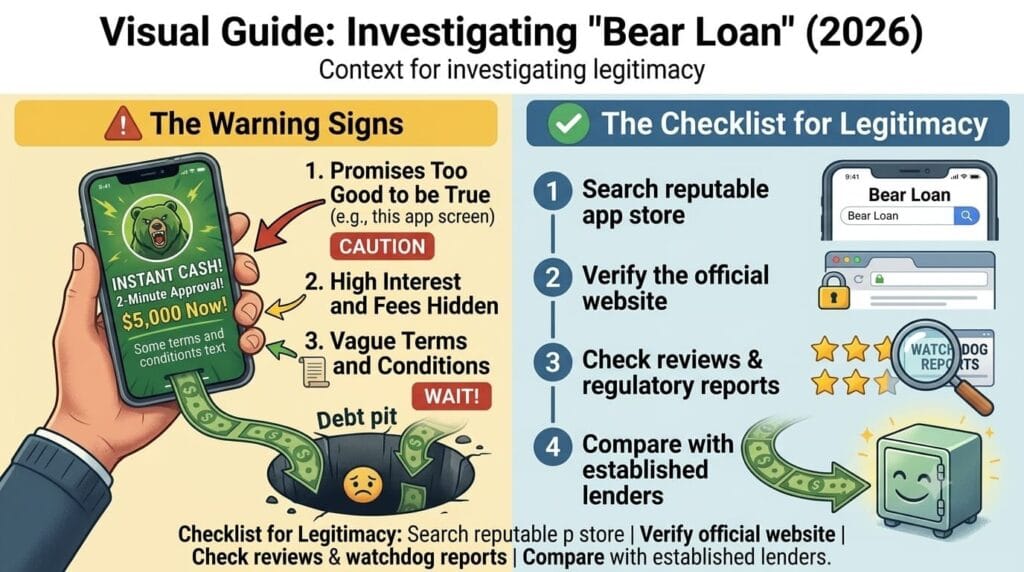
A friend of mine texted me a screenshot last month. It was an app called “Bear Loan Cash Advance,” promising instant approval, no credit check, up to $5,000. She wanted to know if it was safe to hand over her Social Security number.
I spent an evening digging through app store reviews, Trustpilot, and a scam-tracking site. What I found was messier than I expected.
There isn’t one “Bear Loan.” At least four separate operations use some version of the name: MyBearLoan, Cash Loans Bear, BearLoan.org, and a Google Play app called “Bear Loan Cash Advance Now.”
Some connect you to third-party lenders. Others are cash-advance products tied to a specific card. None of them are the same company, and mixing them up is the first mistake most people make.
What “Bear Loan” actually is
Most sites using this name are loan-matching services, not lenders themselves. You fill out a form with your income, employer, and banking details. The site then routes your request to a network of third-party lenders, who decide the actual terms.
That’s a legitimate business model (LendingTree and Credible work the same way), so the structure alone isn’t a red flag. What matters is who ends up on the other end, and what they charge.
A smaller slice of “Bear” products are cash-advance apps tied to a specific card. You get a portion of your next paycheck early, and the app deducts it automatically on payday, plus a flat fee instead of interest.
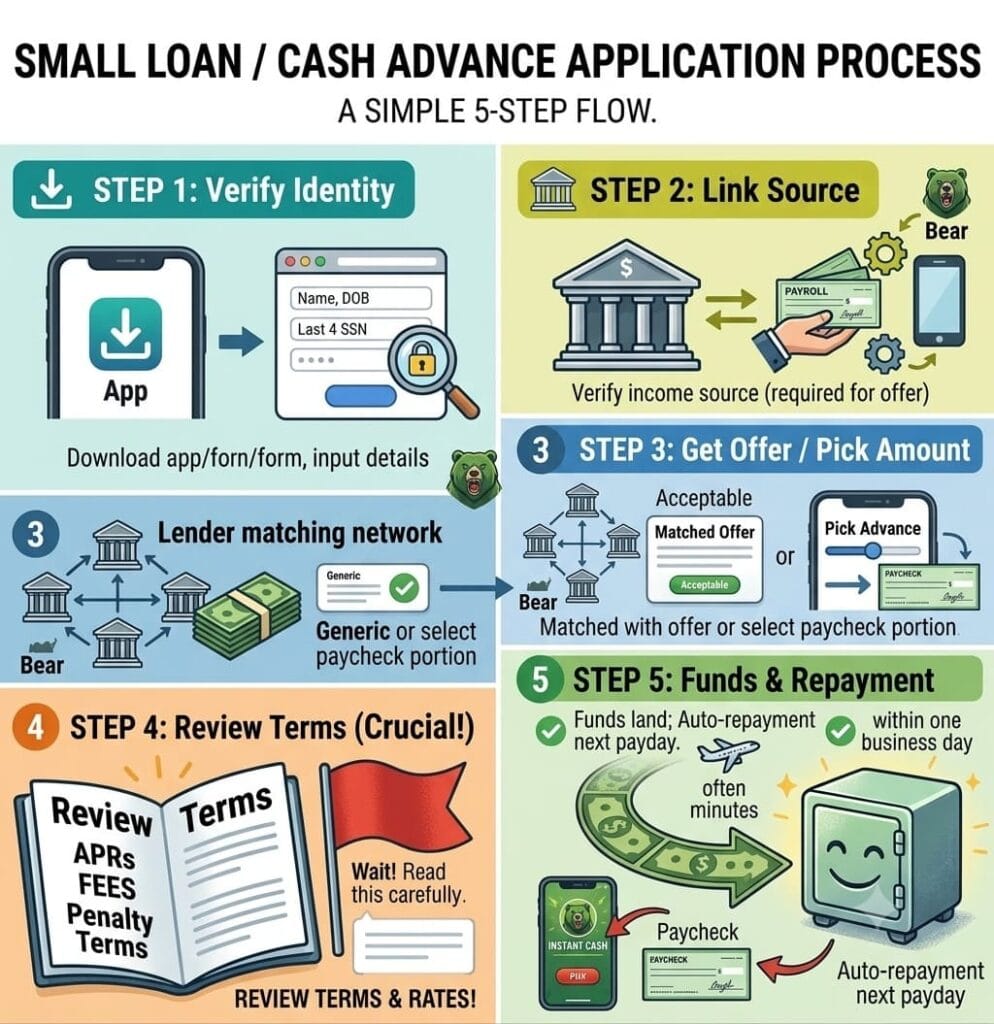
Either way, the actual process usually looks like this:
- Download the app or fill out the web form, and verify your identity (name, date of birth, sometimes the last four of your SSN).
- Link your bank account or payroll source, since the lender or matching service needs to see income to size an offer.
- The lender network matches you with an offer, or in the cash-advance version, you pick an amount up to a portion of your next paycheck.
- Review the actual terms before accepting anything. This is the step people skip, and it’s the one that matters most.
- Funds land, often within minutes to one business day. The app then deducts repayment automatically on your next payday.
Is it legit, or a scam?
Honestly, the evidence is mixed, and I think that’s the accurate answer, not a hedge.
On the “legit enough” side: Scam Detector’s automated validator gave mybearloan.com a trust score of 40 out of 100. It tagged the site “Controversial. Risky. Red Flags.” The score rests on factors like a young domain, registered in September 2025, and privacy-shielded ownership records, not any confirmed fraud finding.
That’s a real, if unflattering, third-party assessment, not a guess. But a young domain and a privacy proxy aren’t proof of a scam. Plenty of legitimate startups look exactly like that on paper.
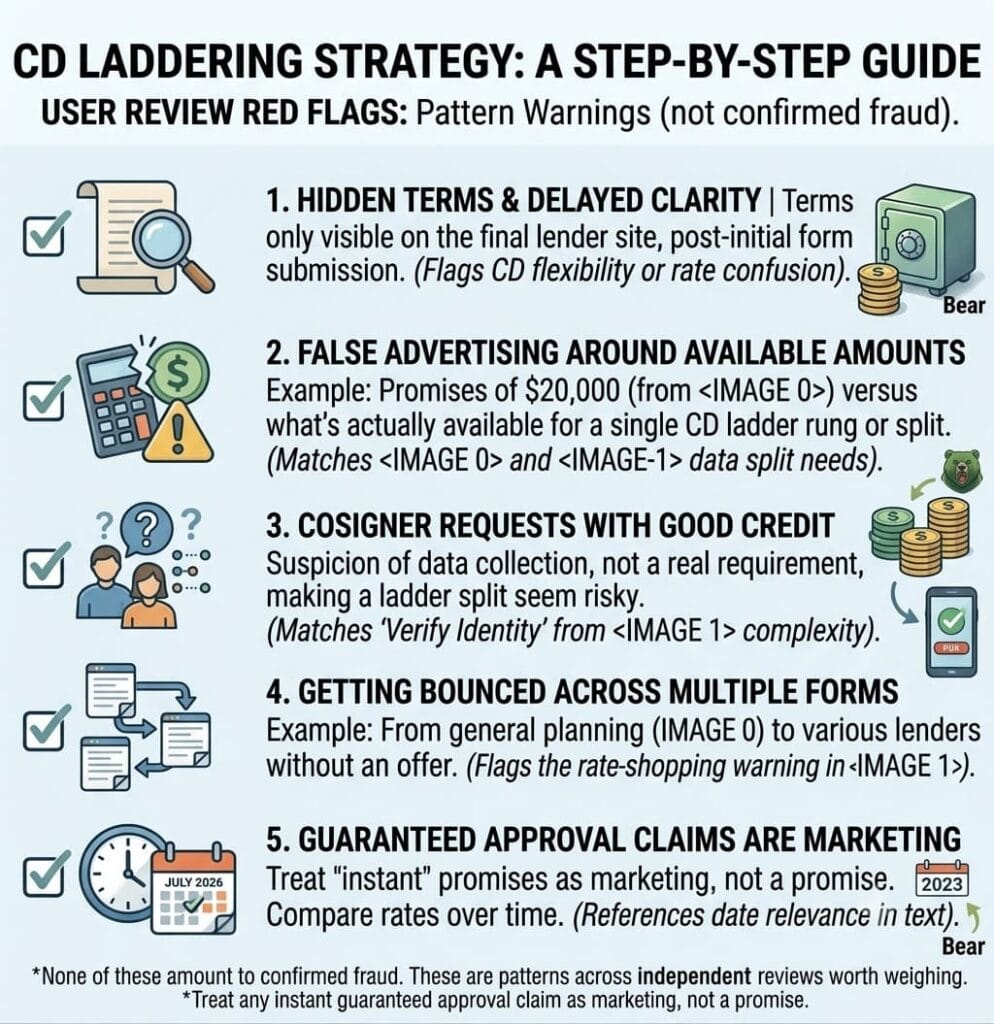
On the “actual red flags” side, user reviews are where it gets uglier. This pattern shows up across the whole loan-matching industry, not just Bear-branded sites. Here’s specifically what reviewers flagged, across Trustpilot and Google Play:
- Terms that only became clear on the lender’s own site, after the initial form was submitted
- A reported case of false advertising around available loan amounts
- Cosigner requests despite good credit, which some reviewers suspected was a tactic to collect more data rather than a real requirement
- Getting bounced between multiple forms without ever receiving an actual offer
None of these amount to a confirmed fraud finding. They’re patterns across independent user reviews, worth weighing before you hand over sensitive information. Treat any instant “guaranteed approval” claim as marketing, not a promise.
What it actually costs
This is the part most people skip. It’s also the part that matters most.
If you land a payday-style lender
Say the network matches you with a payday-style lender. The CFPB’s math here is blunt: a typical two-week loan with a $15-per-$100 fee works out to an APR of almost 400%. Compare that to roughly 12% to 30% on a credit card.
A $300 advance at that rate costs $45 to borrow for two weeks. That fee alone can beat what a personal loan would cost you for an entire year.
If you land an installment loan instead
An installment lender puts you closer to personal-loan territory, where the market average is dramatically lower. As of June 2026, an excellent-credit borrower might land an APR near 6%. A poor-credit borrower could see APRs climb to 36%, the legal ceiling for most traditional lenders.
Credit unions run even lower. Their national average for a 3-year loan was 10.72% in the third quarter of 2025, and federal law caps their rates at 18%.
As of July 2026:
| Option | Typical APR | Source / date |
|---|---|---|
| Payday-style loan (2-week) | ~391% to 400% | CFPB, ongoing guidance |
| Personal loan, fair-to-poor credit | ~26% to 36% | NerdWallet / Bankrate, July 2026 |
| Personal loan, good-to-excellent credit | ~6% to 19% | Bankrate / NerdWallet, June to July 2026 |
| Credit union personal loan (avg.) | ~10.7% | NCUA data, Q3 2025 |
| Credit union Payday Alternative Loan (PAL) | Capped at 28% | Federal credit union rules |
Bear-branded cash-advance products aren’t in the table above on purpose. I couldn’t find a consistently disclosed APR for any of them across the sites and app listings I checked. Some describe a flat fee “of a few dollars” instead of interest. That sounds cheap until you annualize it the way the CFPB does above.
If you’re actually considering one, ask for the APR in writing before you accept anything. If the rep won’t give you a number, that’s your answer. It’s also exactly why this table only includes options with a verifiable rate.
Does it affect your credit score?
It depends entirely on how the specific product reports your account, and this is genuinely worth confirming before you borrow, not after.
If the lender reports your advance as revolving credit, it raises your utilization and adds a new account to your file. Both can nudge your score down temporarily, and a missed payment makes it worse.
If the lender doesn’t report it at all, the score impact is minimal, though you still carry the actual cost of the fee. Either way, ask directly: “Do you report to Experian, Equifax, or TransUnion, and as what?” That’s a fair question for any lender, and a legitimate one will answer it plainly.
Safer options to try first
Before you fill out any loan-matching form, a few cheaper paths are worth ten minutes each:
- Look at a credit union Payday Alternative Loan (PAL), capped at 28% APR by federal rule and built specifically to undercut payday-style products.
- Try a 0% APR promotional period on an existing credit card, if you have one, as long as you can clear the balance before the promo ends.
- Check whether your employer offers a paycheck advance or earned-wage-access benefit. A growing number now do, at no cost.
- Ask your own bank about a short personal loan, especially if you already bank there, since you might skip the origination fee.
None of these require handing your Social Security number to a service you can’t verify.
Key Takeaways
- “Bear Loan” isn’t one company. It covers several unrelated loan-matching sites and apps, and confusing them is the most common mistake people make researching this term.
- One third-party trust check gave a Bear-branded site a 40/100 score, “Controversial. Risky. Red Flags,” mainly due to a young domain and hidden ownership, not confirmed fraud.
- User reviews on Trustpilot and Google Play describe unclear terms and cosigner requests that some suspect are data-collection tactics, not confirmed fraud claims.
- A typical payday-style loan runs close to 400% APR, according to the CFPB, versus roughly 6% to 36% for a personal loan depending on credit.
- The cheapest verified option, if you qualify, is a credit union Payday Alternative Loan capped at 28% APR.
Frequently Asked Questions
Is Bear Loan legit or a scam? It’s not a single company, so the answer depends on which specific site or app you’re looking at. Independent checks show real red flags, like a young domain and unclear terms in user reviews, but no confirmed large-scale fraud finding. Treat any “guaranteed approval” claim as marketing, verify the APR in writing, and check the specific product against a site like Scam Detector before applying.
How does a Bear cash advance actually work? Most versions either match you with a third-party lender based on your income and employer, or pull a portion of your upcoming paycheck early through a linked card. Either way, the app automatically deducts the advance plus a flat fee on your next payday.
Does using it hurt your credit score? Ask the specific lender or app how they report before you borrow. That single answer tells you more than any general rule, since the impact swings from “none” to “real” depending on it.
What’s a cheaper alternative if I need cash fast? A credit union Payday Alternative Loan (capped at 28% APR), an employer paycheck advance, or a 0% promotional credit card period all tend to cost dramatically less than a payday-style product.
If you’re weighing a loan-matching site against your other options, run the actual numbers before you commit rather than going by the advertised monthly payment alone. A cost you can see in dollars is a lot easier to compare than a rate the app never quite discloses.
By Saad Faisal · Published July 11, 2026 · Updated July 11, 2026 For this piece, I cross-checked app store and Trustpilot reviews, Scam Detector’s site validator, and CFPB/Bankrate rate data before writing anything down.
Disclaimer
This article is for general informational purposes only and isn’t financial or legal advice. I’ve used publicly reported rates and reviews here, not confirmed figures from any Bear-branded product itself, since none publish a consistent APR. Domain trust scores and user reviews for the sites named above can shift quickly. If you’re reading this well after July 2026, it’s worth re-checking their current status rather than relying on this snapshot alone. Loan terms, fees, and reporting practices vary by lender and by state, so confirm the actual numbers directly with any lender before signing anything. Read FinToku’s full Financial Disclaimer for more.
Published by Saad Faisal for FinToku (fintoku.com) FinToku publishes free, no-signup finance calculators and practical money guidance.