
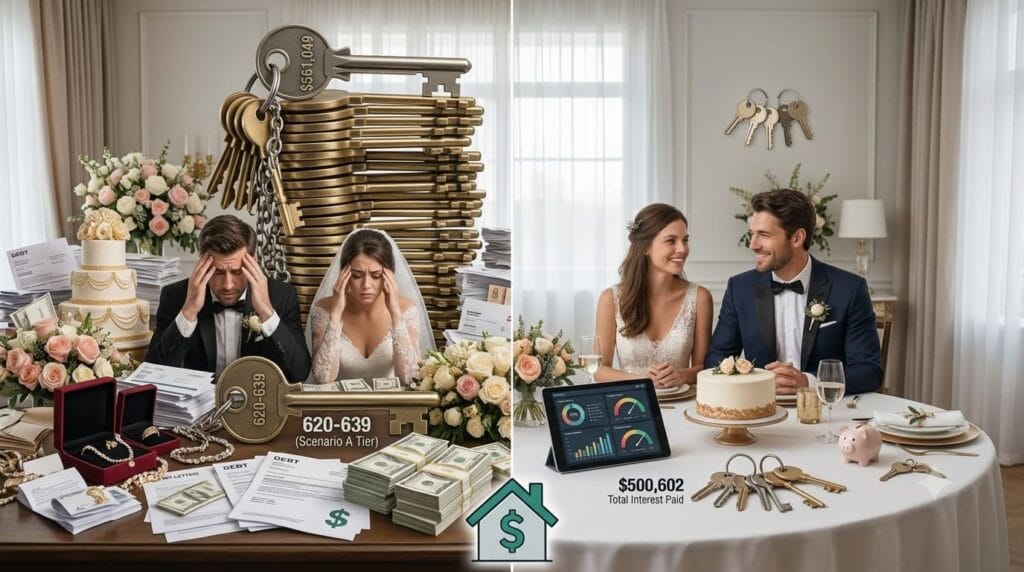
The short answer: a wedding loan is just a personal loan you use to pay for a wedding, and whether it’s a smart move comes down almost entirely to your credit score. Borrowers with excellent credit are paying around 15-16% APR on wedding loans right now. Borrowers with fair or bad credit are paying 24-29%, sometimes more.
The average wedding costs $34,200 in 2026, according to The Knot’s 2026 Real Weddings Study, which surveyed over 10,000 U.S. couples married in 2025. Not everyone has that sitting in a savings account, which is exactly why wedding loans exist.
I sat in on my cousin’s wedding budget spreadsheet a few months ago, half out of curiosity, half because she wanted a second opinion. The venue and catering alone were already close to $20,000, and she was seriously considering a $12,000 personal loan to cover the rest. What she hadn’t done yet was check what her actual credit score would get her in APR. That one number was going to decide whether the loan cost her an extra $2,000 or an extra $6,000 over three years.
This piece walks through exactly what wedding loans cost by credit tier, what’s actually driving the rate you get, and what the data says about how many couples take this route and how it works out for them.
What is a wedding loan?
A wedding loan isn’t a distinct loan product. It’s an unsecured personal loan, marketed for wedding expenses, that you get from a bank, credit union, or online lender and repay in fixed monthly installments. You get the money as a lump sum, and you can spend it on the venue, the caterer, the dress, the rings, or the honeymoon. Lenders don’t restrict how you use it once it’s in your account.
Loan amounts typically run from $1,000 to $100,000, and repayment terms usually stretch from two to seven years, depending on the lender. Because they’re unsecured (no house or car backing them), the interest rate depends almost entirely on your credit profile.
Wedding loan rates by credit score
Here’s where the real variation shows up. According to NerdWallet’s own aggregated data from users who pre-qualified for wedding loans, the APR gap between credit tiers is enormous:
| Credit rating | Score range | Estimated wedding loan APR |
|---|---|---|
| Excellent | 720-850 | 15.66% |
| Good | 690-719 | 23.46% |
| Fair | 630-689 | 24.20% |
| Bad | 300-629 | 28.91% |
Source: NerdWallet, aggregated pre-qualification offer data, July 2026.
That’s not a small spread. Going from “excellent” to “good” credit can add 8 full percentage points to your rate, which on a mid-sized loan is thousands of dollars in extra interest.
For context on the broader personal loan market: Bankrate’s June 2026 survey puts the overall average personal loan rate at 12.28% for a borrower with a 700 FICO score, a $5,000 loan, and a three-year term. Wedding loans specifically tend to run a bit higher than that blended average, since a chunk of wedding-loan borrowers skew toward larger amounts and longer terms.
What a $15,000 wedding loan actually costs, by credit tier
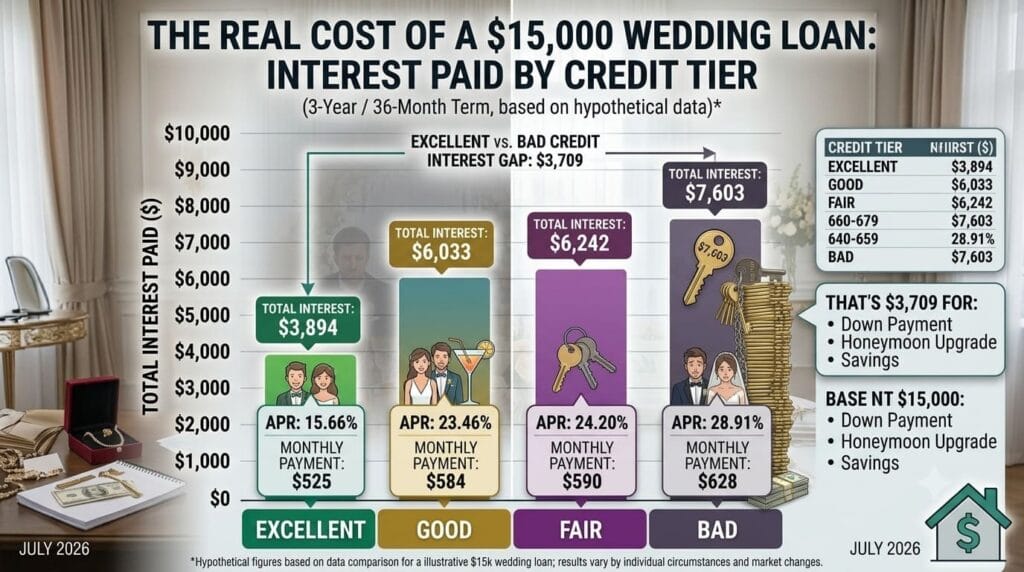
Say you need to borrow $15,000 over three years. Here’s how the total interest changes purely based on your credit tier, using the NerdWallet rate data above:
| Credit tier | APR | Monthly payment | Total interest paid |
|---|---|---|---|
| Excellent | 15.66% | $525 | $3,894 |
| Good | 23.46% | $584 | $6,033 |
| Fair | 24.20% | $590 | $6,242 |
| Bad | 28.91% | $628 | $7,603 |
The difference between excellent and bad credit here is $3,709 in interest alone, on the exact same $15,000. That’s real money that could’ve gone toward a down payment, a honeymoon upgrade, or just staying in your pocket.
What actually sets your rate
Three things stack on top of each other to build your final APR, and only one of them is fully in your control by the time you’re ready to apply.
Your credit score. This is the biggest lever, as the table above makes obvious. Lenders use your score as a proxy for how likely you are to repay on time, and they price accordingly.
The lender type. Credit unions tend to run cheaper than online lenders and banks. Bankrate’s data puts the average credit union personal loan rate at 10.72%, versus 12.06% at commercial banks, with online lenders spanning a much wider range depending on credit tier. The tradeoff is usually membership requirements and a slower, less digital application process at credit unions.
Origination fees. Some lenders charge these upfront, taken out of your loan proceeds before you ever see the money (commonly 1% to 12% of the loan amount). A $15,000 loan with a 6% origination fee means you actually receive $14,100, but you’re still on the hook for repaying the full $15,000 plus interest. Always compare APR, not the advertised interest rate, since APR folds the fee in.
How wedding loan rates compare to the alternative: credit cards
If you’re weighing a personal loan against just putting the wedding on a credit card, the math usually favors the loan. The average credit card interest rate sits at roughly 21% APR as of Q1 2026, per Federal Reserve G.19 data, and cards accruing interest are averaging closer to 22%.
On that same $15,000 over three years, a 21% APR would run you about $5,345 in interest, worse than “good” credit wedding loan pricing, and dramatically worse than “excellent.” Cards also carry variable rates that move with the Fed, while a personal loan locks your rate in the day you sign.
The one exception: a 0% intro-APR credit card, if you genuinely qualify and can pay the full balance off before the promotional period ends (commonly 12-21 months). That beats any personal loan, interest-wise, but only if you actually hit zero before the promo expires. Miss that window and you’re back to paying near-22% on whatever’s left.
How many couples actually borrow for their wedding
This is the part most wedding-loan pages skip, and it’s arguably the most important number in this whole piece. According to LendingTree’s 2025 newlywed survey, 67% of newlyweds say they took on wedding-related debt to pay for their big day, and 24% were still paying it off at the time of the survey.
Of those still carrying wedding debt, 41% expected it to take at least a year to pay off. Nearly half (46%) of newlyweds said savings covered most of the cost, with 24% relying primarily on credit cards and 16% getting help from parents or relatives.
The financial fallout isn’t just the interest. Couples who took on wedding debt were far more likely to argue about money afterward, and a meaningful share said financial stress led them to consider divorce, a genuinely sobering number for a debt category most people don’t think of as “serious,” the way a mortgage or student loan is.
Honestly, that survey result changed how I think about the “just put it on a loan” advice you see everywhere. It’s not that a wedding loan is inherently a bad idea. It’s that most people underestimate how long they’ll actually be paying for one night.
Should you take out a wedding loan?
It depends mostly on your credit and your timeline, not on whether debt is inherently bad.
A wedding loan makes more sense if:
- You have good-to-excellent credit (690+), which puts you closer to that 15-23% range rather than the high 20s
- You’ve already trimmed the budget and this is the genuine gap between savings and total cost
- You can comfortably absorb the monthly payment without it crowding out other near-term goals, like a house down payment
It’s worth reconsidering if:
- Your credit sits below 630, where APRs commonly climb past 28-29%. Waiting a few months to improve your score first can meaningfully change your total cost
- You and your partner haven’t actually agreed on how much debt you’re both willing to carry into the marriage
- You’re planning to buy a house or a car in the next year or two, since a new installment loan affects your debt-to-income ratio for those applications too
Alternatives to a wedding loan
A personal loan isn’t the only way to close the gap. A few options worth comparing first:
- A longer engagement. The average engagement runs about 15 months. Extra saving time, even six more months, can shrink or eliminate the amount you need to borrow entirely.
- 0% intro APR credit card. Works well only if you’re confident you can clear the balance before the promotional window closes.
- Cash registries. Tools like Honeyfund let guests contribute cash instead of physical gifts, which can meaningfully offset costs for couples uncomfortable asking family directly for wedding funds.
- Trimming the guest list. At roughly $290-$300 per guest according to The Knot’s per-head cost data, cutting 20 guests is worth roughly $5,800-$6,000 off the total, often more than any rate-shopping effort will save you.
If you’re trying to figure out where your own numbers land before committing to anything, run a few loan-amount and term combinations through FinToku’s Currency Converter if you’re pricing out a destination wedding in another currency, or just sit down with your partner and map the full budget line by line before you talk to a single lender.
Key Takeaways
- The average U.S. wedding costs $34,200 in 2026, though the median is closer to $10,000. The average is skewed upward by a smaller number of high-end weddings.
- Wedding loan APRs range from about 15.66% for excellent credit to 28.91% for bad credit, a gap that can add over $3,700 in interest on a $15,000, three-year loan.
- 67% of newlyweds took on wedding-related debt in 2025, and 24% were still paying it off, per LendingTree’s survey.
- Credit unions typically offer the cheapest personal loan rates (around 10.72% on average), while credit card APRs average around 21%, making a wedding loan usually cheaper than cards for anyone without a qualifying 0% intro offer.
- Origination fees, common at online lenders, can run 1-12% of the loan and are deducted before you receive the money. Always compare APR, not the advertised rate.
Frequently Asked Questions
What is a wedding loan? It’s an unsecured personal loan used to cover wedding expenses: venue, catering, attire, rings, or honeymoon. It’s not a distinct loan product; it’s a personal loan marketed for this specific use.
Is it a good idea to get a loan for a wedding? It depends mainly on your credit score and whether the loan fills a genuine budget gap after you’ve already trimmed costs. Borrowers with good-to-excellent credit pay meaningfully less than those with fair or bad credit, so it’s worth checking your prequalified rate before deciding either way.
What credit score do you need for a wedding loan? Most lenders want at least 600-660 for approval, though some accept lower scores at a higher rate. You’ll get the most competitive pricing with a score of 720 or above.
Can you get a wedding loan with bad credit? Yes, some lenders specifically work with borrowers in the 500s-600s, but expect an APR closer to 29% or higher. It’s often worth spending a month improving your score first if your timeline allows it.
How much does the average wedding loan cost per month? It depends on the amount and rate, but on a $15,000 loan over three years, expect somewhere between $525 a month (excellent credit) and $628 a month (bad credit).
Is wedding loan interest tax deductible? No. Personal loan interest, including for a wedding, isn’t deductible under current federal tax rules, unlike some interest on mortgages or qualifying new-car loans.
By Saad Faisal · Published July 11, 2026 · Updated July 11, 2026
Disclaimer
This article shares general information, not personalized financial advice. Rates, credit-tier APR ranges, and origination fee ranges cited here are current as of the sources linked above and change often. Confirm actual pricing directly with a lender before applying, since a prequalification quote is the only number that reflects your real situation. For more, see FinToku’s full Financial Disclaimer.