

A friend of mine put $20,000 into a single 5-year CD back in 2023, feeling pretty good about the rate. Then her furnace died two years in. She could either pay a hefty early withdrawal penalty or put the repair on a credit card. She picked the credit card, and she still brings up the furnace every time CDs come up.
That’s the exact problem a CD ladder is built to solve.
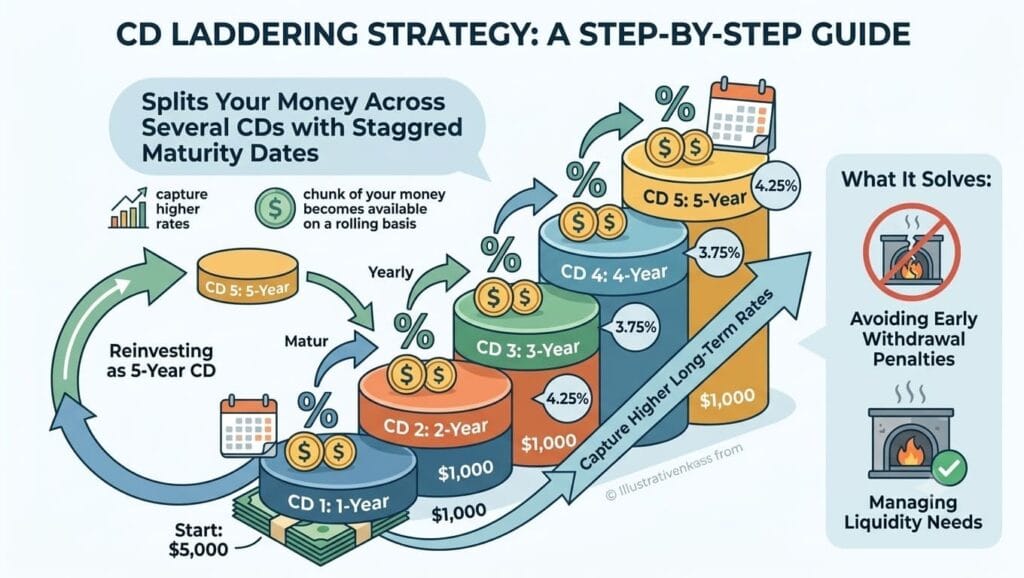
A CD ladder splits your money across several CDs with staggered maturity dates instead of locking it all into one. You still capture the higher rates that longer-term CDs tend to offer, but instead of one lump sum reappearing five years from now, a chunk of your money becomes available on a rolling basis, every six to twelve months, depending on how you build it.
What a CD ladder actually looks like
Picture a real ladder: each rung is a CD with a different term. You don’t climb it all at once. You take it one step at a time, and when you reach the top, you start again from the bottom.
Say you have $5,000 to put to work. Instead of one 5-year CD, you split it into five $1,000 CDs with staggered terms:
- CD 1: 1-year term
- CD 2: 2-year term
- CD 3: 3-year term
- CD 4: 4-year term
- CD 5: 5-year term
When CD 1 matures at the one-year mark, you reinvest that $1,000 (plus interest) into a new 5-year CD. A year later, CD 2 matures, and you do the same thing. Repeat the pattern and by year five, every rung in your ladder is a 5-year CD, but one of them matures every single year. You get the long-term rate on all of it, plus a yearly liquidity event.
How to build one, step by step
Step 1: Decide how much you’re laddering, and how much you’re not
Only put money into a ladder that you’re genuinely comfortable not touching for the shortest rung’s term at minimum. Your emergency fund shouldn’t be part of this; keep that in a high-yield savings account where you can get to it without a penalty. (If you’re weighing that tradeoff directly, High-Yield Savings vs. CDs: Which Wins in 2026? walks through it.)
Step 2: Pick your structure
Three to five rungs is typical, and there’s more than one way to set it up:
- Standard ladder: 1, 2, 3, 4, and 5-year CDs, split evenly.
- Mini ladder: all short terms, say 6, 9, 12, and 18 months, for savers who don’t want to commit past a year or two.
- Barbell ladder: short terms on one end and long terms on the other, with nothing in the middle. You get some quick liquidity plus the top long-term rate, without the “medium” rungs diluting either goal.
Split your total evenly across rungs unless you have a reason not to. $5,000 across five rungs is $1,000 each, for example.
Step 3: Shop rates across more than one bank
This is the step people skip out of convenience, and it’s the one that actually costs money. Rate spreads between banks on the same CD term can run half a point to a full point, and on a $5,000 ladder held over five years, that’s a real difference in total interest, not a rounding error. Bankrate’s CD rate tracker and NerdWallet’s best CD rates roundup both make that spread easy to see in a few minutes of comparing. There’s no rule that says every rung has to sit at the same institution.
Step 4: Open the CDs
Fund each rung according to your split, at whichever bank offered the best rate for that specific term. Standard CDs from FDIC-insured banks usually require a modest minimum deposit, often $500–$1,000, though this varies.
Step 5: Reinvest at maturity, and put a reminder on your calendar
When a rung matures, you’ll typically have a short grace period (often just a few days to two weeks) to decide: roll it into a new long-term CD to keep the ladder going, or take the cash. Banks send maturity notices, but often with only about ten days’ notice, which isn’t much time to rate-shop properly. Set your own reminder 30 days out so you’re not stuck accepting whatever your current bank’s rollover rate happens to be.
A worked example
Take a $5,000 ladder, opened today across five rungs at illustrative rates:
| Rung | Term | Illustrative APY | Amount |
|---|---|---|---|
| 1 | 1 year | 3.75% | $1,000 |
| 2 | 2 years | 4.00% | $1,000 |
| 3 | 3 years | 4.15% | $1,000 |
| 4 | 4 years | 4.20% | $1,000 |
| 5 | 5 years | 4.25% | $1,000 |
These figures are illustrative, not live quotes. As of early July 2026, the top nationally available short-term CDs (six to eighteen months) have been landing in roughly the 4.0%–4.4% APY range, according to rate trackers from Bankrate and NerdWallet, while the FDIC’s own national rate averages run far lower since they include every bank, not just the most competitive ones. Check current rates at either source before locking in a rung.
In year one, rung 1 matures and you roll roughly $1,037 into a new 5-year CD. In year two, rung 2 matures and you do the same. By year five, every rung is a 5-year CD earning a competitive rate, and you’ve had a liquidity checkpoint every single year along the way.
Who a CD ladder is actually for
Good fit if:
- You’re saving toward something 2–5 years out, like a home down payment, a wedding, or tuition.
- You want zero risk to principal and don’t mind giving up stock-market-style upside for certainty.
- You can commit at least the shortest rung’s term without touching the money.
Skip it if:
- This is your emergency fund. Even the shortest rung locks money up longer than you want to wait during an actual emergency.
- Your timeline is a decade or more out. For money that far from being needed, historical stock market returns have significantly outpaced CD rates over long stretches, so a ladder may be too conservative a home for it.
- You’re chasing maximum growth. A ladder is about steady, guaranteed, boring returns; that’s the whole appeal, not a bug.
Key Takeaways
- A CD ladder splits your money across CDs with staggered maturity dates so you capture long-term rates while still getting regular access to a portion of your cash.
- A standard 5-rung ladder (1–5 year terms) gives you one maturity event every year once it’s fully built out.
- Rate shopping across banks, not just staying with your current one, can meaningfully change your total return over several years.
- Set your own 30-day reminder before each CD matures; banks’ notices often arrive with less lead time than you’d like.
- Keep emergency-fund money out of a ladder entirely. It belongs in a high-yield savings account instead.
Frequently Asked Questions
What is a CD ladder and how does it work? It’s a savings strategy that splits a lump sum across multiple CDs with different maturity dates instead of one long CD. As each shorter CD matures, you reinvest it into a new long-term CD, eventually getting long-term rates with a yearly (or more frequent) liquidity checkpoint.
Is CD laddering a good idea in 2026? It can be, especially with the current mix of decent CD rates and uncertainty about where the Fed goes next. The Federal Reserve has held its benchmark federal funds rate steady at 3.50%–3.75% through every meeting so far in 2026, following three cuts in late 2025, and outlets like Fortune have noted the next move is genuinely uncertain, with some observers now floating a hike rather than a cut. A ladder hedges that uncertainty either way. If rates fall, your longer rungs stay locked at today’s better rate; if rates rise, your maturing short rungs get reinvested at the new, higher rate.
What’s the difference between a CD ladder and a barbell CD strategy? A standard ladder has rungs at every interval (1, 2, 3, 4, 5 years). A barbell strategy keeps only the short and long ends, say 1-year and 5-year CDs, and skips the middle terms, prioritizing either quick access or the top long-term rate rather than a smooth spread.
Can I ladder CDs across different banks? Yes, and it’s often the better move. Rate differences between banks on the same term can be significant, and spreading rungs across institutions can also help keep each bank’s balance under the $250,000 FDIC insurance limit if you’re laddering a larger sum.
What should I do when a CD in my ladder matures? Compare current rates before your grace period ends. If they’re still competitive, reinvest in a new long-term CD to keep the ladder intact. If you need the cash or rates have dropped significantly, that’s your chance to pull the funds out without penalty.
Run your own numbers before committing. The illustrative rates above are a starting point, not a quote, and actual CD rates shift regularly.
Disclaimer
This article is for general informational purposes and isn’t financial or tax advice. CD rates, terms, and penalties vary by bank and change over time; confirm current details before opening any account. See FinToku’s full Financial Disclaimer for more.
By Saad Faisal · Published July 11, 2026