

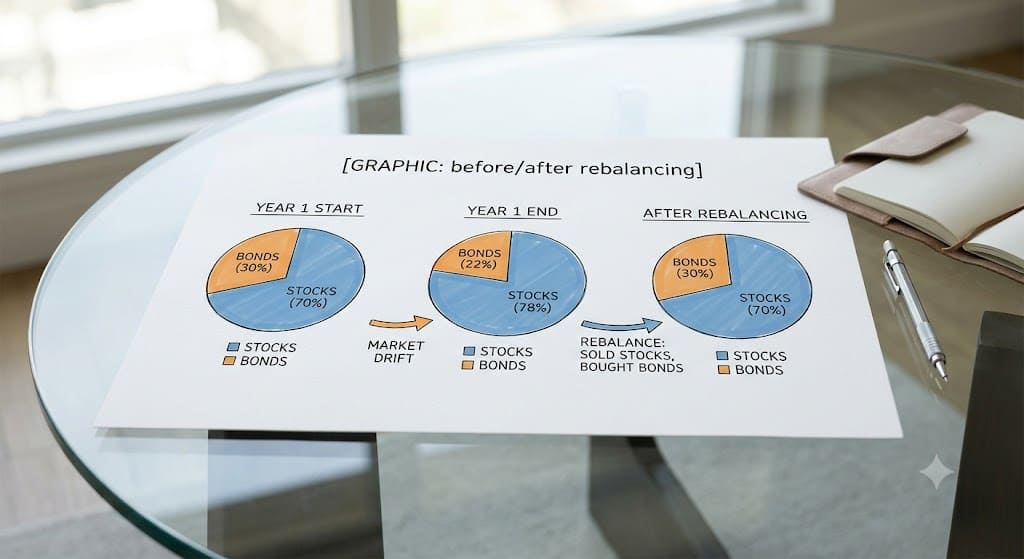
That drift is normal, and it’s the whole reason rebalancing exists. Rebalancing means buying and selling (or redirecting new money) to bring your portfolio back to the mix you originally chose, and you can do it on a set schedule, when your allocation strays past a certain threshold, or a mix of both. It’s not the same thing as growing your portfolio, and mixing the two up is where a lot of first-year investors get stuck.
Rebalancing and growing are two different jobs
Growth is what your money does when it’s invested well and left alone. Rebalancing is maintenance that keeps your risk level from creeping up (or down) without your permission. You need both, but they pull in slightly different directions.
Here’s the tension: the asset that’s growing fastest is usually the one rebalancing tells you to trim. That’s uncomfortable. It also happens to be the entire point.
Why your allocation drifts even if you never touch it
Say you started with $10,000 split 70/30 between a stock index fund and a bond fund. That’s $7,000 in stocks, $3,000 in bonds.
If stocks return 15% over the year and bonds return 4%, here’s what happens without any action from you:
- Stocks: $7,000 → $8,050
- Bonds: $3,000 → $3,120
- New total: $11,170
- New split: about 72% stocks, 28% bonds
That’s a small move for one good year. Run three or four good years for stocks back to back, which isn’t unusual, and a 70/30 portfolio can drift to 80/20 or further without a single trade. At that point you’re carrying more risk than you signed up for, and you probably didn’t notice because the number in your account kept going up.
How to actually rebalance (four steps)
1. Check your current allocation. Most brokerages show this under “holdings” or “portfolio analysis” as a percentage breakdown. If yours doesn’t, add up what’s in stock funds versus bond funds versus cash and divide by your total.
2. Compare it to your target. This is the mix you chose when you started, based on your timeline and risk tolerance. If you never set one, now’s the moment. A common starting point is age-based (401(k) target-date funds use this logic), but there’s no single right answer here.
3. Figure out the gap. If you’re at 78/22 and your target is 70/30, you’re 8 percentage points overweight in stocks. On a $20,000 portfolio, that’s $1,600 that needs to move from stocks to bonds.
4. Move the money. You can sell the overweight position and buy the underweight one, or you can direct new contributions toward whatever’s lagging until the ratio catches up on its own. Which brings us to the part most guides skip.
How to rebalance a portfolio without selling anything
This is the search almost everyone runs into eventually, usually right after they realize rebalancing in a taxable account can trigger a tax bill. The good news: selling is optional.
Use new contributions. If you’re adding money regularly (a paycheck deduction, a monthly transfer), point all of it at whatever asset class fell below target instead of splitting it evenly. Your overall mix drifts back into line without you selling a single share of the winner.
Redirect dividends and interest. Instead of automatically reinvesting a fund’s dividends back into that same fund, route them into the underweighted one. It’s a slower fix than selling, but it costs nothing in taxes.
Rebalance inside tax-advantaged accounts first. A 401(k), traditional or Roth IRA, and HSA all let you sell and buy without triggering a taxable event. If you hold the same fund types in both a taxable brokerage account and a 401(k), do your selling in the 401(k) and leave the taxable account alone.
If you do need to sell in a taxable account, selling a losing position first can offset gains elsewhere at tax time. That’s a real strategy (tax-loss harvesting), not a workaround, but it’s specific enough that it’s worth reading the IRS’s own guidance or talking to a tax professional before you lean on it.
The 5/25 rule, and the Buffett rules people keep asking about
A few named rules show up constantly in rebalancing searches. Worth untangling them, because they answer different questions.
The 5/25 rule is a threshold for when to rebalance, not a target allocation. It says: rebalance an asset class if it drifts either 5 percentage points in absolute terms, or 25% of its own original weight, whichever is smaller. A 30% bond allocation would trigger a rebalance at 25% (5-point absolute move) or at drifting below 22.5%/above 37.5% (a 25% relative move on a small position), whichever hits first. It’s a way to avoid rebalancing over tiny, meaningless wobbles while still catching real drift early.
Warren Buffett’s “90/10” rule isn’t a rebalancing rule at all. It’s an allocation Buffett mentioned for his wife’s inheritance: 90% in a low-cost S&P 500 index fund, 10% in short-term government bonds. It’s aggressive, built for a very long time horizon, and not something Buffett has recommended as a general template for every investor.
The “70/30 Buffett rule” gets attributed to Buffett fairly often online, but it’s really just a common moderate-growth allocation (70% stocks, 30% bonds) that predates and isn’t specifically tied to anything he’s said. If you see it framed as a direct Buffett quote, that’s worth a second look.
How often should you rebalance?
There are three honest answers, and they trade off against each other:
| Approach | How it works | Best for |
|---|---|---|
| Calendar-based | Rebalance on a fixed schedule (quarterly, semi-annually, annually) | Investors who want simplicity and a set-it-and-forget-it habit |
| Threshold-based | Rebalance only when an allocation drifts past a set percentage (like the 5/25 rule) | Investors comfortable checking in more often, who want to avoid unnecessary trades |
| Hybrid | Check on a schedule, but only act if a threshold is also breached | Most people in practice, since it limits both effort and overtrading |
Most professional guidance lands on roughly once or twice a year for a typical long-term portfolio. Rebalancing monthly or more often usually just adds transaction costs and tax events without meaningfully reducing risk, and it can tempt you into reacting to short-term noise instead of sticking to your plan.
If the market is down and your allocation has drifted, it’s still worth rebalancing, and it can even work in your favor: you’re selling the (relatively) higher asset and buying more of what dropped, which is the “buy low” half of buy low, sell high. What you want to avoid is panic-selling stocks entirely and moving to cash. That’s not rebalancing, that’s abandoning your plan at the worst possible moment.
If none of this sounds like something you want to manage by hand, that’s a legitimate answer too. Target-date funds and many 401(k) plans rebalance automatically behind the scenes, on the same calendar or threshold logic described above. You give up some control over the exact method, but you also give up the chance of forgetting to do it for three years.
Why staying invested matters more than getting the timing perfect
| Asset class | Average annual return (nominal) | Period | Source |
|---|---|---|---|
| S&P 500 (with dividends) | 11.79% (arithmetic average) | 1928–2024 | Aswath Damodaran, NYU Stern School of Business |
| 10-year U.S. Treasury bonds | ~4.8% | 1928–2024 | NYU Stern School of Business historical returns dataset |
| 10-year Treasury yield (current) | ~4.7% | Late July 2026 | U.S. Treasury / Federal Reserve (FRED) |
Those long-run averages hide enormous year-to-year swings, which is exactly why rebalancing matters. A portfolio that’s never rebalanced tends to drift toward whatever’s been winning lately, and by definition that’s the asset most likely to be overvalued when the cycle turns. (If you want to see the full year-by-year breakdown behind that 11.79% figure, Damodaran’s historical returns dataset is the primary source and it’s free to download.)
I ran my own numbers through FinToku’s Rule of 72 Calculator before writing this, mostly out of curiosity about how fast a steady annual return actually compounds. At a 10% average return, money roughly doubles every 7.2 years. Seeing that number made the “just stay invested” advice click for me in a way that reading it never did.
A worked example, start to finish
Let’s say you’re one year in with a $15,000 portfolio, target 70/30 stocks/bonds, and stocks have outperformed:
- Current: $11,700 stocks (78%), $3,300 bonds (22%)
- Target: $10,500 stocks (70%), $4,500 bonds (30%)
- Gap: $1,200 needs to move from stocks to bonds
If you’re adding $300/month to this portfolio, you could direct all new contributions to bonds for the next four months instead of selling anything. That closes most of the gap with zero tax impact. If you want it closed immediately, you’d sell $1,200 of the stock fund and buy $1,200 of the bond fund, and check whether that sale happened in a tax-advantaged account before you do it.
Common mistakes people make in year one
- Rebalancing too often. Checking weekly and “fixing” every small wobble racks up costs and taxes for no real benefit.
- Never setting a target in the first place. Without one, there’s nothing to rebalance back to.
- Treating a down market as a reason to abandon the plan instead of a normal part of it.
- Ignoring taxable-account tax consequences and selling winners without checking cost basis or holding period first.
Key Takeaways
- Rebalancing restores your original target allocation; it’s maintenance, not a growth strategy on its own.
- A portfolio can drift 8-10 percentage points off target in just a year or two of strong stock performance, even with zero trading.
- You can rebalance without selling by directing new contributions and dividends toward whatever’s underweight.
- The 5/25 rule is a threshold for when to rebalance (a 5-point absolute or 25% relative drift), not a target allocation like the “90/10” or “70/30” figures often (and sometimes incorrectly) attributed to Warren Buffett.
- Most long-term portfolios only need rebalancing once or twice a year; more frequent rebalancing usually adds cost without reducing risk.
Frequently Asked Questions
What is the 5/25 rule for rebalancing? It’s a threshold that tells you when to act: rebalance an asset class once it drifts 5 percentage points from its target in absolute terms, or 25% of its own target weight, whichever comes first. It’s a rule for timing, not for picking your allocation.
What is Warren Buffett’s 90/10 rule? It refers to an allocation Buffett suggested for his wife’s inheritance: 90% in a low-cost S&P 500 index fund and 10% in short-term government bonds. It’s a specific, aggressive allocation for a long time horizon, not a universal rebalancing formula.
What is the 70/30 Buffett rule in investing? This one’s more myth than direct quote. A 70% stocks / 30% bonds split is a common moderate-growth allocation, but it isn’t a rule Buffett is on record recommending under that name.
How do I rebalance my portfolio without selling? Direct new contributions and reinvested dividends toward whichever asset class is currently underweight instead of splitting them evenly. It takes longer than selling and buying directly, but it avoids triggering any tax event in a taxable account.
How often should you rebalance your portfolio? Once or twice a year is enough for most long-term investors. Some people also use a threshold rule (like 5/25) as a backup trigger between check-ins, so a fast-moving market doesn’t go unnoticed for a full year.
Should I rebalance my portfolio when the market is down? Generally yes, if your allocation has genuinely drifted. Rebalancing during a downturn often means buying more of whatever just got cheaper, which is the mechanism value investors rely on. It’s different from panic-selling everything into cash, which is the move to avoid.
If you’re not sure where your allocation actually stands right now, that’s step one before any of this matters. Pull up your current holdings, calculate the real percentages, and compare them to whatever target you set (or set one today if you never did).
Read More
Disclaimer
This article is for educational purposes only and isn’t personalized financial, investment, or tax advice. Rebalancing decisions depend on your specific goals, account types, and tax situation, and past performance (including the historical returns cited above) doesn’t guarantee future results. See FinToku’s full Financial Disclaimer for more.
Published by Saad Faisal for FinToku (fintoku.com) · Published August 2, 2026 · Updated August 2, 2026 FinToku provides free finance tools and guides to help you make smarter money decisions.