

My aunt got a funeral home quote for $9,200 two days after my uncle died. The first question the funeral director asked wasn’t “how would you like to pay.” It was “would you like to look at financing.” She hadn’t even picked a casket yet.
That’s the short version of why so many families search for a personal loan for funeral expenses. It usually happens at the worst possible moment to compare interest rates. Here’s the direct answer: yes, you can get a personal loan for a funeral. Amounts typically run $1,000 to $50,000 with a two-to-seven-year term. But that first quote is rarely the best rate out there. Cheaper ways to cover at least part of the bill usually exist.
What Is a Personal Loan for Funeral Expenses?
A personal loan for funeral expenses is just an unsecured personal loan marketed for burial, cremation, or memorial costs. Nothing about the loan itself is special. Lenders fund it in a lump sum. You repay it in fixed monthly installments, usually over 24 to 84 months, the same way you would a debt-consolidation or home-improvement loan.
Because it’s unsecured (no collateral, unlike an auto loan or HELOC), your credit score drives almost the entire rate. Lenders can offer a borrower with a 750+ score a far lower rate than a borrower with a 580 score, on the exact same loan amount. Want the fuller breakdown of secured versus unsecured loans? FinToku has a dedicated comparison worth reading before you sign anything.
How Much Does the Average Funeral Actually Cost?
Funeral costs vary a lot by region and by what the family chooses. Here’s what recent industry data shows for the most common options.
| Funeral Type | Median Cost | As of |
|---|---|---|
| Traditional burial with viewing | $8,300 | NFDA statistics, 2024 data |
| Cremation with viewing | $6,280 | NFDA statistics, 2024 data |
| Green/natural burial | ~$2,600 | Industry estimate, 2025 |
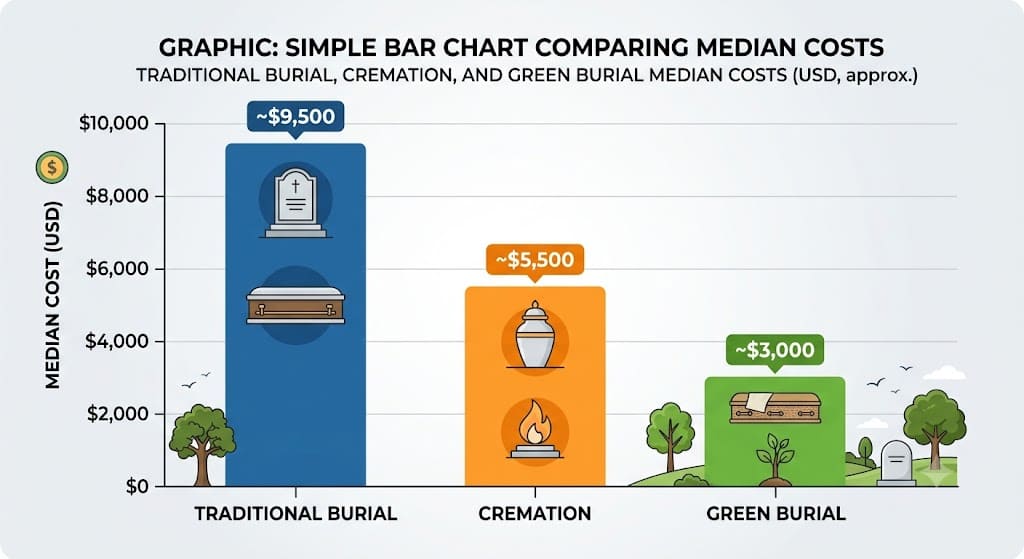
Those numbers explain why the loan amount question comes up right away. Borrow less than the median and your monthly payment drops fast. Borrow more, say for a $25,000 “premium package” some funeral homes push, and you’re financing markup, not just the service.
How Much Will a Funeral Loan Actually Cost You?
The honest answer depends on three things: how much you borrow, your rate, and your term. Here’s what that looks like across a few realistic scenarios.
| Financing Option | Typical APR (2026) | Funding Speed | Source |
|---|---|---|---|
| Personal loan, good credit (720+) | 6%-14.6% | 1-5 business days | Federal Reserve G.19 (Feb. 2026), NerdWallet (July 2026) |
| Personal loan, fair/poor credit | 20%-35.99% | 1-5 business days | ConsumerAffairs, 2025 |
| Credit card, standard rate | ~21.5% avg | Instant | Federal Reserve G.19 |
| 0% APR credit card (promo period) | 0% for 6-21 months, then 18%-29% | Instant | ConsumerAffairs, 2025 |
| Funeral home in-house financing | Up to 29% | Same day | ConsumerAffairs, 2025 |
Running the Real Numbers
Put those rates against an actual loan amount and the gap gets real. A $10,000 loan at 10% APR over five years costs roughly $2,700 in interest. Drop your rate to 6%, the kind of rate a credit union or an existing bank relationship can often get you. That interest bill falls by close to half.
Before you accept whatever rate the first lender quotes, plug your own numbers into FinToku’s Car Payment & In-House Financing Calculator. It works for any lump-sum financing, not just cars, and shows the real monthly payment and total interest at different rates in under a minute. Getting quotes from more than one lender? The Loan Comparator lines them up side by side, so you’re not doing that math on a napkin at the funeral home.
Funeral Loan vs. Other Ways to Pay
A loan isn’t the only option, and it’s rarely the cheapest one.
Life insurance. If your family member had a policy, this is usually the fastest, cheapest source of funds. It isn’t debt at all. Check old paperwork and call former employers for group policies. Try the National Association of Insurance Commissioners’ free locator tool if you’re not sure one exists.
0% APR credit card. Works well only if you’re confident you can pay it off before the promo period ends. Miss that window, and you’re often paying a higher rate than a personal loan would have carried.
Funeral home in-house financing. It’s convenient because staff arrange it on the spot. But it’s also where the highest rates on this whole list show up. Compare it against an outside personal loan before signing, not after.
Crowdfunding or family contributions. This doesn’t touch your credit at all, and it splits the cost across more people than just you.
A personal loan from a bank, credit union, or online lender. Usually cheaper than a card or in-house financing if your credit is decent. It also comes with a fixed payment you can plan around.
My ranking: life insurance first, an outside personal loan or 0% card second. Funeral home financing comes last, if you have any other option at all.
Can You Get a Funeral Loan With Bad Credit?
Yes, but expect a rate at the high end of that 20%-36% range above. The total interest adds up fast at those rates. A $10,000 loan at 30% APR over three years runs thousands more in interest than the same loan at 10%.
If your credit is the main obstacle, read FinToku’s guide on bad credit loans before you apply anywhere. A few of those tactics genuinely move the rate you’re offered. Check your report for errors, get prequalified without a hard pull, and compare credit unions against online lenders.
What Financial Experts Say About Paying for a Funeral
Financial radio host Dave Ramsey draws a sharp line between planning a funeral and paying for one in advance. He’s fine with pre-planning: choosing a funeral home and documenting your wishes ahead of time costs nothing. But he argues strongly against prepaying a funeral home years before you need the service. That money then earns nothing except pace with funeral-cost inflation.
His reasoning is simple. If you invest that money instead, it could be worth far more by the time your family actually needs it. A prepaid balance also carries real risk if the funeral home changes hands or closes. Ramsey recommends preplanning instead and keeping a dedicated cash reserve. He expands on that case at length in The Total Money Makeover: pay with savings rather than debt for nearly everything, funerals included.
That savings-first instinct isn’t new. Jessica Mitford first published The American Way of Death in 1963, and consumer advocates still cite it today. It’s the book that pushed the funeral industry toward the itemized pricing rules that eventually became the FTC’s Funeral Rule. Her core argument still holds: grief makes people terrible negotiators, and funeral homes have historically taken advantage of that. That’s a big part of why regulators require itemized price lists today. It’s also exactly what happened to my aunt. She felt rude saying no to the financing pitch, and that’s the moment worth pausing at.
(Quick heads up: those are affiliate links, so FinToku may earn a small commission if you buy through them. I only link to things I’d actually recommend. Full details in our Affiliate Disclosure.)
How to Get a Funeral Loan Without Overpaying
A few things worth doing before you sign anything:
- Ask for the FTC-required itemized price list. The FTC requires funeral homes to give you one, and it lets you decline any single item, including financing you didn’t ask for.
- Get prequalified with two or three lenders before committing. A soft-pull prequalification won’t touch your credit score, and rates between lenders can differ by 10 points or more for the same borrower.
- Price the casket separately. The law doesn’t require you to buy a casket from the funeral home. Retailers, including Amazon and Costco, sell FTC-compliant caskets and urns for a fraction of funeral home markup. The FTC requires funeral homes to accept them. Filter by material and price rather than picking the first listing. Quality varies a lot at the low end.
- Check the term length against the total cost, not just the monthly payment. A 60-month term looks easier month to month, but it can cost close to double the interest of a 36-month term on the same loan.
- Ask about prepayment penalties, in case family members chip in later and you want to pay the balance down early.
Free and Low-Cost Alternatives Worth Checking First
Before assuming a loan is the only path, a few options are worth ten minutes of research:
- State and county assistance. Several states and counties offer indigent burial or cremation assistance for low-income families. Some funeral homes also have hardship discounts they don’t advertise.
- Social Security’s one-time death payment. It’s a modest $255, but it’s free money that’s easy to miss if nobody applies for it.
- Veterans’ burial benefits, if the deceased served.
- Crowdfunding. Several competitor guides mention this as a real option families use when the circle of people who want to help is larger than just one household.
Key Takeaways
- A personal loan for funeral expenses is a standard unsecured personal loan, usually $1,000 to $50,000 with a 2- to 7-year term, marketed specifically for burial or cremation costs.
- The median cost of a funeral with viewing runs around $8,300 for burial and $6,280 for cremation, according to NFDA data.
- Funeral loan rates typically run 6% to 14.6% with good credit and 20% to 36% with poor credit, both well below most funeral home in-house financing, which can run as high as 29%.
- Checking for existing life insurance before applying for any loan can save thousands. A death benefit often covers the full cost with no new debt.
- Dave Ramsey and other financial experts advise preplanning a funeral, meaning documenting wishes and choosing a provider, rather than prepaying one, since prepaid funds stop earning anything for the family.
Frequently Asked Questions
Cost and Coverage
Can you get a personal loan to pay for a funeral? Yes. Most banks, credit unions, and online lenders offer standard unsecured personal loans usable for funeral costs. Amounts typically range from $1,000 to $50,000 with terms of two to seven years.
How much is a $10,000 burial policy? Burial insurance, sometimes called final expense insurance, for a $10,000 death benefit typically costs $30 to $70 a month. The buyer’s age and health at purchase drive most of that range. Rates vary enough by insurer that it’s worth getting quotes from two or three companies.
What does Dave Ramsey say about prepaid funerals? Ramsey is against prepaying a funeral home directly. He argues the money then earns nothing beyond keeping pace with funeral-cost inflation. Instead, he recommends preplanning, meaning documenting your wishes and choosing a provider in advance, while keeping the actual money in savings or investments.
Getting the Loan
How can I get money fast for a funeral? The fastest options are usually an existing life insurance policy or a same-day online personal loan. A 0% APR credit card works too, if you already have one open. Government one-time death payments and crowdfunding can also move quickly, but they typically take a few more days to land.
Can you get a funeral loan with bad credit? Yes, though expect a higher APR, often in the 20% to 36% range. Some online lenders specialize in bad-credit approvals. Still, compare at least two offers, since rates for the same credit profile can vary a lot between lenders.
If you’re weighing a loan against paying out of savings, run the real numbers first. FinToku’s Emergency Fund Calculator can show you what building a cash cushion for costs like this would take going forward. It won’t help with the bill in front of you right now, but it can change how the next one lands.
Read More
- Bad Credit Loans: How to Actually Get Approved (2026 Guide)
- How to Build an Emergency Fund in 6 Months (Even on a Tight Budget)
- Unsecured Personal Loan vs. Secured Personal Loan: Which One Fits You?
Disclaimer
This article is for general informational purposes only. It shouldn’t be taken as financial, tax, or legal advice. Everyone’s situation is different, and so is every state’s assistance program. The loan and insurance figures above are examples based on published rate data, not guarantees for your specific credit profile. Before signing a loan or a financing agreement at a funeral home, check with a qualified financial advisor who can look at your actual numbers. You can also read FinToku’s full Financial Disclaimer.
Published by Saad Faisal for FinToku (fintoku.com) · Published July 28, 2026 · Updated July 28, 2026 FinToku provides free finance tools and guides to help you make smarter money decisions.