

Choosing between joint vs separate accounts is one of the first real money decisions a couple makes, and there’s no universal right answer, only the setup that fits how you both already handle money. My partner and I tried a fully joint account for exactly four months. It wasn’t the shared rent or utilities that broke it. It was the $6 coffee she bought on a Tuesday that somehow turned into a 20-minute conversation about “priorities.” Neither of us was wrong. We just needed a system that didn’t put every single purchase in front of the other person.
If you’re trying to figure out how to budget as a couple, the honest answer is there’s no single correct account structure. What matters is picking one on purpose, together, instead of drifting into whatever your first joint bill happened to set up.
Joint vs Separate Accounts: The Three Systems Couples Actually Use
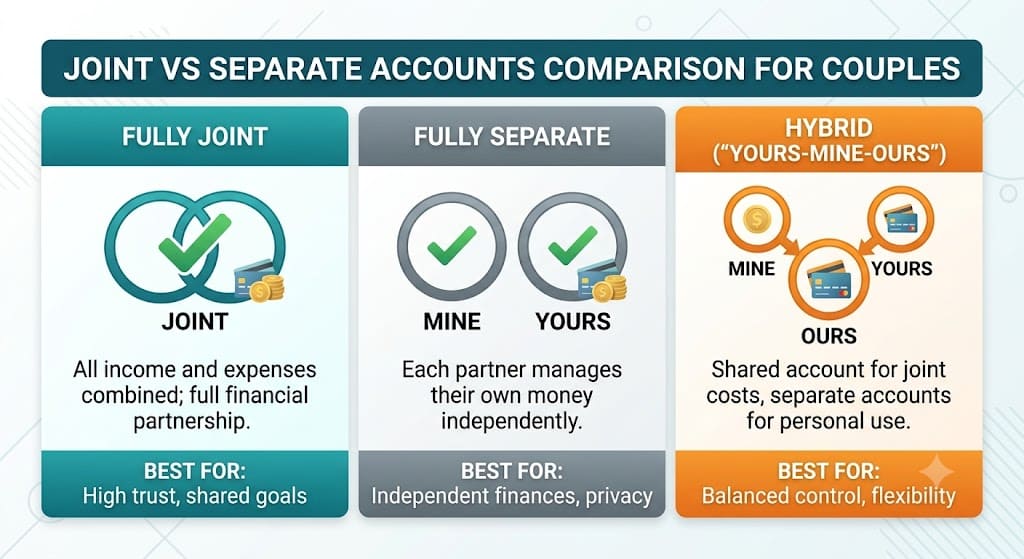
Most couples land in one of three setups: fully joint, fully separate, or a hybrid that’s often nicknamed “yours, mine, and ours.” The joint vs separate accounts decision really comes down to how much visibility you want versus how much independence you need, and each setup creates a different kind of friction if you pick it without talking it through first.
Fully joint means every paycheck and every account is shared. Fully separate means you keep individual accounts and split shared costs some other way. Hybrid keeps personal accounts intact while routing an agreed amount from each person into one shared account for rent, groceries, and bills.
Fully joint accounts
This is the traditional default, and it still works well for a lot of couples, especially once you’re combining major goals like a house or kids. Everything is visible. Nobody has to guess what the household actually spends in a month.
The tradeoff is exactly what happened with my coffee incident: total visibility means every purchase is technically up for discussion, which can turn small spending differences into recurring arguments if you don’t set some ground rules early.
Fully separate accounts
Here, you keep your own checking and savings, and split shared costs through transfers, a shared bill-splitting app, or whoever’s turn it is to pay what. YNAB’s guide to budgeting for couples who don’t share accounts walks through a version of this using an imaginary couple, Jamie and Jordan: each partner runs their own budget with their own categories, and each contributes a set amount every payday into <cite index=”11-1″>a category they’ve labeled something like Shared Budget, which then gets transferred into the household checking and savings accounts</cite> that cover rent and joint goals.
This setup preserves financial independence and keeps “my money, my business” purchases private. It takes more coordination, though. Somebody has to actually track who paid what, or resentment creeps in fast.
Hybrid, or “yours, mine, and ours”
This is the one most financial writers actually recommend once a relationship gets serious, and it’s the version author Ramit Sethi lands on in his book Money for Couples. He suggests each partner keep an individual account for no-questions-asked personal spending, while <cite index=”27-1″>the shared future runs through joint accounts that reflect joint goals</cite>, built around what he calls a “conscious spending plan.”
David Bach makes a similar case in Smart Couples Finish Rich, pushing couples toward joint accounts for shared goals like a house down payment or an emergency fund, while still protecting some individual spending money, so <cite index=”40-1″>each partner keeps a sense of privacy and both still know the full household cash flow</cite>.
I’ll be honest: hybrid is more setup work than either extreme. You have to agree on a contribution formula and actually stick to it. But it’s the version that’s held up best for us, and it’s the one both books above independently arrive at.
How to split shared expenses when incomes aren’t equal
A straight 50/50 split sounds fair until one of you earns considerably more than the other. Proportional splitting fixes that: each partner contributes to shared costs based on their share of total household income, not a flat half each.
Say one partner earns $70,000 and the other earns $50,000. Instead of splitting the $2,400 rent evenly, you’d split it roughly 58/42 based on income share, closer to $1,400 and $1,000. Run your own numbers through FinToku’s Budget Planner & 50/30/20 Calculator to see what a proportional split actually looks like against your real bills, rather than eyeballing it.
Joint vs Separate Accounts: What the Data Actually Shows
| Metric | Figure | Source (as of) |
|---|---|---|
| Married couples with at least one joint account | 77% | U.S. Census Bureau, SIPP (2023 data, published Sept. 2025) |
| Married couples with no joint account at all | 23%, up from 15% in 1996 | U.S. Census Bureau, SIPP (published Sept. 2025) |
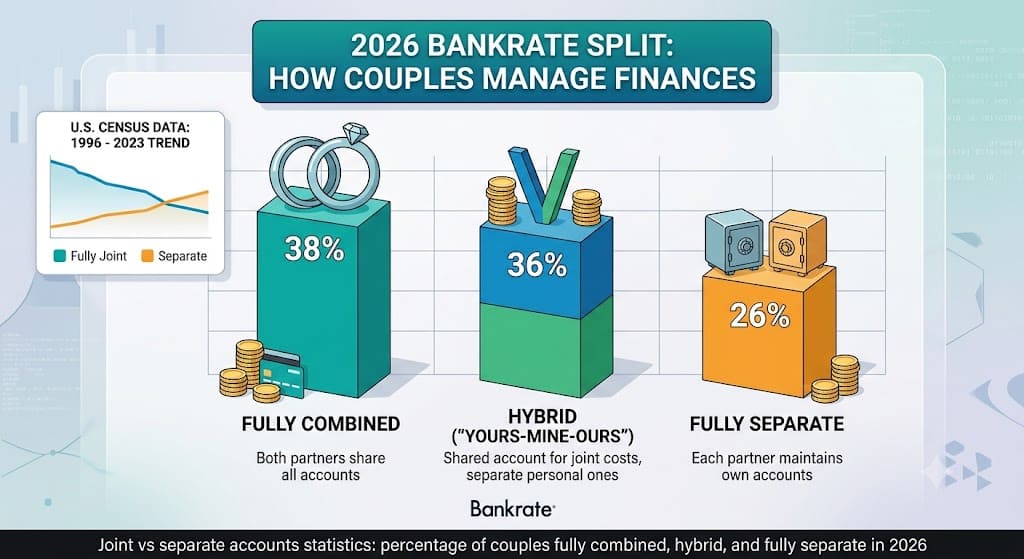
| Couples who completely combine finances | 38% | Bankrate 2026 Couples and Finances Survey (Feb. 2026) |
| Couples who keep finances completely separate | 26% | Bankrate 2026 Couples and Finances Survey (Feb. 2026) |
| Couples with a hybrid (joint + separate) setup | 36% | Bankrate 2026 Couples and Finances Survey (Feb. 2026) |
| Gen Z couples who keep at least some money separate | 51% keep it fully separate | Bankrate 2026 Couples and Finances Survey (Feb. 2026) |
The trend line matters as much as any single number: <cite index=”23-1″>married couples without any joint bank account went from 15% in 1996 to 23% in 2023</cite>, and <cite index=”23-1″>among couples who do share accounts, the share also keeping separate accounts on the side rose from 9% to 17% over that same period</cite>, according to the Census Bureau’s SIPP report. Full merging is quietly becoming the minority approach, not the assumed default.
The part nobody mentions: liability on joint accounts
Before you open one, know what you’re actually agreeing to. On a joint credit account, the Consumer Financial Protection Bureau is direct about this: <cite index=”42-1″>each account holder is responsible for the full balance, and the card company can collect the entire amount due from either person</cite>. That’s true even for charges you didn’t personally make. If the relationship ends, closing the account doesn’t erase what’s owed on it.
This isn’t a reason to avoid joint accounts. It’s a reason to actually talk about spending limits and overdraft habits before you combine anything, not after a surprise statement shows up.
Common mistakes couples make with a shared budget
- Merging everything on the first joint bill. Opening a joint account because rent needs to get paid isn’t the same as agreeing on a system. Decide the structure first.
- Never revisiting the split after a raise or a job change. A 50/50 split that made sense two years ago can quietly become unfair.
- Treating “joint” as “no privacy.” Even fully merged couples benefit from a small no-questions-asked allowance each month.
- Skipping the money meeting. A 20-minute check-in once a month catches problems while they’re still small.
Key Takeaways
- There’s no universally “right” answer to the joint vs separate accounts question. Fully joint, fully separate, and hybrid all work, depending on income gaps, spending styles, and how much privacy each partner wants.
- Proportional splitting, contributing to shared costs based on income share rather than a flat 50/50, is generally fairer when incomes differ significantly.
- As of 2023 Census data, 23% of married couples have no joint account at all, up from 15% in 1996, and full merging is no longer the majority default.
- On a joint credit account, both holders are legally responsible for the entire balance, per the CFPB, regardless of who made the charge.
- A hybrid “yours, mine, and ours” setup, keeping individual accounts plus one shared account for bills, is the structure most couples’ finance books, including Ramit Sethi’s and David Bach’s, land on for long-term relationships.
Frequently Asked Questions
Joint vs separate accounts: which should couples choose? Either can work, and there’s no single right answer. Joint accounts give full visibility and simplify shared bills; separate accounts preserve independence but need more active coordination to split costs fairly. Most couples’ finance experts land on a hybrid of the two.
How do you split bills when you make different amounts? Split shared costs proportionally to income rather than 50/50, so each partner contributes the same share of what they earn, not the same dollar amount.
What is the 50/30/20 rule for couples? It’s the same framework as for individuals, 50% of combined income to needs, 30% to wants, 20% to savings and debt, just applied to household totals instead of one paycheck.
Is it normal for married couples to have separate accounts? Yes. Census data shows 23% of married couples hold no joint account at all, and Bankrate’s 2026 survey found 36% run a hybrid of joint and separate accounts.
How much money should you keep private from your partner? There’s no fixed number. The common thread across couples’ finance books is a modest, agreed-upon personal allowance neither partner has to explain, on top of full visibility into shared income and expenses.
If you’re still deciding, run your actual numbers through FinToku’s Budget Planner & 50/30/20 Calculator before you pick a structure, seeing the real split tends to make the conversation easier than talking about it in the abstract.
Read More
- How to Budget on an Irregular Income (2026 Guide)
- Can You Have Two Checking Accounts? Yes, Here’s How It Works
- The 50/30/20 Budget Rule Explained (And Why It Might Not Fit Your Paycheck)
Disclaimer
This article is for general informational purposes and isn’t personalized financial or legal advice. Every relationship’s finances are different, and a joint account carries real legal and credit implications, so read our full Financial Disclaimer before making account decisions with a partner.
Published by Saad Faisal for FinToku (fintoku.com) · Published July 27, 2026 · Updated July 27, 2026 FinToku provides free finance tools and guides to help you make smarter money decisions.