

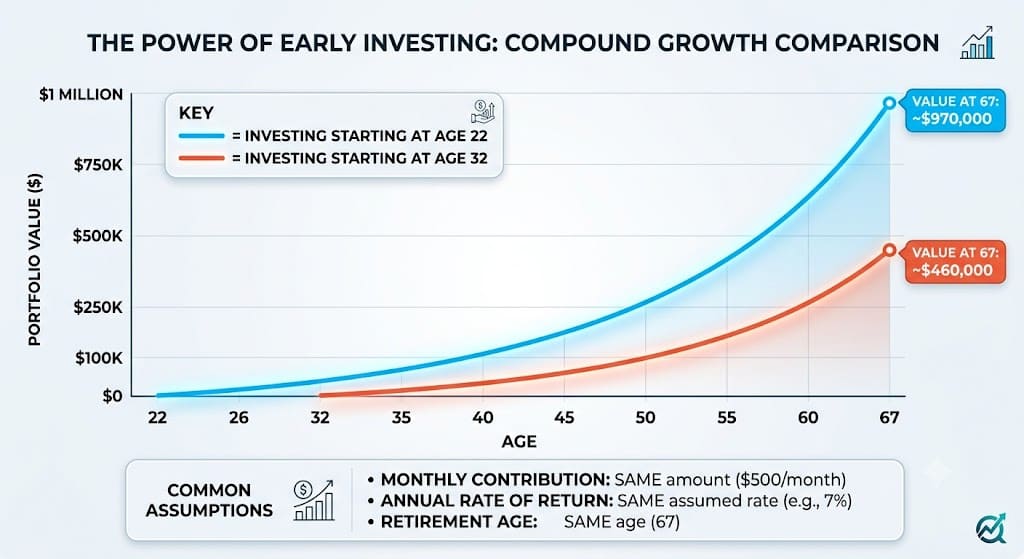
Say two people invest $300 a month. Same fund, same hypothetical 7% average annual return. One starts at 22. The other waits until 32. By 65, the early starter would have roughly $982,000. The one who waited a decade lands closer to $463,000. She only contributed about $36,000 less over her lifetime. Neither number is a promise. Real returns don’t move in a straight line. But the gap between them isn’t effort or income. It’s ten years.
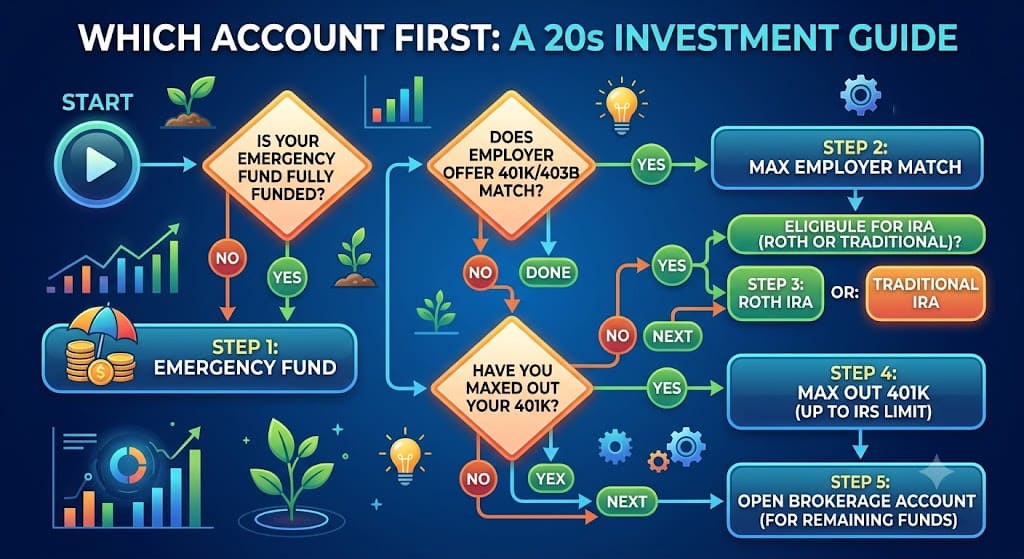
The best investment strategy in your 20s isn’t about picking a stock. It’s about getting the order of operations right. Build your emergency fund first. Grab your employer match next. Then fund tax-advantaged accounts. Then put that money in low-cost, diversified funds. Automate it, and leave it alone. Do those five things in roughly that order and you’re already ahead of most people twice your age.
What “having a strategy” even means at this stage
An investment strategy is just a plan. It covers how much you invest, where you put it, and how much risk you take. That plan should match how long you have until you need the money. In your 20s, your plan looks different than it will in your 40s. You have one asset nobody can buy back: time.
That’s not just a motivational line. Time is what makes compounding actually work.
Why starting now beats starting “better” later
Here’s the math nobody shows you until you ask. Say you invest $300 a month starting at 22, and you get a hypothetical 7% average annual return. That’s illustrative only. Markets don’t move in a straight line, and no return is guaranteed. Still, you’d have around $982,000 by 65. Wait until 32 to start the same $300 a month, and you’d land closer to $463,000.
You only contributed about $36,000 less by waiting ten years. You ended up with less than half. That’s compounding. Your early gains start earning their own gains. The earliest dollars in get the most years to do that.
Want to see this with your own numbers instead of mine? FinToku’s SIP Calculator projects how a recurring monthly investment grows over time, so you can plug in your actual budget instead of trusting a hypothetical.
Step 1: Build the base before you invest a dollar
Before any of this works, you need two things in place. Skip them, and you’ll end up selling investments at the worst possible time. That’s exactly how good long-term plans fall apart.
An emergency fund. The Consumer Financial Protection Bureau recommends three to six months of essential expenses. Keep it in a separate, accessible account, not invested in the market. Say your car breaks down, or you lose your job. This fund is what keeps you from raiding your Roth IRA and paying a penalty for it.
High-interest debt, paid down. Say you’re carrying a credit card at 22% APR. Paying that off beats almost any guaranteed return the stock market offers. No reliable investment beats a 22% interest cost.
I’d budget first, honestly, before touching either one. FinToku’s Budget Planner & 50/30/20 Calculator shows you how much room you actually have each month once rent, debt, and spending come out. If you want the longer version of the emergency-fund math, I walked through it step by step here.
Step 2: Take the free money before anything else
Say your employer offers a 401(k) match. Contribute enough to get the full match before you touch anything else with your investable cash. A common match structure is 50 cents on the dollar, up to 6% of your salary. Skipping that isn’t playing it safe. It’s turning down a guaranteed 50% return on that slice of your paycheck.
Step 3: Pick the right account for the job
Once you’ve covered the match, where you put the next dollar matters almost as much as what you buy with it. Here’s how the common options compare for someone in their 20s:
| Account | Best for | Tax treatment | 2026 contribution limit |
|---|---|---|---|
| 401(k) (with match) | Retirement, if employer matches | Pre-tax now, taxed on withdrawal | $24,500 (under 50) |
| Roth IRA | Retirement, low tax bracket now | Taxed now, tax-free growth and withdrawal | $7,500 (under 50) |
| Traditional IRA | Retirement, no workplace plan | Often tax-deductible now, taxed on withdrawal | $7,500 (under 50) |
| Standard brokerage account | Money you might need before 59½ | No special treatment, taxed on gains | No limit |
Source: IRS, 401(k) limit increases to $24,500 for 2026, IRA limit increases to $7,500 (as of Nov 2025). Figures apply to the 2026 tax year. Double-check them against the IRS site before you file, since limits change every year.
A Roth IRA deserves a specific mention here. In your 20s, you’re likely in the lowest tax bracket you’ll ever see. Pay tax on that money now, while the rate is low. Let decades of growth come out completely tax-free later. That’s one of the cleaner trades available to a young investor. I broke down how a Roth interacts with your 401(k) in more detail here, if you’re trying to decide between the two or want to know if you can use both.
Step 4: What to actually put your money in
This is the part people overthink. You don’t need to pick individual stocks. Honestly, most professional fund managers don’t reliably beat the market either. A broad, low-cost index fund, tracking something like the S&P 500 or a total market index, gives you instant diversification. You get exposure to hundreds or thousands of companies, usually for an annual fee under 0.1%.
Diversification just means you don’t have all your money riding on one company, sector, or country. Say one stock crashes. The other 499 in an S&P 500 fund keep doing their thing. Diversification won’t stop your portfolio from falling in a broad downturn. But it protects you from one bad bet wiping you out.
You likely have decades before you need this money. That means you can afford to lean more heavily into stocks than someone in their 50s would. Some investors use a rough starting point: hold a percentage in bonds roughly equal to your age, and put the rest in stocks. In your 20s, that puts the bulk of a retirement account in equities, with bonds playing a small role, if any.
Don’t let a small paycheck talk you out of diversifying. Most major brokerages now let you buy fractional shares. That means $20 can get you a slice of an S&P 500 fund. You don’t need hundreds of dollars for a full share anymore. You can start with whatever’s left over after rent, even if that’s $25 a paycheck.
Step 5: Automate it and then leave it alone
Set up an automatic transfer that moves money into your investment account right after payday, before you have a chance to spend it. People call this dollar-cost averaging: a fixed amount, going in on a schedule. The real benefit isn’t higher returns. It’s that it removes the temptation to time the market, which even professionals are bad at.
Then don’t check it every day. Checking a long-term account daily is a good way to talk yourself into a bad decision during a normal, temporary dip.
Mistakes that quietly wreck a good plan
Chasing hype. Meme stocks, whatever crypto is trending this month, or a “sure thing” a friend heard about. These aren’t a strategy. They’re a bet. And betting your retirement money on one is a different game entirely from investing it.
Skipping the emergency fund. Without one, a single bad month forces you to sell investments, possibly at a loss, possibly with a penalty if it’s in a retirement account.
Overtrading. Buying and selling based on news headlines racks up costs and taxes. It usually underperforms just leaving a diversified fund alone.
Ignoring fees. A 1% annual fee sounds small. Over 40 years, it can quietly eat a six-figure chunk out of your final balance compared to a 0.05% index fund. Fees compound too, just against you.
Can you actually turn $1,000 into $10,000 in a month?
Honestly? Not reliably, and not without taking on risk that’s just as likely to turn $1,000 into $100. A 10x return in 30 days isn’t an investment outcome. It’s what happens with leveraged options, high-risk crypto, or gambling, and the odds run against you. Say someone’s selling you a system that promises this. That’s the part to be skeptical of, not the goal itself.
The honest version of “growing $1,000 fast” looks different. Put $1,000 in a diversified fund and give it decades, not weeks, to work. It’s a much less exciting answer, but it’s the one that actually shows up in most people’s account balances by retirement.
Key Takeaways
- Starting ten years earlier can roughly double your final balance even with a smaller total contribution, purely because of compounding.
- Build a 3-6 month emergency fund and pay down high-interest debt before investing anything beyond your 401(k) match.
- Always capture a full employer 401(k) match first. It’s an immediate, guaranteed return you can’t get anywhere else.
- A Roth IRA is often the strongest next move in your 20s, since you’re likely in your lowest lifetime tax bracket right now.
- Low-cost, diversified index funds, held consistently and left alone, beat picking individual stocks or chasing trends for most people over the long run.
Frequently Asked Questions
What should a 20 year old be investing in?
Most 20-somethings are well served by low-cost, diversified index funds or ETFs tracking a broad market index, held inside a 401(k) (up to the employer match) and a Roth IRA, with any extra going to a standard brokerage account.
How to turn $1,000 into $10,000 in a month?
There’s no reliable, low-risk way to 10x money in a month. Strategies that promise this rely on high-risk leverage or speculation, where you’re just as likely to lose most or all of it as you are to see the upside.
Is $50,000 saved at 25 good?
It’s well above typical benchmarks for that age and puts you ahead of most peers, though “good” depends on your income, debt, and cost of living. What matters more than the number is whether it’s working for you in an emergency fund plus invested accounts, rather than sitting idle.
What if I invest $1,000 a month for 20 years?
Using a hypothetical 7% average annual return, $1,000 a month for 20 years grows to roughly $520,000. You’d have put in $240,000 of that yourself. Actual results depend entirely on real market returns, which vary year to year and aren’t guaranteed.
Best investments for young adults?
Beyond retirement accounts, many young adults also keep a high-yield savings account for their emergency fund and short-term goals, since it earns meaningfully more than a typical checking account while staying liquid.
If you want a specific book to start with, The Simple Path to Wealth by JL Collins is one I’d point a beginner toward for the index-fund case in plain language. (Quick heads up, that’s an affiliate link, so FinToku may earn a small commission if you buy through it. Full details in our Affiliate Disclosure.)
Still weighing Roth versus traditional? FinToku’s Personal Income Tax Calculator gives you a rough read on your current bracket in a couple minutes, which is really the whole decision.
Read More
- Can I Contribute to Both IRA and 401k? (2026 Limits Explained)
- How to Build an Emergency Fund in 6 Months (Even on a Tight Budget)
- How Much Should You Save Each Month? A Realistic, No-Guilt Answer
Disclaimer
This article is for general informational purposes only. Don’t take it as financial, tax, or legal advice. The 7% return I used above is a hypothetical for illustration. It’s not a promise of what any real investment will do. Your own results will depend on the actual accounts, funds, and market conditions you end up with. Before making a real investing decision, talk to a qualified financial advisor or tax professional who can look at your specific situation. You can read FinToku’s full Financial Disclaimer for more.
Published by Saad Faisal for FinToku (fintoku.com) · Published July 22, 2026 · Updated July 22, 2026 FinToku provides free finance tools and guides to help you make smarter money decisions.