

I found out I was “credit invisible” the hard way. I was standing at a car dealership at 19, watching a finance guy squint at his screen. He told me the system had nothing to go on. Not bad credit. No credit. Turns out that’s actually the more common problem. Millions of people run into this exact wall every year. It’s not because they messed something up. It’s because they simply never had a reason to borrow money before.
Building credit from zero isn’t complicated, but it does take a specific sequence. Get one account reporting to the credit bureaus. Use it lightly. Pay it on time. Then wait. Most people go from no score to a usable one in about three to six months. Getting to a solidly “good” score usually takes another 6 to 12 months on top of that. Here’s the actual playbook, in the order I’d do it.
What “No Credit History” Actually Means
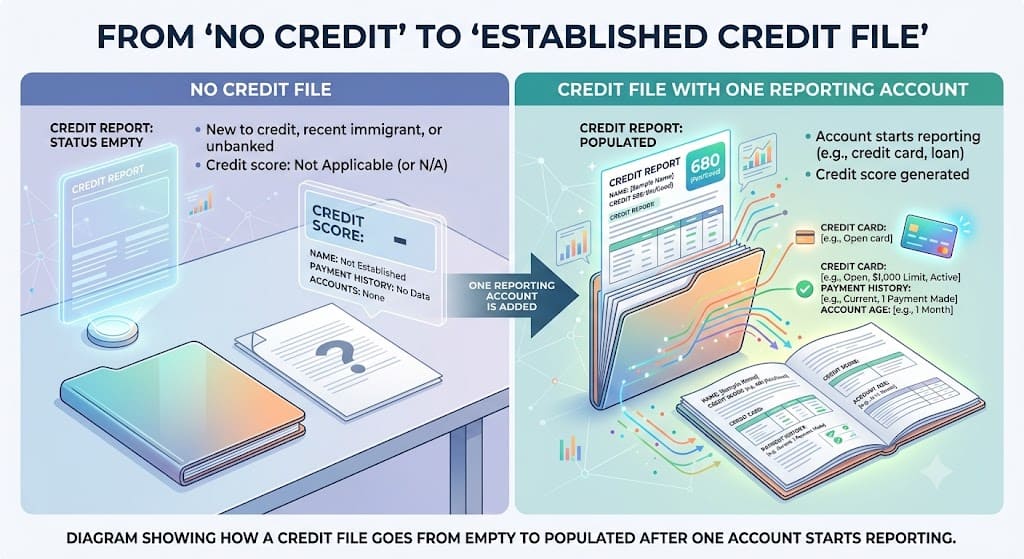
Having no credit history means the three major credit bureaus, Equifax, Experian, and TransUnion, have nothing on file for you. No credit cards, no loans, no reported payments. Without that file, a scoring model like FICO or VantageScore has nothing to calculate. So you don’t have a low score. You have no score at all.
That’s a different problem from bad credit, and it’s actually easier to fix. Bad credit means undoing damage. No credit just means giving the bureaus something to measure.
Get a Secured Credit Card
A secured credit card is the fastest, most reliable way to start a credit file when you have none. You put down a refundable deposit, usually somewhere between $150 and $500. That deposit becomes your credit limit. Your own cash covers the issuer’s risk, so they’ll approve almost anyone. Most secured cards require no credit check or credit history.
Here’s the part that trips people up: not every card labeled “for building credit” actually helps. If the issuer doesn’t report to all three bureaus, you’re just paying a deposit for a card that never shows up on your credit file. Before you apply, check the card’s terms or call and ask.
Once approved, use the card for two or three small recurring purchases a month, something you’d buy anyway. Then pay the full statement balance every month. Do this consistently, and most issuers will offer to upgrade you to an unsecured card. They’ll typically refund your deposit around the 7-to-12 month mark.
Comparing First-Time Credit-Building Cards
| Card | Deposit / Credit Limit | Annual Fee | Regular APR | Reports to All 3 Bureaus? |
|---|---|---|---|---|
| Capital One Quicksilver Secured | $200+ | $0 | 28.99% (variable) | Yes |
| OpenSky® Secured Visa | $200+ | $35 | ~23.89% (variable) | Yes |
| Chase Freedom Rise® (unsecured — no deposit required) | N/A; approval-based, income/banking-history check instead | $0 | Standard variable purchase APR, confirm current rate with Chase | Yes |
A note on Discover it® Secured: as of this writing, Discover has paused new applications for this card. Capital One (which acquired Discover in 2025) plans to relaunch it later in 2026 — worth checking back on if it was on your shortlist.
Figures reflect publicly available issuer and reviewer data as of July 2026. APRs are variable and move with the prime rate. Issuers can also update deposit minimums and fees at any time, so confirm current terms directly with them before applying.
Become an Authorized User
Ask someone you trust, a parent, a spouse, a sibling, if they’ll add you as an authorized user on their card, as long as it’s in good standing. You get your own card tied to their account. Their payment history on that account, good or bad, starts showing up on your credit file too.
This only works if the card issuer actually reports authorized users to the credit bureaus. Not all of them do, so make a quick phone call to check before you get your hopes up. It’s also worth remembering this cuts both ways. If the primary cardholder misses payments or runs the balance up high, that shows up on your report just like the good behavior would.
Take Out a Credit-Builder Loan
A credit-builder loan flips a normal loan backward. Instead of getting the money upfront, you make fixed monthly payments into a locked savings account or CD. This runs somewhere between 6 and 24 months. At the end, you get the money back, minus a small amount of interest. The lender reports every payment to the bureaus the whole time.
Credit unions are usually the best place to look for these. Many will approve you based on your banking history rather than a credit check you don’t have yet. The tradeoff: your money stays locked up for the loan term. This works best if you don’t need the cash right away. Miss a payment, though, and it can hurt your file the same way a missed credit card payment would.
Ask Your Landlord to Report Your Rent
If you’re paying rent on time every month, you might already have a year or more of positive payment history. It just isn’t showing up anywhere yet. Some landlords and property managers report rent directly to the bureaus. If yours doesn’t, third-party services like Esusu or RentReporters can add your rent payments to your credit file for a fee. Some free tools, like Experian Boost, will also pull in rent along with utility and streaming bills you’re already paying.
This is one of the easiest wins on this list. You’re not opening anything new, you’re just getting credit for money you’re already spending.
Look Into a Student Credit Card
If you’re in college, student credit cards are worth a specific mention. They’re unsecured, so no deposit required, but issuers set looser approval standards for people with thin or no credit files. Expect a modest credit limit, and sometimes a small cash-back reward on top. They won’t approve everyone, but they’re worth checking alongside a secured card if you’re currently enrolled.
How Long Does It Actually Take to Build Credit From 0 to 700?
Most people generate their first credit score within about three to six months of their first account reporting. That’s roughly the minimum data scoring models need. Getting from that first score up to a “good” range (670-739 on the FICO scale) typically takes another 6 to 12 months. You’ll need consistent, on-time payments and low balances to get there. Reaching 700+ generally takes 12 to 18 months of clean history, assuming you don’t open a lot of new accounts or miss payments along the way.
That’s a range, not a guarantee. It moves faster or slower depending on how many accounts you open and how you use them. Two habits matter more than anything else on this list combined:
- Pay on time, every time. Payment history is the single largest factor in most scoring models. Even one 30-day-late mark can set you back months.
- Keep your utilization low. Try to use less than 30% of any credit limit, and under 10% if you can manage it. Scoring models reward a wide gap between what you could spend and what you actually do.
A Word of Caution on “Guaranteed Approval” Ads
If you’ve searched around this topic, you’ve probably seen ads for cards promising a $10,000 limit with no credit check. Be skeptical of these. Legitimate first-time credit products cap deposits and limits at a level that matches the issuer’s actual risk. That’s usually a few hundred dollars, not five figures. A card that promises a huge limit with zero underwriting is either predatory or simply not real. The predatory version often hides fees that eat the “limit” before you ever use it. Stick to issuers you can verify. Confirm they report to all three bureaus, and check that they show up on a bank or credit union’s own site, not just in a search ad.
Key Takeaways
- Having no credit history isn’t the same as bad credit. It just means the bureaus have nothing on file to score yet.
- A secured credit card that reports to all three bureaus is the fastest, most reliable way to start a file from zero.
- Becoming an authorized user and taking out a credit-builder loan are solid companion strategies, especially through a credit union.
- Most people see a first credit score in 3 to 6 months and a “good” score (670+) somewhere in the 12-to-18-month range with consistent on-time payments and low utilization.
- Ignore ads promising guaranteed approval on high-limit cards with no credit check. Legitimate starter products keep limits modest because they’re tied to your own deposit or income, not marketing copy.
Frequently Asked Questions
What is the fastest way to build credit if you have no credit history?
Open a secured credit card that reports to all three credit bureaus. It’s generally the fastest route, since it starts a file immediately and can generate a usable score within a few months of on-time payments.
How long does it take to build credit from 0 to 700?
Most people reach a first score in 3 to 6 months. From there, expect another 12 to 18 months of on-time payments and low utilization to climb into the 700+ range, assuming no missed payments or major new debt along the way.
Can I get a credit report with no credit history?
Not until an account starts reporting to a bureau. Once you open a secured card, become an authorized user, or take out a credit-builder loan, a report typically appears within one to two billing cycles.
Can you get credit with no credit history?
Yes. Lenders that specialize in first-time credit, secured card issuers, credit-builder loan providers, and student card issuers among them, are built specifically to approve people with no file. The deposit or income check replaces the missing credit history.
Do I need a deposit to build credit from scratch?
Not necessarily. Authorized user status, rent reporting, and student credit cards don’t require one. Only secured credit cards and some credit-builder loans need a refundable deposit.
If you’re not sure whether a secured card or a credit-builder loan fits your situation better, FinToku’s Loan Comparator can help you weigh the actual costs side by side before you commit to either one.
Once you’ve got that first account open and a score starts showing up, the next real decision is usually whether to take on your first loan. My piece on bad credit loans and how approval actually works is worth a read before you get there, since a lot of the same “guaranteed approval” red flags apply.
Read More
- Bad Credit Loans: How to Actually Get Approved (2026 Guide)
- Credit Union vs Bank vs Online Lender: Greater Personal Loan
- FHA Loan Requirements 2026: Credit Score, Down Payment & Limits Explained
Disclaimer
This article is for general informational purposes only and shouldn’t be taken as financial or credit advice. Everyone’s credit situation is different, and the card terms, timelines, and deposit amounts here are examples, not guarantees for your specific application. Before applying for any credit product, check the issuer’s current terms directly. Consider talking with a nonprofit credit counselor, like one through the NFCC, if you want a second opinion. You can also read FinToku’s full Financial Disclaimer.
Published by Saad Faisal for FinToku (fintoku.com) · Published July 21, 2026 · Updated July 21, 2026
FinToku provides free finance tools and guides to help you make smarter money decisions.