
My electric bill jumped by $140 the month my cousin left his “test rig” plugged in at my place while he was between apartments. He’d told me it was “just a GPU doing some crypto stuff.” It was, in fact, three GPUs running around the clock, and I learned more about cryptocurrency mining from that one bill than from any article I’d read up to that point.
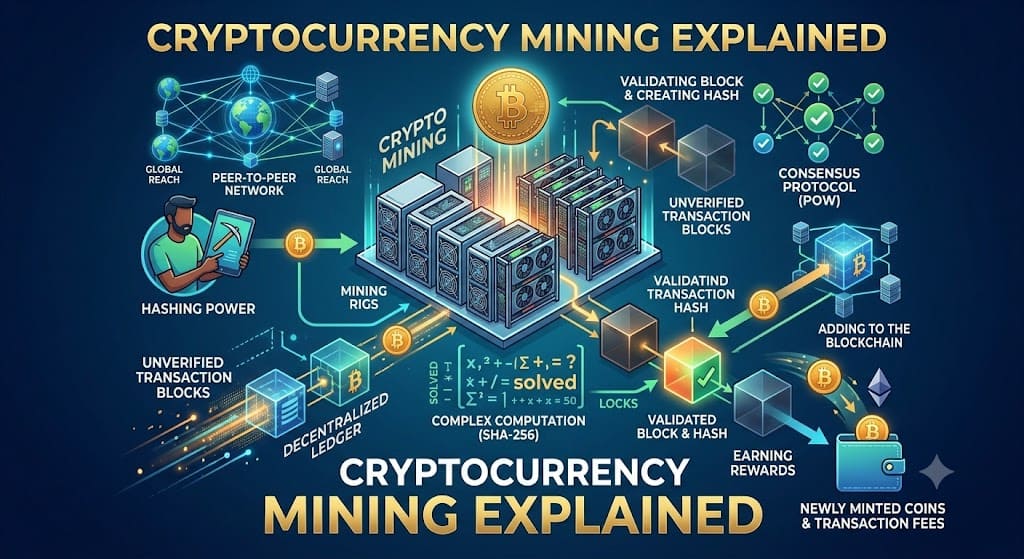
Cryptocurrency mining is the process of using computer hardware to verify transactions on a blockchain and add them to it, in exchange for newly created coins and transaction fees. It’s how networks like Bitcoin create new currency and keep their transaction record secure, without a bank or government running things. Not every cryptocurrency uses mining (Ethereum switched away from it in 2022), but Bitcoin and a handful of others still depend on it entirely.
How does cryptocurrency mining actually work?
Mining is a competition. Miners around the world race to solve a math puzzle, and whoever solves it first gets to add the next “block” of verified transactions to the chain, collecting a reward for their trouble.
Here’s the sequence, using Bitcoin as the example since it’s the largest proof-of-work network:
- Transactions get bundled. Pending Bitcoin transactions sit in a queue until a miner packages a batch of them into a candidate block.
- Miners guess at a hash. Specialized hardware runs trillions of guesses per second, trying to find a specific type of output (a “hash”) that meets the network’s current difficulty target.
- The first correct guess wins. Whoever finds a valid hash first broadcasts it to the network. Other participants quickly verify it’s legitimate.
- The reward gets paid. The winning miner receives newly minted Bitcoin (the “block reward”) plus the transaction fees attached to that block. As of the April 2024 halving, that reward is 3.125 BTC per block, mined roughly every 10 minutes.
- Difficulty resets. Every 2,016 blocks, the network adjusts how hard the puzzle is, so blocks keep arriving at that same 10-minute pace no matter how much computing power joins or leaves.
That difficulty adjustment is the part people miss most. It’s not that mining gets “used up.” It’s that as more miners join, the puzzle automatically gets harder, so your odds of winning any single block shrink even if your own hardware hasn’t changed at all.
Why blocks get halved every four years
Roughly every four years, or every 210,000 blocks, the block reward cuts in half. It went from 50 BTC in 2009 down to 3.125 BTC after the 2024 halving, and the next halving (expected around April 2028) will drop it to 1.5625 BTC. This is baked into Bitcoin’s code to cap the total supply at 21 million coins, and it’s a big part of why mining profitability shifts so much from one cycle to the next.
The hardware behind mining: ASICs vs. GPUs
You genuinely cannot mine Bitcoin profitably on a laptop anymore, and that surprises a lot of people who remember reading that “anyone with a computer” could do it in Bitcoin’s early years.
ASICs (application-specific integrated circuits) are purpose-built chips that do one thing: compute one specific hashing algorithm, extremely fast. They’re what almost all serious Bitcoin mining runs on today, because nothing else comes close on hashes-per-watt. The tradeoff is they’re expensive, they become outdated within a couple of years as newer models ship, and they’re useless for anything besides mining that one algorithm.
GPUs (graphics cards) are more flexible. They can’t touch an ASIC’s efficiency on Bitcoin’s SHA-256 algorithm, but they’re the standard for mining ASIC-resistant coins, and they double as gaming or AI hardware when you’re not mining. A single high-end GPU pulls roughly 150 to 350 watts, so a small home rig adds up fast on a power bill, which is exactly what caught my cousin off guard.
| Hardware | Best for | Rough cost | Flexibility |
|---|---|---|---|
| ASIC | Bitcoin (SHA-256) | $1,500 to $10,000+ | Single algorithm only |
| GPU | Ethereum Classic, Kaspa, Ravencoin, Monero-style coins | $250 to $1,600 per card | Reusable for gaming, AI work |
| CPU | A shrinking list of privacy coins | Whatever you already own | Least efficient, most flexible |
Most people who try mining today either join a mining pool (combining hash power with others and splitting the reward proportionally) or rent hash power through cloud mining, rather than buying and babysitting their own rig.
How much electricity does cryptocurrency mining use?
This is genuinely the most-searched question about mining, and for good reason: electricity is the single biggest ongoing cost a miner faces.
| Metric | Figure | As of |
|---|---|---|
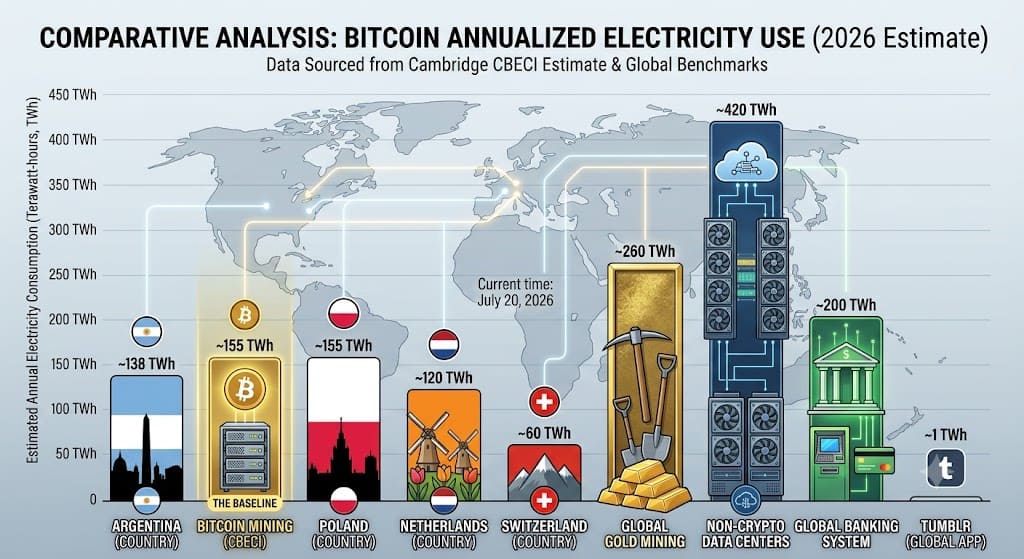
| Bitcoin network annualized electricity use (Cambridge CBECI estimate) | Roughly 170-180 TWh per year | Early 2026 |
| Share of global electricity demand | About 0.7-0.8% | Early 2026 |
| Comparable country-level consumption | Similar to Thailand or Vietnam’s total annual use | Early 2026 |
| Ethereum proof-of-work energy per transaction (historical, pre-2022) | About 84,000 Wh | Before the 2022 Merge |
| Ethereum proof-of-stake energy per transaction (current) | About 35 Wh, a 99%+ drop | Post-Merge |
The Cambridge Centre for Alternative Finance’s Bitcoin Electricity Consumption Index is the most-cited academic estimate in the space, and it’s a range rather than one hard number because nobody can directly measure every miner’s power draw. It’s built from a model of hardware efficiency and network hash rate instead. That’s worth knowing before you trust any single “Bitcoin uses as much power as X country” headline at face value; the underlying number moves depending on hash rate, hardware mix, and electricity price assumptions.
Is cryptocurrency mining profitable in 2026?
Sometimes, and it depends on three things pulling against each other: your electricity rate, your hardware’s efficiency, and the coin’s current price. Miners paying under roughly $0.06 to $0.08 per kilowatt-hour on modern ASICs are the ones with a real shot at consistent profit. Above that, thin margins get eaten alive fast.
I’d honestly steer most casual readers away from buying hardware purely to mine Bitcoin at home in 2026. The math tends to work only at industrial scale, with negotiated power rates most individuals can’t access. GPU mining on ASIC-resistant coins is a lower-stakes way to try it, since the hardware has resale value even if mining stops making sense.
A quick gut check before spending anything: multiply your hardware’s power draw by your local electricity rate, then compare that daily cost against what the coin actually pays out at current difficulty. If you don’t have a real number for that second half, don’t guess. Run it through a live mining profitability calculator before buying anything.
Mining vs. cryptojacking: the difference actually matters
Not all mining is legitimate, and this is where a lot of confusion (and a lot of malware) lives.
Mining itself is legal in the US and most of the world. What’s illegal is cryptojacking, which is when someone mines using a device’s processing power without the owner’s consent, usually by sneaking malware onto a computer through a fake download or an infected browser script. Kaspersky’s threat research has tracked sharp swings in cryptojacking activity tied to crypto price cycles, since it’s a way for attackers to profit off other people’s electricity bills instead of their own.
A few signs your device might be cryptojacked rather than just running slow: your fan runs constantly even when you’re not doing anything demanding, your electricity bill jumps without an obvious reason, and Task Manager or Activity Monitor shows sustained high CPU or GPU use on a browser tab or process you don’t recognize.
Do you pay taxes on mined cryptocurrency?
Yes. The IRS treats mining rewards as ordinary income, taxed at their fair market value on the day you receive them, and that value also becomes your cost basis if you sell later.
That creates two separate tax events, not one. Say you mine 0.05 BTC in a month when Bitcoin is averaging $85,000. You’d report $4,250 in ordinary income for that month, taxed at your regular bracket. If you later sell that same 0.05 BTC for more than $4,250, the difference is a separate capital gain. Sell it for less, and it’s a capital loss.
Whether you also owe self-employment tax depends on whether the IRS would consider your mining a hobby or a business, based on things like how regularly you do it and whether you’re running it like an operation rather than a side curiosity. Business miners report on Schedule C, can deduct real expenses like electricity and hardware, but also owe the 15.3% self-employment tax on net profit above $400. Hobby miners report the income but can’t deduct their costs against it.
Starting with the 2025 tax year, US exchanges are required to issue Form 1099-DA reporting digital asset activity directly to the IRS, so the assumption that mining income is somehow invisible hasn’t been true for a while, if it ever was. I ran a rough version of my own numbers through FinToku’s Personal Income Tax Calculator before writing this section, just to see how a chunk of mining income would actually land against a normal salary, and it’s a fast way to sanity-check your own bracket before tax season instead of guessing.
This isn’t tax advice for your specific situation. Crypto tax rules shift, and a tax professional who can see your full picture is worth the conversation before you file.
Common misconceptions about crypto mining
- “Anyone can mine Bitcoin from home and make money.” Not anymore, realistically. Industrial-scale ASIC farms with negotiated electricity rates dominate Bitcoin mining now.
- “Mining creates the coins out of nothing.” Mining releases new coins according to a fixed, pre-written schedule. Miners don’t set how many coins exist; the protocol does.
- “More miners means faster transactions.” More miners mean more security and a harder-to-manipulate network, but Bitcoin’s 10-minute block time stays roughly constant regardless of how many miners join, because difficulty adjusts to compensate.
- “Mining and staking are the same thing.” Mining is proof-of-work; it requires hardware and electricity. Staking is proof-of-stake; it requires locking up coins instead of running equipment. Ethereum moved from the first model to the second in 2022, which is why you’ll see very different energy figures depending on which one an article is describing.
Key Takeaways
- Cryptocurrency mining is the process of using computing power to verify blockchain transactions and earn new coins as a reward, most commonly associated with Bitcoin’s proof-of-work system.
- As of the 2024 halving, Bitcoin’s block reward is 3.125 BTC per block, and the next halving around April 2028 will cut that to 1.5625 BTC.
- Serious Bitcoin mining today runs on ASIC hardware, since GPUs can’t compete on efficiency for that specific algorithm, though GPUs remain the standard for mining other proof-of-work coins.
- The Cambridge CBECI estimates Bitcoin’s network uses roughly 170 to 180 TWh of electricity annually as of early 2026, about 0.7 to 0.8% of global electricity demand.
- The IRS taxes mined cryptocurrency as ordinary income at its fair market value when received, and taxes it again as a capital gain or loss only when you later sell or spend it.
Frequently Asked Questions
Is crypto mining still profitable in 2026?
It can be, but mainly for operations with electricity rates under about $0.06 to $0.08 per kWh running current-generation ASICs. Casual home mining on Bitcoin specifically is rarely worth it once you count power costs honestly.
Is cryptocurrency mining legal in the United States?
Yes, mining itself is legal under US federal law. Some states and utilities have added local rules around large-scale mining operations and energy use, so check local regulations if you’re planning anything beyond a hobby scale.
How much electricity does Bitcoin mining use?
The Cambridge CBECI puts it at roughly 170 to 180 TWh annually as of early 2026, comparable to a mid-sized country’s total electricity consumption.
Can I mine crypto on my phone or a regular laptop?
Technically some apps claim to let you, but real mining rewards require far more computing power than a phone or standard laptop can provide. Most “mobile mining” apps are either simulations, referral schemes, or not worth the battery and heat they generate.
Do I have to pay taxes on cryptocurrency I mine?
Yes. The IRS treats mined crypto as ordinary income based on its value the day you receive it, and you owe capital gains tax separately if you sell it later for more than that value.
If you’re weighing whether mining fits into a broader crypto strategy versus just buying and holding, it’s worth running your own numbers before committing real money to hardware. FinToku’s Personal Income Tax Calculator is a fast way to see how mining income would sit against the rest of your tax picture.
Read More
Disclaimer
This article is for general informational purposes only and shouldn’t be taken as financial, tax, or legal advice. The mining income example above uses illustrative numbers, not a guarantee of what any real mining setup would earn. Cryptocurrency tax rules, electricity-consumption estimates, and mining profitability all shift often, so before making a real financial decision, it’s worth checking current figures and talking to a qualified tax professional who can look at your specific situation. You can also read FinToku’s full Financial Disclaimer.
Published by Saad Faisal for FinToku (fintoku.com) · Published July 20, 2026 · Updated July 20, 2026 FinToku provides free finance tools and guides to help you make smarter money decisions.