

The fastest ways to lower a car insurance bill are raising your deductible, shopping around every renewal instead of auto-renewing, and asking your insurer directly what discounts you already qualify for. Together those three moves typically save drivers several hundred dollars a year, and none of them require switching to less coverage than you actually need.
That first renewal shock is what sent me down this whole rabbit hole. Here’s everything that actually moved the needle, in the order I’d tackle them.
1. Shop Around Before You Auto-Renew
Insurers don’t all price risk the same way. One company might charge you $150 a month and another might charge $220 for identical coverage, because they weight your age, ZIP code, and driving history differently behind the scenes.
NerdWallet’s own rate analysis found that a good driver with good credit can pay anywhere from $139 to $339 a month depending on which of the largest national insurers they choose. That gap gets even wider for drivers with an accident or poor credit on file.
Most people just let their policy auto-renew. Get two or three quotes every year instead, even if you like your current company. If the price gap is small, call your insurer and ask them to match it before you switch. A lot of the time they will.
2. Ask for Every Discount You Actually Qualify For
Insurers advertise their cheapest possible rate, then quietly require you to ask for the discounts that get you there. I didn’t know my insurer offered a discount just for going paperless until I called and asked what I was missing.
Common ones worth asking about:
- Bundling home and auto with the same company
- Paperless billing and autopay
- Good student discounts if you or a dependent is in school
- Military, alumni association, or employer group discounts
- Anti-theft devices or safety features like automatic emergency braking
None of these show up automatically on your bill. Your insurer’s website has a discounts page, but call anyway. Agents sometimes know about combinations that the website doesn’t list.
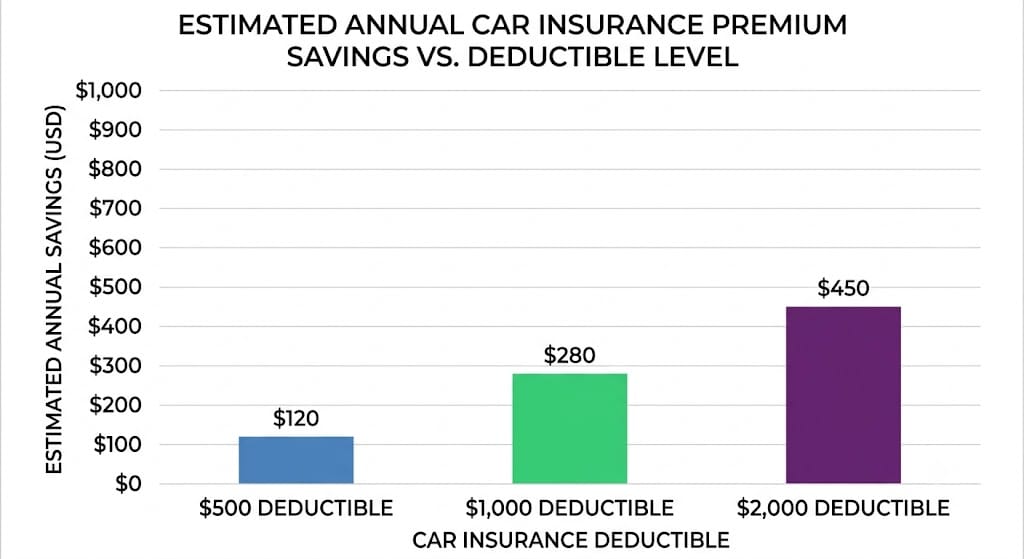
3. Raise Your Deductible (This Is the Single Biggest Lever)
Your deductible is what you pay out of pocket before insurance covers the rest of a claim. A higher deductible means a lower monthly premium, because you’re absorbing more of the risk yourself.
Loretta Worters of the Insurance Information Institute puts it simply: moving from a $500 to a $1,000 deductible typically cuts your annual premium by 20 to 25 percent. That’s real money, but only if you actually have that $1,000 sitting somewhere you can get to it fast.
| Deductible | Estimated annual savings vs. $500 | Best for |
|---|---|---|
| $500 | Baseline | Thin or no emergency fund |
| $1,000 | 20-25% lower premium | An emergency fund that covers the gap |
| $2,000 | Bigger cut, but check your insurer’s cap first | Older car, strong savings cushion |
Source: Insurance Information Institute estimates cited by Consumer Reports, as of August 2025. Actual savings vary by insurer and state.
So if someone’s asking whether $500 or $1,000 is the better deductible, the honest answer is: $1,000 saves more, but only pick it once you’ve actually got $1,000 set aside. Otherwise you’re just moving the pain from your monthly bill to the day you file a claim.
4. Drop Coverage Your Car No Longer Needs
Collision and comprehensive coverage pay to repair or replace your own car. On an older vehicle, that coverage can cost more per year than the payout would ever be worth.
A rough rule of thumb from the Insurance Information Institute: if your car’s value is less than 10 times what you’re paying for collision and comprehensive combined, it’s probably time to drop them. Look up your car’s actual value on Kelley Blue Book before you decide, not just a guess.
Consumer Reports found drivers who dropped this coverage saved roughly $1,165 a year on average. Just make sure you’re setting that money aside instead of spending it, in case you ever do need to replace the car out of pocket.
5. Bundle Your Policies, But Check the Math
Carrying home and auto insurance with the same company usually unlocks a bundling discount, sometimes worth up to 30 percent according to Consumer Reports’ analysis of industry data.
I’ll be honest, bundling isn’t automatically the winning move for everyone. Sometimes the cheapest home insurer and the cheapest auto insurer are two different companies, and splitting them beats the bundled discount. Get both quotes bundled and separate before you assume bundling wins.
6. Build Your Credit, If Your State Allows It
Most states let insurers use a credit-based insurance score to help set your rate, and it can matter more than your actual driving record in some pricing models. That feels backwards, but insurers say the data shows people who manage credit responsibly also file fewer claims.
California, Hawaii, Massachusetts, and Michigan ban this practice entirely, so your credit score won’t move your auto premium at all in those four states. Everywhere else, paying bills on time and keeping your card balances well below your limits can quietly lower your rate over time, on top of every other financial reason to do it anyway.
7. Consider Usage-Based or Pay-Per-Mile Insurance
If you don’t drive much, usage-based insurance can be one of the biggest discounts available, and most people never even get asked about it. You install an app or a small device that tracks your mileage and driving habits, and your rate adjusts based on actual usage instead of a flat estimate.
Consumer Reports’ 2024 survey found that drivers who signed up for driver monitoring programs saved a median of $120 a year, and most policyholders didn’t even know the option existed until they asked. Several major insurers, including Progressive, State Farm, and Travelers, offer some version of this. Just know that a few insurers can raise your rate if the app flags risky driving, so read the fine print before you opt in.
8. Buy (or Keep) a Car That’s Cheap to Insure
The car itself drives a big chunk of your premium, especially if you carry collision and comprehensive coverage. Repair cost, theft rate, and safety ratings all factor into what insurers charge.
Before you buy your next car, call your insurance company and ask what it would cost to insure the specific model you’re considering. Small, moderately priced SUVs and sedans are consistently cheaper to insure than sports cars, luxury models, or brand-new vehicles, because they’re less expensive to fix and less likely to be stolen.
Insurance is only half the monthly math, though. I ran a few models through FinToku’s Car Payment & In-House Financing Calculator before my last purchase, and seeing the loan payment and the insurance estimate side by side made it obvious which cars actually fit my budget and which ones just looked like they did.
9. Keep Your Driving Record Clean
This one’s obvious but worth saying plainly: tickets and accidents raise your rate more than almost anything else on this list, and the increase can stick around for three to five years depending on your state and insurer.
If you do get a ticket, ask about traffic school. Many states let you complete a course to keep the violation off your record entirely. A defensive driving course can also unlock a standalone discount even if you have a clean record already. In New York, for example, a state-approved course costs about $25 and knocks roughly 10 percent off your premium.
10. Review Your Policy After Every Life Change
Insurance companies aren’t going to flag it for you when your situation changes, so it’s on you to check. Common triggers that should send you back to your policy:
- You moved to a new city or state
- You started working from home and drive far less than before
- A teen driver on your policy now has their own coverage
- You paid off your car loan
- You got married or divorced
I know someone who kept paying for a “teen driver” surcharge two years after that teen moved out and got their own separate policy. Nobody catches that but you.
11. Talk to an Independent Agent
An independent agent represents multiple insurance companies instead of just one, so they can compare quotes across insurers you might not think to check yourself, including smaller regional companies that don’t advertise nationally. It costs nothing extra to use one since they’re paid by the insurer, not by you.
This isn’t the right move for everyone. If you’re the type who’s happy comparing three or four quotes online yourself, you probably don’t need the middleman. But if the whole process feels overwhelming, an independent agent can genuinely save you the legwork.
12. Change How and When You Pay Your Premium
A smaller lever, but a real one. Paying your six-month or annual premium in full, instead of monthly, is often cheaper because it saves the insurer the cost of processing monthly payments. Setting up autopay can unlock a separate discount on top of that.
If you can’t pay in full, at least check whether autopay or paperless billing shaves anything off your bill. It usually takes one phone call to find out.
How Much Does Car Insurance Actually Cost Right Now?
| Metric | Figure | Source & date |
|---|---|---|
| National average, full coverage | $186/month (~$2,232/year) | Insurify, July 2026 |
| Typical range across other major trackers | $181-$209/month | The Zebra, Experian, and NerdWallet, Jan-June 2026 |
| Rate range across large insurers, good driver/good credit | $139-$339/month | NerdWallet rate analysis, June 2026 |
| Median savings from switching insurers | $461/year | Consumer Reports 2024 auto insurance survey |
| Median savings from driver monitoring enrollment | $120/year | Consumer Reports 2024 auto insurance survey |
Insurify’s July 2026 figure is the most current available, so treat it as the headline number. The range beside it exists because trackers pull from different quote pools and update on different schedules, not because any one of them is wrong. Your actual quote depends far more on your state, driving history, credit tier, and the car you drive than on which national tracker you compare yourself against.
How Much Liability Coverage Do You Actually Need?
Liability coverage pays for the other driver’s medical bills and property damage when you’re at fault. It’s the coverage almost every state legally requires, and it’s also the one place where cutting corners to save money can backfire badly.
Most state minimums are low enough that a single serious accident can blow straight through them, leaving you personally on the hook for the rest. Insurance experts commonly recommend at least $100,000 per person and $300,000 per accident in bodily injury liability, higher if you have real assets to protect. If your net worth is climbing, an umbrella policy on top of your auto liability is worth pricing out too.
None of this means paying for more coverage across the board. It means putting the savings from a higher deductible and dropped collision coverage toward liability limits that actually protect you, instead of just pocketing the difference.
Key Takeaways
- Raising your deductible from $500 to $1,000 typically cuts your premium 20-25 percent, but only makes sense once you actually have that amount saved.
- Shopping around every renewal, rather than auto-renewing, can be worth hundreds of dollars a year since insurers price the same driver very differently.
- Credit-based pricing is banned in California, Hawaii, Massachusetts, and Michigan, so building credit won’t move your auto rate in those four states.
- Dropping collision and comprehensive coverage on an older car makes sense once its value falls below roughly 10 times what that coverage costs you annually.
- Usage-based and pay-per-mile programs are widely underused discounts, worth asking about even if you’ve never seen them advertised.
Frequently Asked Questions
What is the best way to save money on car insurance? Raising your deductible and shopping around at renewal are the two moves that tend to save the most money the fastest, since both directly change what you’re quoted rather than relying on a discount you may or may not qualify for.
How can I get a lower rate on my car insurance? Ask your current insurer directly what discounts you’re missing, get quotes from two or three competitors before renewal, and consider a higher deductible if you have the savings to back it up.
Is it better to have a $500 deductible or $1,000? A $1,000 deductible usually saves 20-25 percent on your premium compared to $500, according to Insurance Information Institute estimates. It’s the better choice only if you genuinely have $1,000 available to cover a claim without financial strain.
Is $300 a month for car insurance bad? It depends entirely on your state, driving record, coverage limits, and vehicle. $300 a month is above the current national full-coverage average of about $186-$209 a month, but drivers in high-cost states like Florida, Louisiana, or New York often pay well above that regardless of how careful they drive. Get a couple of comparison quotes before assuming you’re overpaying.
Can young drivers or drivers under 25 get cheaper car insurance? Yes, though rates for drivers under 25 are naturally higher across the board. Good student discounts, staying on a parent’s policy where allowed, and usage-based programs tend to help younger drivers the most.
If you want to see how car insurance fits against the rest of your monthly expenses, FinToku’s Budget Planner & 50/30/20 Calculator is a quick way to check before you decide how much of a rate hike you can actually absorb.
Read More
- NAIC: Auto Insurance Basics – the National Association of Insurance Commissioners’ consumer guide to how coverage, liability, and usage-based insurance actually work.
- NAIC: Tips for Saving on Your Auto Insurance – a regulator-level rundown of savings tips, useful for cross-checking anything in this guide.
- IIHS Top Safety Pick Ratings – check a specific model’s crash-test ratings before you buy, since safer cars are consistently cheaper to insure.
Disclaimer
This article is for general informational purposes only and shouldn’t be taken as financial or insurance advice. The savings figures above are estimates from the cited sources, not guarantees, and your actual premium depends on your state, insurer, driving history, and credit profile. Before making a real coverage decision, it’s worth checking with a licensed insurance agent who can look at your specific policy. You can also read FinToku’s full Financial Disclaimer.
Published by Saad Faisal for FinToku (fintoku.com) FinToku publishes free, no-signup finance calculators and practical money guidance.