
Do you own semiconductor stocks? Hold a broad tech index fund? Or just want to know where the AI spending boom heads next? Either way, this earnings call deserves ten minutes of your attention.
TSMC’s $100 billion US investment: what was actually announced
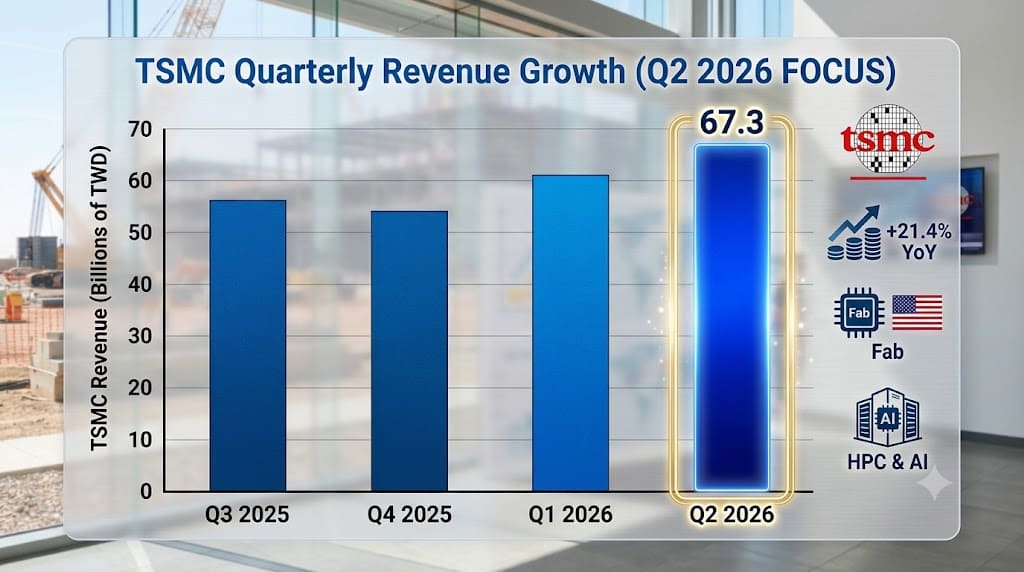
Taiwan Semiconductor Manufacturing Co. makes advanced chips for Nvidia, Apple, and Broadcom. For the second quarter of 2026, it posted net profit of roughly $22 billion (NT$706.6 billion), a 77% jump from the same quarter last year. That beat the market forecast of about NT$632.6 billion. It also marked TSMC’s ninth straight quarter of double-digit growth. Quarterly revenue came in around $40.2 billion, up 36% year-over-year.
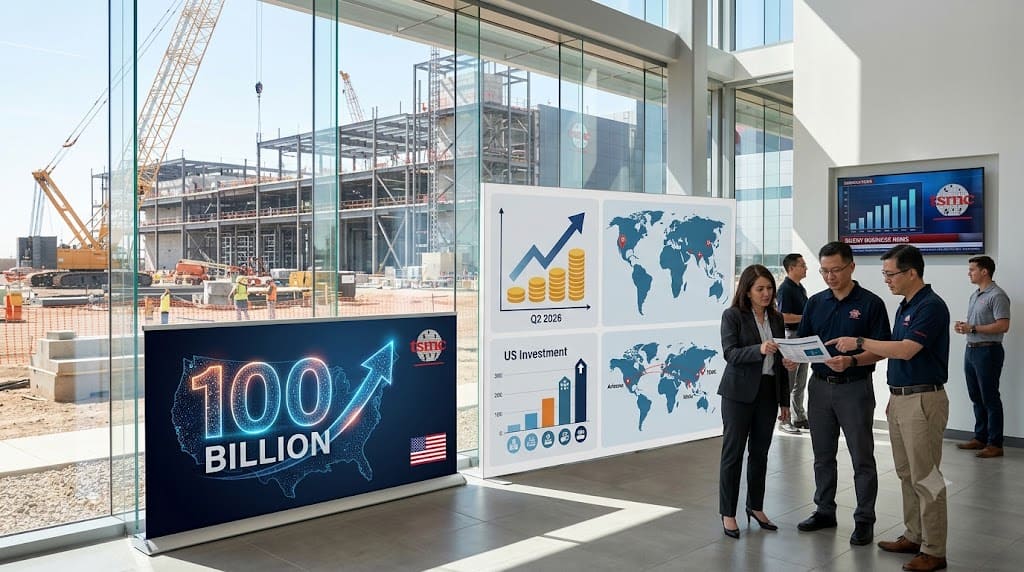
On top of the earnings beat, CEO C.C. Wei told analysts about TSMC’s $100 billion US investment plan for Arizona. The plan covers four or more new fabs, including facilities for advanced packaging. That brings TSMC’s total committed US investment to roughly $265 billion. Wei put it plainly: the goal is to build up the US semiconductor ecosystem and support high-paying manufacturing jobs. It’s also about meeting demand TSMC says it can’t currently keep up with.
TSMC also raised two separate forecasts in the same call, which almost never happens together:
- Full-year 2026 capital expenditure, up to a range of $60 billion to $64 billion, from a prior high end of $56 billion
- Full-year 2026 revenue growth, now expected to be “slightly above 40%” in US dollar terms, up from the earlier forecast of over 30%
For the current quarter, TSMC guided revenue between $44.6 billion and $45.8 billion, versus $33.1 billion in the same period last year.
Why the stock barely reacted
This is the part that actually surprised me. Shares gained about 1.23% in Taipei trading the day of the announcement, a small move for a 77% profit beat. Meanwhile, TSMC’s US-listed ADR reportedly slipped more than 3% in pre-market trading the same day.
My read: investors had already priced in a strong quarter. The stock is up over 58% this year, so the profit beat itself wasn’t the number that mattered. What mattered was whether the guidance justified an already-expensive stock.
Raising capex by billions is good news for the AI trade long-term. But it also means TSMC spends more now, before it collects more later. Some traders read that as margin pressure today versus payoff down the road. That’s a real tension worth sitting with. Heavier spending today usually buys bigger capacity tomorrow. Or it squeezes free cash flow in the meantime. The market hasn’t decided which one wins yet.
TSMC’s Q2 2026 results at a glance
| Metric | Q2 2026 | Prior guidance / comparison | Source, as of July 2026 |
|---|---|---|---|
| Net profit | ~$22B (NT$706.6B), +77% YoY | Beat forecast of NT$632.6B | CNBC, TradingKey |
| Revenue | ~$40.2B, +36% YoY | – | TradingKey |
| Q3 2026 revenue guidance | $44.6B-$45.8B | Up from $33.1B a year earlier | CNBC |
| 2026 capex guidance | $60B-$64B | Raised from $52B-$56B | TradingKey, Daily Sabah |
| 2026 revenue growth guidance (USD) | “Slightly above 40%” | Raised from “over 30%” | Yahoo Finance, Daily Sabah |
| New Arizona investment | $100B additional | Brings total US commitment to ~$265B | Daily Sabah |
| Stock move (Taipei) | +1.23% | Up 58%+ year to date | CNBC |
I’d treat the guidance ranges as the most important row here. Companies rarely raise both capex and revenue growth targets in the same quarter, and TSMC just did.
What this means if you’re not a TSMC shareholder
You don’t need to own the stock for this to matter. TSMC makes the physical chips behind most of the AI hardware boom. Its capex guidance works as a rough proxy for how much runway the “AI buildout” story still has. TSMC’s $100 billion US investment adds to spending on new capacity for 2-nanometer and advanced packaging fabs, and that signals cloud providers still aren’t slowing down their demand, at least not yet.
I ran a quick currency check on the NT$706.6 billion profit figure using FinToku’s Currency Converter. I wanted to sanity-check the USD number myself. Exchange rate quirks can shift headline conversions by a percent or two depending on the day. If you follow international earnings regularly, do the same instead of trusting one outlet’s conversion at face value.
Key Takeaways
- TSMC’s Q2 2026 net profit rose 77% year-over-year to roughly $22 billion, beating analyst forecasts and marking a ninth straight quarter of double-digit growth.
- The company pledged an additional $100 billion for Arizona chip plants, bringing its total committed US investment to about $265 billion.
- TSMC raised its 2026 capital expenditure guidance to $60-$64 billion and its full-year USD revenue growth forecast to “slightly above 40%.”
- Despite the earnings beat, TSMC’s US-listed shares reportedly dropped over 3% in pre-market trading, while Taipei-listed shares rose just over 1%.
- TSMC guided third-quarter 2026 revenue between $44.6 billion and $45.8 billion, up sharply from $33.1 billion a year earlier.
Frequently Asked Questions
How much has TSMC now committed to invest in the US in total? Counting the newly announced TSMC $100 billion US investment for Arizona, the company now has roughly $265 billion committed to US investment overall. That covers chip fabrication and advanced packaging plants.
Why did TSMC’s stock fall despite record profit? Reports point to a divergence. TSMC’s Taipei-listed shares rose modestly, about 1.23%, while its US-listed ADR reportedly fell over 3% in pre-market trading. That likely reflects investor caution about higher near-term capital spending against an already richly valued stock, up 58%+ this year.
What is TSMC’s new capital expenditure guidance for 2026? TSMC raised its 2026 capex guidance to a range of $60 billion to $64 billion, up from a previous high end of $56 billion.
Is TSMC’s earnings beat a signal for the broader AI chip sector? It’s one of the clearer signals available. TSMC manufactures chips for Nvidia, Apple, and Broadcom, so analysts watch its guidance closely as a gauge of how durable AI-related hardware demand really is. It’s not the only data point worth tracking, though.
When will TSMC’s new Arizona fabs be operational? TSMC hasn’t given a firm timeline for the additional plants beyond the ones already under construction. CEO C.C. Wei said the pace depends on the “market situation.”
If you’re tracking earnings season more broadly and want to keep tabs on how currency swings affect the headline numbers you read, FinToku’s Currency Converter is free and takes about ten seconds to run a quick check.
Disclaimer
This article is for general informational purposes only and isn’t investment, financial, or tax advice. The figures above come from TSMC’s own earnings call and press coverage as of July 16, 2026. Stock prices, guidance, and analyst estimates change quickly, though. Check TSMC’s official investor relations disclosures, and talk to a licensed financial advisor, before making any decisions based on this information. You can also read FinToku’s full Financial Disclaimer.
Sources referenced: CNBC, Yahoo Finance, TradingKey, Daily Sabah (via Agence France-Presse), and Communications Today. Every figure above traces back to these outlets’ July 16, 2026 coverage of TSMC’s Q2 2026 earnings call; none are FinToku’s own estimates.
Published by Saad Faisal for FinToku (fintoku.com) · Published July 16, 2026 · Updated July 16, 2026 FinToku publishes free, no-signup finance calculators and practical money guidance.