

My uncle spent about two years chasing $1.26 million.
He’d read it somewhere as “the number Americans think they need to retire comfortably,” and he built his entire plan around hitting it. Then he actually sat down and did the math on his own spending, his paid-off house, and his Social Security estimate. His real number turned out to be closer to $780,000. He’d been stressing over a stranger’s average instead of his own math.
The short version: most people need somewhere between 10 and 12 times their final salary saved by retirement age, or enough that a 4% annual withdrawal covers the gap between their expenses and Social Security. Your actual number depends on when you retire, how much you plan to spend, and what other income shows up alongside your savings. There’s no single figure that works for everyone, but there is a real process for finding yours. Here’s how.
What “Enough to Retire” Actually Means
Your retirement number is the amount of savings that, combined with Social Security and any other income, can cover your expenses for as long as you’re likely to live. It’s not a fixed target everyone should hit. It’s a personal calculation built from your spending, your timeline, and how much risk you’re comfortable taking with your investments.
That’s why “$1.26 million” or “$1 million” headlines are almost always misleading on their own. They’re averages of very different people’s very different lives.
The 3 Ways People Actually Calculate Their Number
Financial planners generally lean on one of three approaches, or some blend of the three.
Method 1: The income multiple rule
This is the simplest one. You aim to have a multiple of your salary saved by a given age, and the multiple grows as you get closer to retirement. A common version: 1x your salary by 30, 3x by 40, 6x by 50, 8x by 60, and 10x by 67. Someone earning $100,000 near retirement would target roughly $1 million saved.
Method 2: The 4% rule (and its shortcut, the 25x rule)
This one starts from your spending instead of your salary. The idea comes from research going back to the 1990s. A retiree withdraws about 4% of their portfolio in year one, then adjusts that dollar amount for inflation every year after, without running out of money over a 30-year retirement. Flip it around and you get the 25x rule: multiply your expected annual retirement spending by 25 to get your savings target. Need $60,000 a year? You’d want roughly $1.5 million saved.
Method 3: The income replacement method
Instead of a multiple, this approach asks what percentage of your current income you’ll need once you stop working. Most planners land somewhere around 70-80%, since you’ll drop commuting costs, work clothes, and retirement contributions, though your healthcare spending usually goes up.
| Method | What it’s based on | Best for |
|---|---|---|
| Income multiple | Your salary at a given age | A quick gut-check on whether you’re behind or ahead |
| 4% rule / 25x rule | Your expected retirement spending | Setting an actual savings target, not just a milestone |
| Income replacement | A percentage of current income | People who don’t yet know their retirement budget |
None of these is “correct.” I’d treat the income multiple as a sanity check, the 25x rule as your actual target once you know your spending, and the income replacement method as a bridge if you haven’t built a retirement budget yet. If you’d rather work backward from a withdrawal rate you’re comfortable with instead of the standard 4%, the math still holds, just swap in your own percentage.
5 Factors That Move Your Number Up or Down
When you plan to retire
Retire at 62 instead of 67 and you’re funding a longer retirement with a shorter savings runway. You’ll also likely take a smaller Social Security check for claiming early. Every year you delay tends to lower how much you need saved, since your money has longer to grow and your retirement itself gets shorter.
Social Security and other income
Don’t ignore this line item. As of early 2026, the average monthly Social Security benefit for a retired worker is a little over $2,000. If you and a spouse are each getting close to that, you might only need your savings to cover the gap between that combined income and your actual spending, not your entire budget.
Healthcare costs
This is the one people consistently underestimate. Medicare doesn’t cover everything, and out-of-pocket medical costs in retirement routinely run into six figures over a couple’s lifetime once you add premiums, deductibles, and the stuff Medicare simply doesn’t pay for.
Life expectancy
A 65-year-old today has a real chance of living past 90. If your retirement plan only stretches to 80, you could be in trouble at 81. I’d rather plan for 25-30 years of retirement and be pleasantly surprised than plan for 15 and come up short.
Inflation and investment returns
Inflation quietly erodes a fixed retirement budget. Spend $70,000 a year today, and at 3% average inflation, that same lifestyle costs roughly $115,000 a year 17 years from now. Your portfolio’s growth rate has to outpace that, both before and after retirement. Most plans assume around 6-7% pre-retirement and something more conservative once you’re drawing it down. If growth falls short, your real spending power shrinks every year.
A Worked Example: Finding One Person’s Number
Here’s how the pieces actually fit together, using a made-up but realistic scenario. Say you’re 45, earning $90,000, and planning to retire at 67.
You want to spend about 75% of your current income in retirement, so roughly $67,500 a year. You and your spouse expect a combined $3,200 a month from Social Security, or $38,400 a year. That leaves a gap of about $29,100 a year that your savings need to cover.
Apply the 25x rule to that gap, not your full spending: $29,100 x 25 is about $728,000. That’s your target, not $1.7 million (75% of your full income x 25), because Social Security is already doing part of the work.
Compare that to the income multiple rule for someone your age: 6x your $90,000 salary by 50 would put you around $540,000, climbing toward 10x by 67. The two methods land in a similar ballpark once you account for the fact that the multiple rule assumes Social Security is baked into its math too.
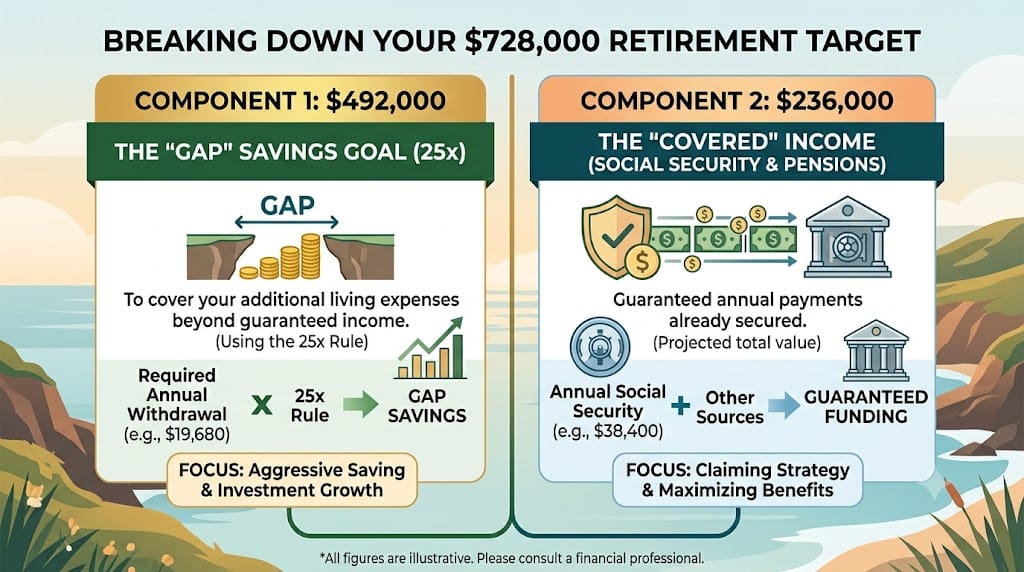
That’s the whole exercise: figure out your spending, subtract what Social Security (or a pension) is already covering, then apply the 25x rule to what’s left. The multiple-rule number is a useful gut-check, but the gap-based number is the one I’d actually save toward.
Are You on Track? Average Retirement Savings by Age
It helps to see where you land next to actual households, not just the guideline. This data is pulled from the Federal Reserve’s Survey of Consumer Finances, as reported in 2026:
| Age range | Average household savings | Median household savings | Recommended multiple |
|---|---|---|---|
| Under 35 | $49,130 | $18,880 | 1x income |
| 35-44 | $141,520 | $45,000 | 3x income |
| 45-54 | $313,220 | $115,000 | 6x income |
| 55-64 | $537,560 | $185,000 | 8x income |
| 65-74 | $609,230 | $200,000 | 10x income |
Figures as of 2026, sourced from the Federal Reserve’s Survey of Consumer Finances.
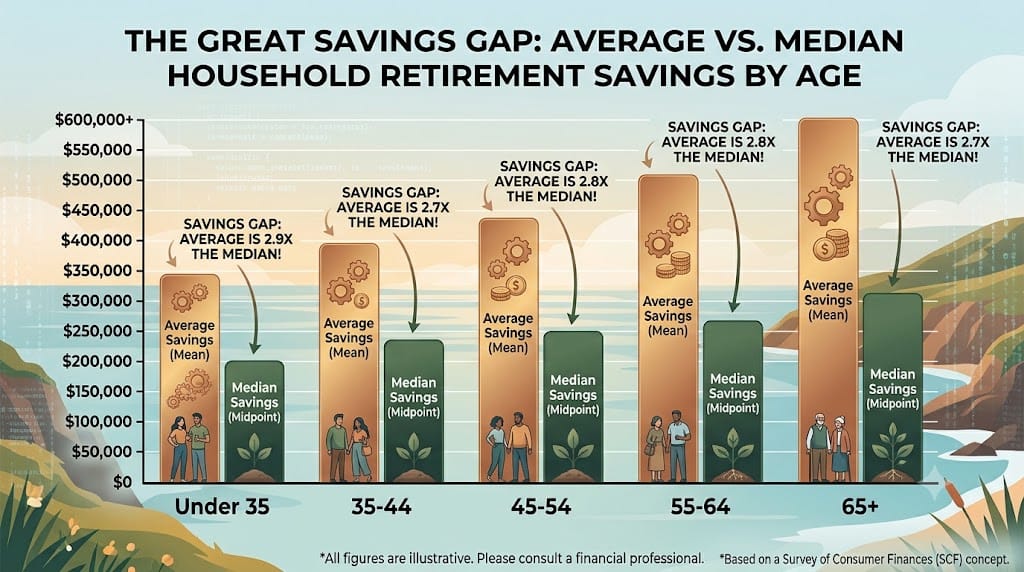
The gap between “average” and “median” here matters. Averages get pulled up by a small number of very high earners, so median is a more honest picture of where a typical household actually stands. If your number is below the median for your age group, you’re not alone, and it’s not too late to close the gap with catch-up contributions once you turn 50 and grow your nest egg faster than these averages assume.
Mistakes That Throw Off the Math
A few things I’ve seen trip people up when they run this calculation for themselves:
- Using gross income instead of spending. Your retirement number should be based on what you’ll actually spend, not what you currently earn before taxes and savings come out.
- Forgetting healthcare inflation runs hotter than general inflation. Medical costs have historically risen faster than the broader inflation rate used in most retirement calculators.
- Assuming Social Security will be there exactly as projected. It’s reasonable to plan around current benefit estimates, but it’s also smart to build in some cushion.
- Ignoring taxes on withdrawals. Money coming out of a traditional 401(k) or IRA is taxed as income, so your “gross” withdrawal number and your “spendable” number aren’t the same thing.
Key Takeaways
- Most retirement guidelines land on saving 10-12x your final salary, or enough that a 4% annual withdrawal covers your expenses after Social Security.
- The 25x rule (25 times your expected annual spending) is usually a more accurate target than a flat salary multiple, since it starts from your actual budget.
- Social Security covers a real chunk of most people’s retirement income, averaging just over $2,000 a month per retired worker as of early 2026, so your savings only need to cover the gap.
- Healthcare and inflation are the two factors people consistently underestimate when running this math themselves.
- Median household retirement savings are far below the common guidelines at every age bracket, so being behind a rule of thumb doesn’t mean you’re behind everyone else.
Frequently Asked Questions
How much money do I need to retire comfortably? Most guidelines suggest 10-12 times your final salary, or 25 times your expected annual retirement spending. Your actual number depends heavily on your spending plans, healthcare needs, and other income like Social Security.
How much should I have saved for retirement by age 40? By 50? A common benchmark is 3x your salary by 40 and 6x by 50, though actual median household savings run well below that at both ages.
Can I retire on $1 million? For many people, yes, especially if Social Security and a modest spending plan cover the rest. Using the 4% rule, $1 million supports about $40,000 a year in withdrawals before other income.
What is the 4% rule for retirement? It’s a guideline suggesting you can withdraw about 4% of your retirement portfolio in your first year of retirement, then adjust that dollar amount for inflation each year after, with a low risk of running out of money over a 30-year retirement.
How much retirement income will Social Security actually provide? The average monthly benefit for a retired worker is a little over $2,000 as of early 2026, though your actual benefit depends on your earnings history and the age you claim.
If you’re still building toward your number, it’s worth running your own numbers through a few of these methods side by side rather than anchoring on one headline figure. Bookmark this if you’re still deciding how to approach your own plan.
Disclaimer
This article is for general informational purposes only and shouldn’t be taken as financial, tax, or legal advice. Everyone’s situation is different: the income, spending, and Social Security figures I’ve used in the worked example above are illustrative, not guarantees. Before making a real retirement decision, it’s worth checking with a qualified financial advisor who can look at your specific numbers. You can also read FinToku’s full Financial Disclaimer.
Published by Saad Faisal for FinToku (fintoku.com) · Published July 15, 2026 · Updated July 15, 2026 FinToku publishes free, no-signup finance calculators and practical money guidance.