
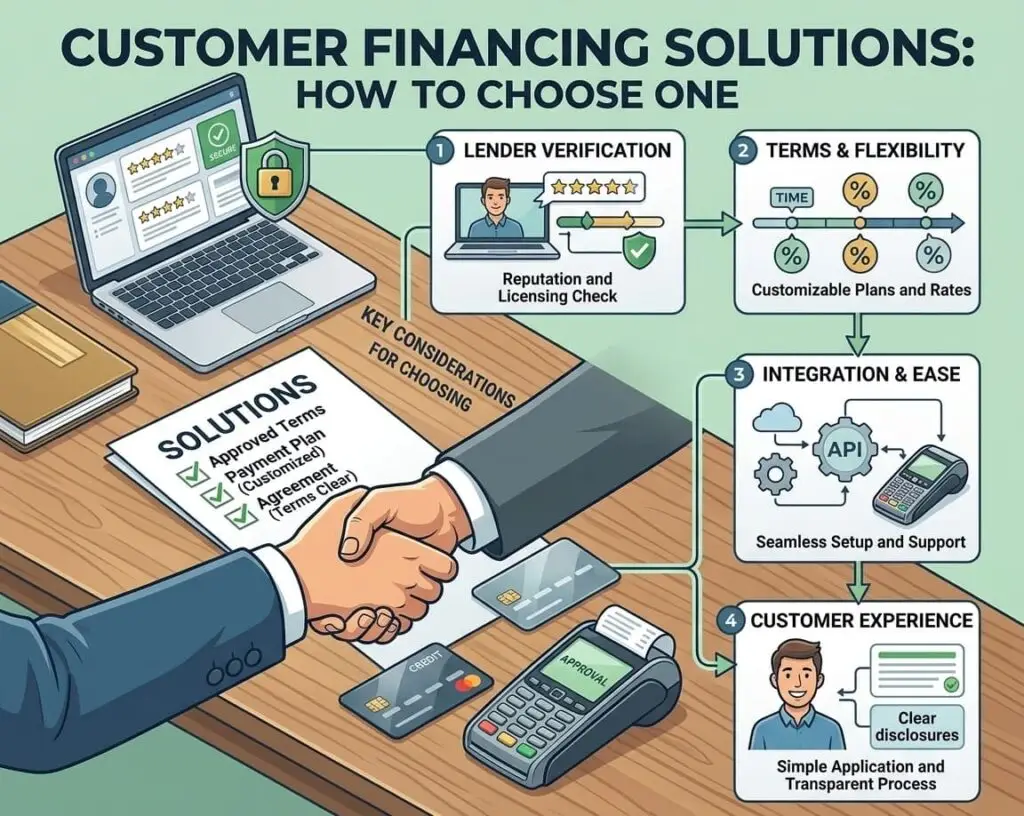
Customer financing solutions let your customers pay for a purchase over time instead of all at once, either through your own in-house payment plan or through a third-party lender who fronts you the cash and collects the payments themselves. The right setup depends mostly on how big your average sale is and how much administrative risk you’re willing to carry.
A contractor I know used to lose about one job in five right at the estimate stage. Not because his price was wrong, but because the customer couldn’t pay it all at once. He started offering third-party financing through one provider, and within two months, most of those “let me think about it” conversations turned into signed jobs.
What is customer financing, exactly?
Customer financing is a payment option that lets your customers spread the cost of a purchase across weeks, months, or years instead of paying the full amount upfront. You can run it yourself (in-house) or hand it off to a specialist lender (third-party) who takes on the credit risk and collection work in exchange for a fee.
It’s not the same thing as a small business loan for your company. This is financing for what your customers owe you, not financing for your own operations.
In-house vs. third-party financing: which one actually fits you
Here’s the honest tradeoff: in-house financing gives you full control and no fees, but you carry all the risk if someone stops paying. Third-party financing costs you a percentage per transaction, but the provider handles credit checks, approvals, and chasing down late payments.
| In-house financing | Third-party financing | |
|---|---|---|
| Who sets the terms | You do | The lender does |
| Who does credit checks | You (or nobody, which is riskier) | The lender |
| When you get paid | Whenever the customer pays | Upfront, in full, minus a fee |
| Bad debt risk | Yours | The lender’s |
| Admin workload | High (invoicing, follow-ups, collections) | Low (mostly just enrolling customers) |
| Typical cost to you | None directly, but tied-up cash and staff time | A transaction fee, often 2-4%+ |
If you’re a small operation without a dedicated bookkeeper, in-house financing usually turns into a part-time collections job you didn’t ask for. That’s why most small businesses, especially in home services, dental, and retail, lean toward a third-party provider instead.
Customer financing solutions: a quick list of companies that offer it
There’s no single “best” provider. It depends on your industry, your average ticket size, and how much of a name-brand feel you want at checkout. Here’s how the major players stack up:
| Provider | Best for | Typical terms | Notable detail |
|---|---|---|---|
| Synchrony | Retailers wanting a recognizable branded credit card | 12-60 months, varies by program | Runs both store-branded cards and CareCredit for healthcare/service providers |
| Wisetack | Home service pros (HVAC, plumbing, electrical, auto repair) | 3-60 months, 0-35.9% APR | Application takes minutes over text; no subscription fee, just a per-transaction rate |
| QuickBooks/Credit Karma financing | Existing QuickBooks Online users sending estimates | Lender-dependent | Built into QuickBooks estimates over $1,000; no cost to you, customer shops lenders in the Credit Karma marketplace |
| LendingTree (business financing marketplace) | Businesses that want to compare several lenders at once | 6-60 months, varies by lender | Aggregates multiple lenders rather than being a lender itself |
| Affirm / Klarna / Afterpay | E-commerce and retail checkout | 6 weeks to 36 months | Built for online cart flow, less common in service industries |
| CareCredit | Dental, veterinary, elective medical | 6-60 months | A Synchrony product, purpose-built for healthcare |
I ran through a few of these myself before writing this, and the split that matters most isn’t “big brand vs. small brand.” It’s whether the provider is built for your industry. A CareCredit rep isn’t going to be useful to a landscaping company, and Wisetack isn’t going to help a jewelry retailer.

What’s the best third-party financing for your customers?
This is genuinely the most common question business owners ask once they’ve decided to go the third-party route, so here’s a straight answer for a few common situations:
- You run a home service business (HVAC, roofing, plumbing, landscaping): Wisetack is built specifically for this. It integrates with tools like Housecall Pro and FieldPulse, and the application takes a couple of minutes on the customer’s phone.
- You’re a retailer wanting a branded credit card: Synchrony is the largest issuer of private-label retail credit cards in the country, so if a recognizable card matters to your brand, it’s worth a look.
- You’re already on QuickBooks Online and send estimates over $1,000: the built-in Credit Karma financing option costs you nothing extra and is already sitting in your account settings.
- You run a dental, vision, or vet practice: CareCredit exists almost entirely for this niche.
- You sell online: Affirm, Klarna, or Afterpay slot into checkout flows most e-commerce platforms already support.
None of these is “wrong.” They’re just built for different transaction sizes and sales channels.
How much does customer financing actually cost your business?
Third-party financing isn’t free, even when the marketing copy says “no cost to you.” Someone pays for the lender’s risk and infrastructure, and it’s usually baked into a transaction fee rather than a fee on your invoice.
Say you close a $4,000 job and your provider charges a 4% transaction fee. That’s $160 off the top, but you get the remaining $3,840 in your account in a day or two instead of chasing installments for a year. For a lot of small businesses, that tradeoff is worth it purely for the cash flow certainty, even before counting the sales you’d have lost without financing at all. I ran a few scenarios through FinToku’s Customer Financing Calculator before writing this, comparing in-house against third-party at a few different fee percentages, and the breakeven point moves around more than you’d expect once you plug in your own job size.

A few numbers worth asking any provider before you sign up:
- The percentage fee per transaction
- Any flat per-transaction or monthly fees
- Setup or integration costs, if any
- Minimum and maximum transaction size they’ll finance
For a rough benchmark, the CFPB has noted that merchants offering buy-now-pay-later-style financing typically pay somewhere in the 3% to 6% range of the purchase price, a useful starting point for comparison, though your actual rate depends on your industry, transaction size, and the specific provider. [NEEDS SOURCE: confirm current rates directly with each provider you’re evaluating, since these shift over time]
Does offering financing actually move the needle?
Industry data on buy-now-pay-later and point-of-sale financing generally points the same direction: customers spend more, and more of them say yes, when a payment plan is on the table. The exact percentage varies by report and industry, so treat any single figure as directional rather than gospel, but the pattern shows up consistently enough across home improvement, healthcare, and retail that it’s worth testing in your own numbers rather than dismissing outright.
If you want a primary-source read on how BNPL and installment products are tracked and regulated, the CFPB’s Buy Now, Pay Later market report breaks down loan volume, approval rates, and late-fee trends using real lender data, and the Federal Reserve’s Small Business Credit Survey tracks how small businesses actually seek and use financing year over year.
How to roll out financing without it feeling like a bait-and-switch
The businesses that get the most out of financing don’t bolt it on as an afterthought at the invoice stage. They mention it early.
- Bring it up at the estimate, not the invoice. By the time someone’s staring at a final bill, the “sticker shock” moment has already happened.
- Train your team on the actual process, not just that it exists. A salesperson who can answer “how fast do I get approved” on the spot closes more deals than one who says “I’ll have to check.”
- Put it in writing everywhere, the estimate, the follow-up email, your website. Repetition is what makes customers remember the option exists.
- Actually check your approval rates after a few months. If a big chunk of customers are getting declined, that’s a sign to add a second provider rather than assume financing “didn’t work” for your business.
Key Takeaways
- Customer financing lets your customers pay over time while you either take on the collection risk yourself (in-house) or hand it to a provider for a transaction fee (third-party).
- Third-party financing is the more common choice for small businesses because it removes the credit-check and collections workload.
- Providers are industry-specific: Wisetack for home services, Synchrony/CareCredit for retail and healthcare, Affirm/Klarna/Afterpay for e-commerce, and QuickBooks’ built-in option if you’re already using QuickBooks Online.
- Expect to pay a transaction fee (commonly in the low-to-mid single digits as a percentage) for third-party financing. Ask every provider for their exact fee structure before signing up.
- Mentioning financing early, at the estimate stage rather than the invoice, converts more sales than treating it as a last-resort offer.
Frequently Asked Questions
What’s the best third-party financing for my customers? It depends on your industry more than anything else. Wisetack fits home service businesses well, Synchrony and CareCredit suit retail and healthcare, and Affirm, Klarna, or Afterpay are built for online checkout. Match the provider to your transaction type before comparing rates.
What is customer financing and how does it work? Customer financing lets a customer pay for a purchase over time instead of all at once. With third-party financing, the provider pays you in full upfront (usually minus a fee) and then collects installment payments directly from the customer.
What types of businesses can offer customer financing? Any business with a big-ticket product or service can benefit, but it’s most common in home improvement, healthcare and dental, auto repair, and retail, anywhere a customer might hesitate at a large upfront cost.
What should I look for in a customer financing company? Look for approval rates in your customer base’s typical credit range, transaction fees that fit your margins, how fast you actually get paid, and whether it integrates with the invoicing or point-of-sale software you already use.
Is buy-now-pay-later financing only for online retailers? No. BNPL-style products have expanded well beyond e-commerce into home services, healthcare, and in-person retail, though the specific providers differ by channel.
If you’re still weighing in-house against a third-party provider, run your own numbers through FinToku’s Customer Financing Calculator before you decide. It’s worth revisiting every year or so as your average transaction size and cash flow needs change.
Disclaimer
This article is for general informational purposes only and isn’t financial or legal advice. The fee example above uses a round, illustrative number. Actual provider fees vary and change, so confirm current rates directly with any provider before enrolling. For guidance specific to your business, it’s worth talking to an accountant or financial advisor who knows your numbers. You can also read FinToku’s full Financial Disclaimer.
Written by Saad Faisal