
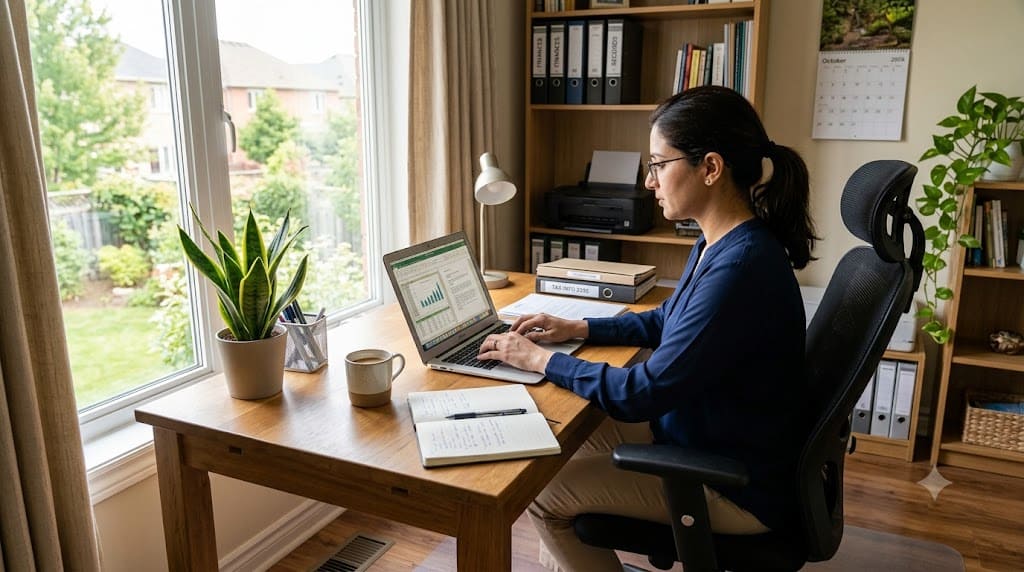
Only one group of remote workers can legally write off a home office this year, and it isn’t the one all the “work from home tax break” headlines are talking about.
If you’re self-employed, whether that’s freelancing, running a side business, or working as a 1099 contractor, you can deduct part of your home’s costs when you use a specific area regularly and exclusively for work. If you’re a W-2 employee, even one whose employer requires full-time remote work, you can’t claim it on your federal return. That restriction became permanent under the One Big Beautiful Bill Act (OBBBA), signed in July 2025.
I get some version of this question every February from freelancers who spent the whole year working out of a spare bedroom: can I actually write this off? The short answer fits in the two sentences above. The rest of this guide covers the part that trips people up: the exact tests the IRS uses, which of the two calculation methods gets you more money back, and the mistakes that turn a legitimate deduction into an audit flag.
Who Actually Qualifies for the Home Office Deduction
You qualify if you’re self-employed and you use part of your home regularly and exclusively for business. That’s the whole rule, and it’s stricter than it sounds.
You can claim it if you’re:
- A sole proprietor or single-member LLC owner
- A freelancer or independent contractor filing a 1099
- A partner in a business
- An S-corp owner, though you’ll need an accountable reimbursement plan rather than a direct Schedule C deduction, since you’re technically your corporation’s employee
You cannot claim it if you’re:
- A W-2 employee, even one working from home full time at your employer’s request
- Running a hobby rather than a genuine trade or business
- Just managing personal investments from a home desk
A handful of states, California among them, never adopted the federal change and still let W-2 employees deduct unreimbursed home office expenses on the state return. Worth checking if you’re in one of those states, since the federal answer above doesn’t automatically apply to your state filing.
The Two Tests That Actually Decide This
Regular use and exclusive use are where most claims fall apart, and they’re two different requirements, not one.
Regular use means consistent, ongoing business activity in the space, not occasional use. IRS Publication 587 puts it plainly: incidental or occasional business use isn’t regular use. There’s no minimum-hours rule. Using the space every weekday satisfies it; using it once a month for paperwork doesn’t.
Exclusive use means the space is used only for business, with no personal activity happening there at all. A guest bedroom that occasionally hosts overnight visitors fails this test, even if it’s your office nine days out of ten. So does a dining table where you work during the day and eat dinner at night.
| Scenario | Qualifies? |
|---|---|
| Dedicated spare bedroom used only as an office | Yes |
| Desk in the corner of a living room, walled off with a divider, used only for work | Yes |
| Guest bedroom with a desk that hosts visitors a few times a year | No |
| Kitchen table used for both meals and client invoicing | No |
You don’t need an entire room. A clearly defined section of a larger room qualifies, as long as that specific area sees no personal use. Two exceptions relax the exclusive-use rule entirely: storing inventory or product samples for a retail business with no other fixed location, and running a licensed daycare.
Principal Place of Business, or One of Four Alternatives
Beyond regular and exclusive use, your space has to fit at least one of five categories. The most common is being your principal place of business, meaning either you work only from home, or you handle the administrative and management side of your business at home (billing, bookkeeping, scheduling) with no other fixed location where you do that work, even if the hands-on work happens elsewhere.
The other four: a space where you regularly meet clients or patients in person, a separate freestanding structure like a detached garage or studio, a storage area for inventory in a retail business, or a licensed daycare facility.
Simplified Method vs. Regular Method: Which Gets You More
Both are IRS-approved. Neither is automatically better, and you can switch between them from year to year.
| Simplified Method | Regular Method | |
|---|---|---|
| Calculation | $5 per sq ft of office space | Actual expenses × business-use % |
| Cap | 300 sq ft, $1,500 max | No dollar cap, limited by business income |
| Paperwork | Minimal, no Form 8829 | Form 8829 required |
| Depreciation | None claimed | Claimed on business portion of home |
| Carryforward if over income limit | Not available | Available |
| Best for | Small offices, minimal recordkeeping, planning to sell soon | Larger offices, high housing costs, want the bigger deduction |
Stats as of the 2026 tax year (also applies to 2025 returns filed in 2026):
| Figure | Amount | Source |
|---|---|---|
| Simplified method rate | $5 / sq ft | IRS Rev. Proc. 2013-13 |
| Simplified method cap | 300 sq ft ($1,500 max) | IRS Rev. Proc. 2013-13 |
| Home depreciation period (regular method) | 39 years, straight-line | IRS Publication 587 |
| SALT deduction cap (affects Schedule A property tax) | $40,000 (2025), $40,400 (2026) | Reported by multiple 2026 filings guides |
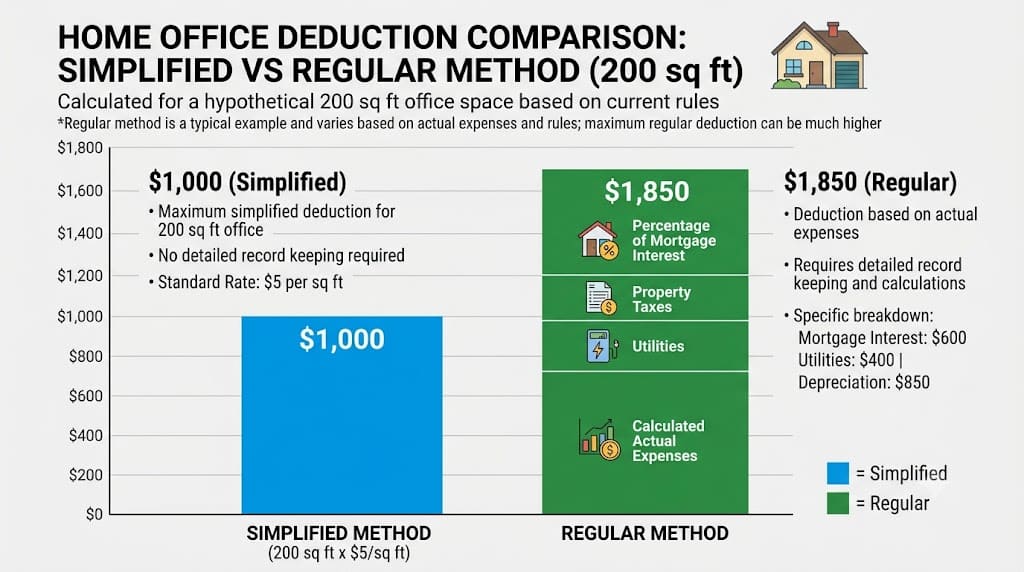
Simplified method, worked example: A 200 square foot office comes out to 200 × $5, or a $1,000 deduction. No utility bills, no mortgage statements, no Form 8829.
Regular method, worked example: A 300 square foot office in a 2,000 square foot home is 15% business use. Apply that percentage to $12,000 in mortgage interest, $4,000 in property taxes, $1,500 in insurance, and $3,000 in utilities, add roughly $769 in annual depreciation on a $200,000 home basis, and the total lands around $4,600, several times the simplified cap.
The regular method usually wins on larger offices or expensive housing costs. The tradeoff is depreciation recapture: when you eventually sell, the IRS taxes back the depreciation you claimed, at up to 25%. The simplified method sidesteps that entirely since it claims zero depreciation.
Can Renters Claim It? What About W-2 Remote Workers?
Renters qualify the same way owners do. You deduct the business percentage of rent, renters insurance, and utilities under the regular method, or take the flat $5 per square foot rate either way. Renters often do better on the regular method since rent is fully allocable and there’s no depreciation recapture to think about down the line.
For W-2 employees, the workaround isn’t a workaround on your personal return at all. Ask your employer for an accountable-plan reimbursement, which is tax-free to you and deductible for them. Or, if you run a side business from a separate qualifying space, claim the deduction against that Schedule C income instead of your W-2 wages.
Common Mistakes That Get This Deduction Denied
- Mixing personal and business use. Watching TV in your “office” at night undoes the exclusive-use test, even if you worked there all day.
- Claiming your whole apartment. A one-bedroom unit claimed entirely as office space, with nowhere left to sleep, doesn’t hold up.
- Skipping documentation. No measurements, no photos, no floor plan. This is one of the more frequently scrutinized deductions, and thin records are the first thing that falls apart under a closer look.
- W-2 employees claiming it anyway, often because they misread an old article that predates the 2018 change.
- Ignoring the gross income limitation. Under both methods, the deduction can’t exceed your business’s gross income. Only the regular method lets you carry the excess forward.
Record-Keeping That Actually Protects You
Keep a simple floor plan with measurements, dated photos of the setup, and a calendar or log showing regular use if anyone ever asks. For the regular method, add twelve months of mortgage or rent statements, utility bills, and insurance premiums. Retain general records for three years from filing, and depreciation-related records for three years after you sell the home.
Run your own square footage and expenses through FinToku’s federal income tax calculator before you decide which method to use. Seeing the actual dollar difference on your return makes the choice a lot easier than working it out on paper.
Key Takeaways
- The home office deduction is only available to self-employed people, freelancers, and business owners. W-2 remote employees can’t claim it, and the OBBBA made that permanent as of July 2025.
- Your space must pass two tests: regular use (consistent, not occasional) and exclusive use (no personal activity in the space at all).
- The simplified method deducts $5 per square foot up to 300 sq ft, capped at $1,500. The regular method deducts actual expenses times your business-use percentage, with no dollar cap but more paperwork.
- Renters qualify identically to homeowners; rent simply replaces mortgage interest in the calculation.
- You can switch between the simplified and regular method each year, so it’s worth calculating both before filing.
Frequently Asked Questions
Can I claim the home office deduction if I work from home as a W-2 employee? No. The 2018 Tax Cuts and Jobs Act suspended this for employees, and the One Big Beautiful Bill Act made that suspension permanent starting with the 2025 tax year. Ask your employer about an accountable-plan reimbursement instead, or check whether your state still allows it.
What’s the difference between the simplified and regular method? The simplified method deducts $5 per square foot of office space, capped at $1,500, with no Form 8829 required. The regular method calculates actual home expenses times your business-use percentage, with no dollar cap but more recordkeeping and a required Form 8829.
Do I need a whole separate room to qualify? No. A clearly defined section of a larger room, like a desk in the corner of a living room separated by a divider, qualifies as long as that specific area is used only for business.
Can I switch methods from one year to the next? Yes. You elect a method each year on your return, and there’s no penalty for switching. If you move from simplified to regular after skipping depreciation, there are specific rules for calculating the transition, so it’s worth checking Publication 587 or a tax professional before you switch back and forth repeatedly.
Does claiming a home office increase my audit risk? It’s historically been one of the more scrutinized deductions, largely because of poor documentation rather than the claim itself. Sole proprietor audit rates have generally run near or below 1% in recent years, and solid records (measurements, photos, a floor plan) protect you if the IRS does ask questions.
Bookmark this page if you’re still deciding between methods. It’s worth running the numbers both ways before you file.
Read More
Disclaimer
This article is for general informational purposes only and shouldn’t be taken as tax or legal advice. The square footage and expense figures used in the examples above are illustrative, not your actual numbers. Before claiming this deduction, it’s worth checking with a qualified tax professional who can look at your specific home office setup and business structure. You can also read FinToku’s full Financial Disclaimer.
Published by Saad Faisal for FinToku (fintoku.com) · Published July 23, 2026 · Updated July 23, 2026 FinToku provides free finance tools and guides to help you make smarter money decisions.