

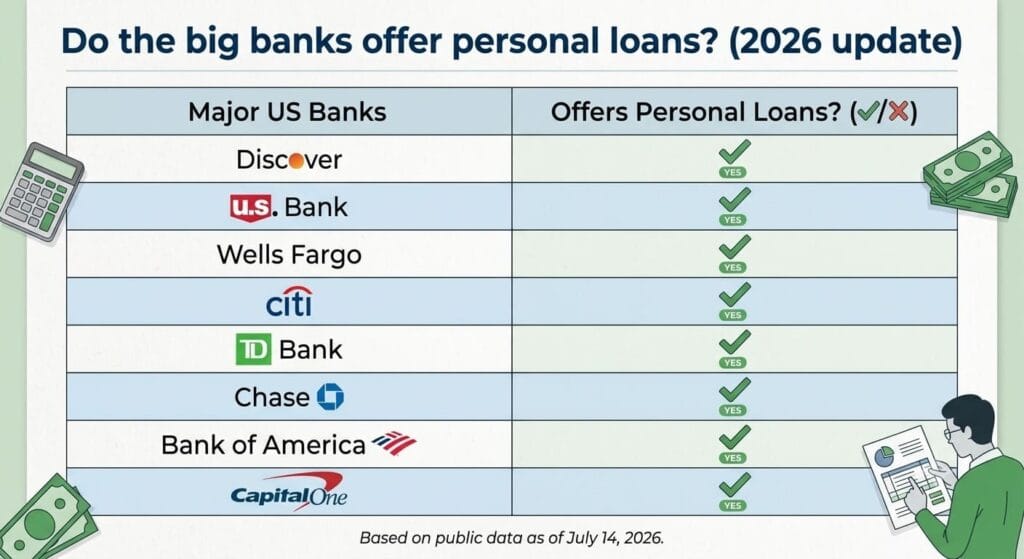
Here’s the direct answer: a handful of banks — Discover, U.S. Bank, Wells Fargo, Citi, TD Bank, and Happen Bank (the rebranded LendingClub) — issue personal loans directly, with rates roughly between 7% and 25% APR depending on credit. Three of the biggest names in American banking, Chase, Bank of America, and Capital One, don’t offer personal loans at all, no matter how good your credit is or how long you’ve banked with them.
Which big banks actually offer personal loans (and which don’t)
This is the part most comparison sites bury a few thousand words in, and it trips up a lot of people who assume their everyday bank must have this product somewhere.
Banks that offer personal loans: Discover, U.S. Bank, Wells Fargo, Citi, TD Bank, PNC, American Express, Fifth Third Bank, KeyBank, and Happen Bank.
Banks that don’t offer personal loans, at all, currently: Chase, Bank of America, and Capital One. None of these three banks currently offer personal loans, and there are several structural reasons why it doesn’t make financial or administrative sense for them to add the product back. Chase does have a workaround for existing cardholders called My Chase Loan, which lets you borrow against your card’s available credit at a lower APR than your card’s standard rate, without a new credit check — but that’s a credit-line draw, not a traditional installment loan.
Bank of America is similar. It skips personal loans entirely and focuses on credit cards, mortgages, auto loans, and business loans instead. Capital One used to run a personal loan business and quietly wound it down — today it only offers auto, small business, and commercial loans, and if you want a personal loan through the company you technically now bank with, you’d apply through Discover, which Capital One acquired in 2025, not Capital One directly.
Best banks for personal loans in 2026, compared
| Bank | Best for | APR range | Loan amounts | Existing customer required? |
|---|---|---|---|---|
| Discover | Overall / no fees | Competitive, no origination fee | Up to $50,000 | No |
| U.S. Bank | Small loans | Competitive; no major fees | $1,000–$50,000 | No, but better terms for customers |
| Wells Fargo | Large loan amounts | ~6.74%–25.99% | $3,000–$100,000 | Yes, 12+ months |
| Citi | Rate discounts | Varies with relationship discounts | Varies | Existing customers get better pricing |
| TD Bank | East Coast branch access | Varies | Varies | No pre-qualification option |
| Happen Bank (formerly LendingClub) | Debt consolidation | Varies | Varies, pays up to 12 creditors directly | No |
| American Express | Low-APR, card-based | 6.99%–19.97% | Varies | Must have an Amex card + pre-approval |
A few things stand out once you line these up side by side. U.S. Bank is one of the few large, traditional banks that still offers personal loans, though they’re only available to existing customers who’ve had an account open for at least four months. Wells Fargo is the opposite kind of restrictive — it offers up to $100,000 in funding with same-day payout once approved, but applicants must already have another Wells Fargo account open for at least 12 months before they’re even eligible.
If none of the big names fit, don’t stop looking at “banks” as the only category. PenFed, a federal credit union anyone can join, offers a competitive starting APR with no origination fees, and Discover’s rate profile stays strong across the board, according to Money’s most recent roundup.
What personal loan rates actually look like right now
I’ll be straight with you: headline rates on lender homepages are almost always the best-case number, reserved for the most creditworthy applicants, not what a typical borrower gets approved for.
The typical personal loan APR range runs from about 8% to 36%, averaging 12.16% across lenders tracked by Bankrate, and the average rate on a two-year, bank-issued personal loan sat at 11.40% as of February 2026, according to the Federal Reserve’s G.19 Consumer Credit release. That Fed number is the one worth trusting over any single lender’s advertised “starting at” rate, since it reflects what banks across the country are actually charging, not just their best offer.
Credit unions tend to beat both banks and online lenders on price. The national average rate for a three-year personal loan at a credit union was 10.72% in the third quarter of 2025, noticeably below the bank average, and federal credit unions are legally capped at an 18% maximum rate under NCUA rules — a real ceiling banks and online lenders simply don’t have.
One thing that surprised me digging into this: rate cuts from the Fed don’t move personal loan pricing the way you’d expect. Since September 2024, the Fed has cut its benchmark rate by more than a full percentage point, yet the average personal loan rate has only dropped about 15 basis points, since demand for these loans doesn’t really shrink or grow with what the Fed does. So don’t wait for a Fed meeting to “fix” your rate — shop the lenders you actually qualify for today.
Bank loans vs. credit unions vs. online lenders
| Banks | Credit unions | Online lenders | |
|---|---|---|---|
| Typical rate range | ~7%–26% | ~9%–18% (capped) | ~6%–36% |
| Speed to fund | 1–5 business days, some same-day | A few days, in-person option | Often same-day to next-day |
| Best for | Existing customers, large amounts | Members with fair-to-good credit | Fast funding, thinner credit files |
| Membership/relationship required | Sometimes | Yes, always | No |
Should you get a personal loan from a bank?
A bank loan makes the most sense when you already bank there, your credit is solid, and you want a large, single lump sum with a predictable fixed payment — debt consolidation, a big home repair, or a wedding are the classic use cases. Lenders generally want to see a reliable income source and a credit score above roughly 670, though requirements vary by lender, and some will work with fair or bad credit at a steeper rate.
It’s a weaker fit if you’re not already a customer of one of the banks that lends (Wells Fargo and Citi, in particular, favor existing relationships), if you need the money today rather than in a few business days, or if your credit is thin. In those cases, an online lender or a credit union you can join usually beats waiting on a bank’s underwriting.
One thing I’d flag before you refinance anything into a personal loan: if you’re consolidating student debt, don’t fold federal loans into a private personal loan without thinking it through first — you permanently give up federal protections like income-driven repayment and Public Service Loan Forgiveness eligibility the moment you do, and there’s no undoing it once it’s done.
How to actually get a bank personal loan
- Check your credit score and report first. Knowing your number before you apply tells you which lenders are realistic and which will just waste a hard inquiry.
- Pre-qualify with 2–3 lenders. Pre-qualification uses a soft credit pull, so you can preview your likely APR without it touching your score.
- Compare the full offer, not just the rate. Origination fees, autopay discounts, and repayment length all change the real cost — a longer repayment term lowers your monthly payment but increases the total interest you pay over the life of the loan.
- Submit the formal application with your chosen lender once you’ve picked the best offer.
- Review the final terms carefully before you sign, especially the APR, any origination fee, and the exact payment date.
Run your own numbers before you commit to anything — a rate that looks fine on a lender’s homepage can look different once you drop in your actual loan amount and term. FinToku’s Currency Converter is handy if you’re comparing a loan offer against savings or income you’re tracking in a different currency, but for the loan math itself, any lender’s own calculator (most of the ones above have one) will show your real monthly payment fastest.
Key Takeaways
- Chase, Bank of America, and Capital One don’t offer personal loans at all in 2026 — if you bank with one of them, you’ll need to look elsewhere for this product.
- Discover, U.S. Bank, Wells Fargo, Citi, TD Bank, and Happen Bank (formerly LendingClub) are among the banks that do issue personal loans directly.
- The average personal loan rate from a bank was 11.40% as of February 2026 per Federal Reserve data, while credit unions averaged 10.72% and are capped at 18%.
- Wells Fargo and Citi generally favor existing customers with rate discounts and eligibility perks; U.S. Bank and Discover are more open to new applicants.
- Pre-qualifying with a soft credit check lets you compare real rates from several lenders before a single hard inquiry touches your credit score.
Frequently Asked Questions
Does Bank of America offer personal loans? No. Bank of America doesn’t offer personal loans and instead focuses on credit cards, mortgages, auto loans, and business loans.
Can I get a personal loan from Chase? No, not a traditional one. Chase doesn’t offer personal loans, though existing cardholders may qualify for My Chase Loan, which borrows against your card’s available credit at a lower rate than the card’s standard APR.
What’s a good interest rate for a personal loan right now? Anything meaningfully below the current average is a good sign. The average personal loan rate was 12.28% as of June 2026, so a rate in the single digits generally means you’re getting one of the better offers on the market for your credit tier.
Are credit unions cheaper than banks for personal loans? Usually, yes. Credit unions averaged 10.72% on a three-year personal loan versus higher averages at banks, and federal credit unions can’t legally charge more than 18%, which acts as a real ceiling banks don’t have.
How much can I borrow from a bank personal loan? It depends heavily on the lender. U.S. Bank offers loans as small as $1,000, while Wells Fargo goes up to $100,000 for well-qualified, existing customers.
Still deciding between a couple of offers? Bookmark this page — bank personal loan rates and eligibility rules shift often enough that it’s worth a second look before you sign anything.
Disclaimer
This article is for general informational purposes only and isn’t financial or lending advice. Rates, fees, and eligibility rules mentioned above change often and vary by lender, credit profile, and state — the specific APR ranges I’ve cited here were current as of their source dates but should be confirmed directly with the lender before you apply. For a full picture, see FinToku’s Financial Disclaimer.
By Saad Faisal · Published July 13, 2026