

This glossary defines the 40+ banking terms U.S. customers run into most, from checking accounts and APY to FDIC insurance and overdraft fees, each explained in one to three plain-English sentences with a real-world example, and grouped by everyday accounts, fees, interest, credit and mortgages, and regulation so you can jump straight to the term you need.
Banking language is full of words that sound simple but aren’t defined anywhere obvious. Here’s a plain-English glossary of the terms you’ll actually run into as a U.S. bank customer, grouped so you can jump to what you need.
Everyday accounts
Checking account. The account you use for daily spending: paying rent, swiping a debit card, writing the occasional check. Most checking accounts pay little to no interest, which is the tradeoff for easy access to your money.
Savings account. A deposit account meant for money you’re not touching every week. It earns interest, though the national average is lower than most people expect (more on that below).
Money market account (MMA). A hybrid between checking and savings. It usually pays a better rate than a basic savings account and may come with check-writing privileges, but often requires a higher minimum balance.
Certificate of deposit (CD). You lock up a lump sum for a fixed term, say 12 months, at a fixed rate. Pull the money out early and you’ll usually eat a penalty worth a few months of interest.
Demand deposit account (DDA). The technical name for an account where you can withdraw funds anytime without giving the bank advance notice. Checking accounts are the most common example.
Direct deposit. Your paycheck (or a tax refund, or benefits payment) landing in your account electronically instead of as a paper check.
Routing number. A nine-digit code that identifies your specific bank. You’ll need it alongside your account number for direct deposit or setting up bill pay.
ACH transfer. Short for Automated Clearing House, the network banks use to move money electronically between accounts. Direct deposit and most bill payments run through ACH.
Wire transfer. A faster, more direct way to move money, usually same-day, often used for larger transactions like a home down payment. Wires typically carry a fee; ACH transfers usually don’t.
Balances, overdrafts, and fees
Available balance. What you can actually spend right now, after pending transactions and holds are factored in. It’s often lower than your account’s stated total.
Ledger balance. Also called your actual or current balance. It only reflects transactions that have fully settled, not the ones still pending.
Overdraft. Spending more than what’s in your account. The bank covers the difference, then charges you a fee, sometimes over $30 per transaction, for the privilege.
NSF (non-sufficient funds). What happens when a payment is rejected outright because there isn’t enough money to cover it, rather than the bank covering the shortfall. Both overdraft and NSF fees are things I’d budget hard to avoid; they add up fast if you’re living close to the edge of your balance.
Minimum balance. The lowest amount you’re required to keep in an account to avoid a monthly service fee.
Maintenance fee. A recurring charge, often monthly, just for holding the account. Many banks waive it if you meet a minimum balance or set up direct deposit.
Interest and rates
APY (annual percentage yield). The real return you earn on a deposit account over a year, including the effect of compounding. This is the number to compare when shopping for savings accounts, not the plain interest rate.
APR (annual percentage rate). The cost of borrowing over a year, expressed as a percentage, including most fees. Used for loans and credit cards. APY and APR sound alike but measure opposite things: one is what you earn, the other is what you pay.
Compound interest. Interest calculated on both your original deposit and any interest you’ve already earned. A $1,000 deposit at 5% APY earns $50 in year one; in year two, you earn 5% on $1,050, not just the original $1,000.
Simple interest. Interest calculated only on the original principal, with no compounding. More common in some personal loans than in deposit accounts.
Fixed rate. An interest rate that stays the same for the life of the loan or account term.
Variable (adjustable) rate. A rate that can move up or down over time, usually tied to a benchmark like the prime rate.
Loans, credit, and mortgages
Principal. The original amount borrowed (or deposited), not counting interest.
Collateral. An asset, like a car or a house, pledged to secure a loan. Default on the loan and the lender can seize it.
Credit score. A three-digit number, typically 300 to 850, that lenders use to gauge how risky it is to lend you money. FICO is the most widely used scoring model in U.S. lending.
Credit report. The underlying record of your borrowing and repayment history that your credit score is calculated from.
Debt-to-income ratio (DTI). Your total monthly debt payments divided by your gross monthly income. Mortgage lenders lean on this heavily when deciding how much they’ll let you borrow.
Cosigner. Someone who signs onto your loan and becomes equally responsible for repaying it if you don’t. It helps you qualify, but it puts their credit on the line too.
Amortization. The process of paying down a loan through scheduled payments that cover both interest and principal, structured so the balance hits zero by the end of the term.
Balloon payment. A large lump-sum payment due at the end of certain loans, after a series of smaller payments that didn’t fully pay off the balance.
HELOC (home equity line of credit). A revolving credit line secured by the equity in your home. If your house is worth $300,000 and you owe $200,000, you likely have $100,000 in equity to borrow against, minus whatever cushion the lender requires.
Escrow. An account, usually tied to a mortgage, that holds funds for property taxes and homeowners insurance so they get paid on time.
Safety, regulation, and digital banking
FDIC (Federal Deposit Insurance Corporation). A federal agency that insures deposits at member banks, protecting your money up to $250,000 per depositor, per bank, per ownership category, even if the bank fails.
NCUA (National Credit Union Administration). The credit union equivalent of the FDIC. It insures deposits at federally insured credit unions, also up to $250,000.
The Fed (Federal Reserve). The central bank of the United States. It sets the federal funds rate, which ripples out to influence everything from mortgage rates to what your savings account pays.
ChexSystems. A reporting agency banks check before opening a new account, similar in spirit to a credit bureau but focused on your history of overdrafts, unpaid fees, and closed accounts in bad standing.
Two-factor authentication (2FA). A login step that requires something beyond your password, usually a code sent to your phone, to confirm it’s really you accessing your account.
Mobile deposit. Depositing a check by photographing it in your bank’s app instead of visiting a branch or ATM.
EMV chip. The small metallic chip on debit and credit cards that encrypts transaction data, making it harder to clone your card than with the old magnetic stripe alone.
Current U.S. deposit rates (as of June 2026)
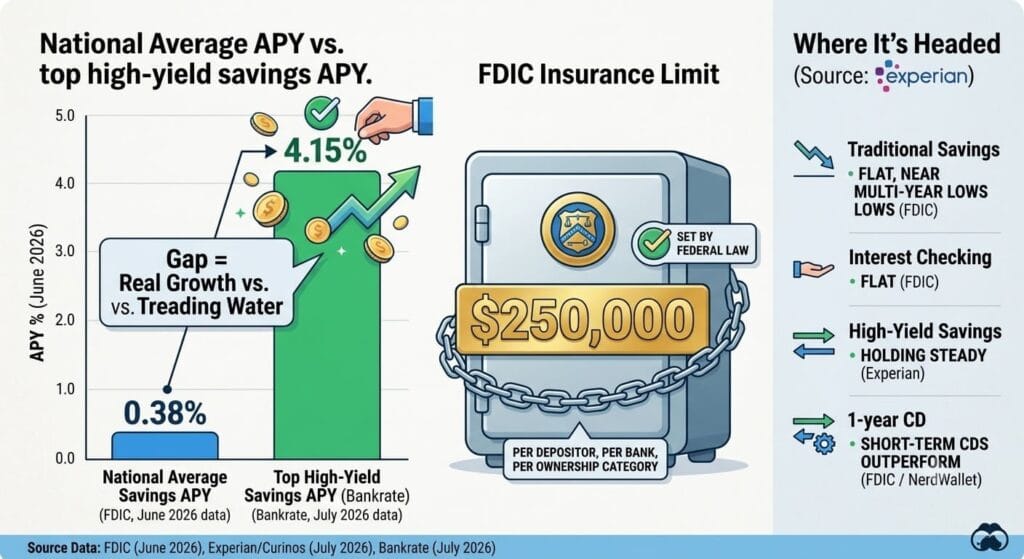
Rates change constantly, so treat this as a snapshot rather than something to bank on long-term. As of June 2026, the FDIC puts the national average savings account rate at 0.38% and the national average interest checking rate at just 0.07%.
| Account type | National average APY | Where it’s headed | Source |
|---|---|---|---|
| Traditional savings | 0.38% | Flat, near multi-year lows | FDIC, June 2026 |
| Interest checking | 0.07% | Flat | FDIC, June 2026 |
| High-yield savings | ~1.60% avg, up to 4%+ at top online banks | Holding steady after 2024-2025 declines | Curinos data via Experian, July 2026 |
| 1-year CD | ~1.65%-2.49% (varies by data source) | Short-term CDs outperforming longer terms | FDIC / NerdWallet, 2026 |
| FDIC insurance limit | $250,000 per depositor, per bank, per ownership category | Set by federal law, not market-driven | FDIC.gov |
As of July 2026, Bankrate’s top-tracked savings rate sits around 4.15% APY, roughly six times the national average, so the gap between what a traditional bank pays and what an online bank pays on the exact same deposit is often the difference between real growth and treading water.
If you’re also weighing how these accounts affect your tax picture, FinToku’s Currency Converter is handy if you’re moving money across borders, and business owners juggling U.S. accounts should check FinToku’s US Business Federal Income Tax Calculator before assuming interest income won’t move the needle on what you owe.
If you want a deeper, ground-up primer beyond a glossary, [AMAZON AFFILIATE LINK: personal finance basics book] is one I’d point a total beginner toward. Heads up, that’s a link I may earn a small commission on if you buy through it; FinToku’s affiliate disclosure has the full details.
Key Takeaways
- APY measures what you earn on deposits, APR measures what you pay on loans. They’re not interchangeable, even though they sound similar.
- The FDIC and NCUA both insure deposits up to $250,000 per depositor, per institution, per ownership category, whether your money sits in a bank or a credit union.
- The national average savings rate sits far below what high-yield online savings accounts pay, often by 5 to 10 times.
- Overdraft and NSF fees are two different things: one covers a shortfall for a fee, the other rejects the transaction outright.
- Your credit score and credit report are related but distinct: the report is the record, the score is the number calculated from it.
Frequently Asked Questions
What’s the difference between APY and APR? APY is what you earn on a deposit account, including compounding. APR is what you pay to borrow, including most fees. A higher APY is good for you as a saver; a higher APR is bad for you as a borrower.
Is my money safe if my bank fails? Yes, up to the insured limit. FDIC-insured banks and NCUA-insured credit unions both protect deposits up to $250,000 per depositor, per institution, per ownership category.
What’s a good average savings account rate right now? As of mid-2026, the national average sits around 0.38% APY, but competitive high-yield savings accounts pay well above 1.60% on average, with some top offers over 4%.
Why did I get charged an overdraft fee instead of the transaction just being declined? It depends on whether you opted into overdraft coverage for that transaction type. Without it, many debit transactions get declined instead (an NSF situation); with it, the bank covers the gap and charges a fee.
What is ACH and is it safe? ACH is the electronic network U.S. banks use to move money for direct deposit, bill pay, and transfers between accounts. It’s a standard, heavily regulated system used by virtually every bank in the country.
If any of these terms showed up on a recent statement and you’re still not sure what it means for your actual balance, that’s worth a quick call to your bank rather than guessing. It’s a five-minute conversation that can save you a fee down the line.
Disclaimer
This article is for general educational purposes only and isn’t financial, tax, or legal advice. Rates, fees, and insurance limits mentioned here can change, and your specific bank’s terms may differ from the national averages cited. See FinToku’s full financial disclaimer for more.
Published by Saad Faisal for FinToku (fintoku.com) FinToku publishes free, no-signup finance calculators and practical money guidance.
Read more
- FDIC: Glossary of Banking Terms and Phrases: the federal government’s own plain-English banking glossary
- FDIC: National Rates and Rate Caps: the source data behind current deposit rate averages
- Federal Reserve: How the Fed sets interest rates: background on how Fed policy filters down to savings and loan rates
- NerdWallet: Average Bank Interest Rates for Savings Accounts, CDs and More: up-to-date rate comparisons across account types
- Consumer Financial Protection Bureau (CFPB): for complaints, disputes, and consumer protection basics not covered here
By Saad Faisal · Published July 13, 2026 · Updated July 13, 2026