
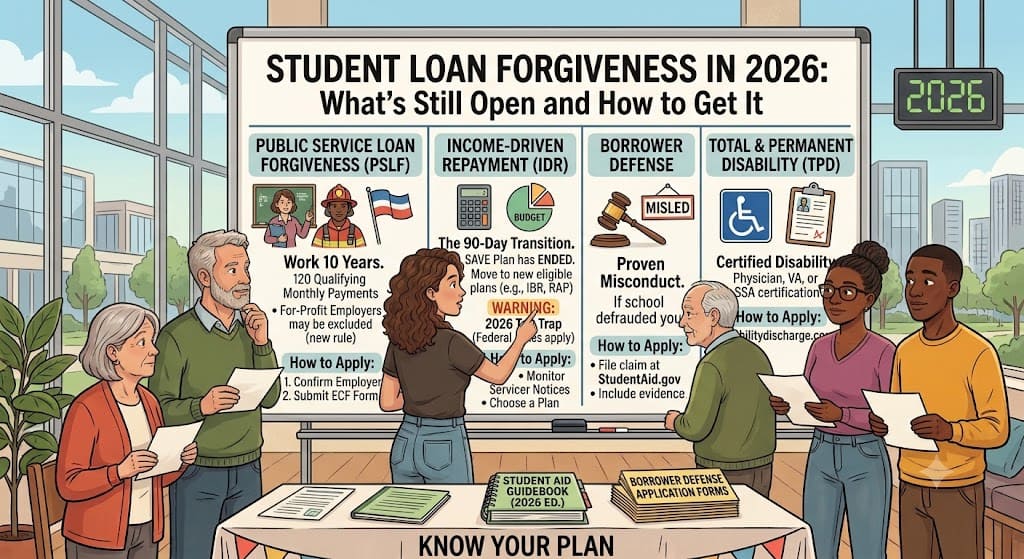
Student loan forgiveness is not dead in 2026. Public Service Loan Forgiveness, income-driven repayment forgiveness, borrower defense, and disability discharge are all open and processing applications right now. What changed this year is which repayment plan gets you there, how long it takes, and whether you’ll owe taxes on what’s forgiven.
Search “student loan forgiveness” right now, though, and you’ll hit a wall of contradictory headlines. Some say it’s dead. Some say Trump just approved it. Some say the courts killed it back in 2023. Almost none of them agree, and that’s exactly the problem: most of these stories are talking about one narrow slice of a much bigger system, then writing the headline as if it covers everything. Here’s what’s actually true, program by program.
What Is Student Loan Forgiveness?
Student loan forgiveness is when the federal government cancels part or all of your remaining federal loan balance. You no longer have to pay it back, but it’s not automatic. You qualify by meeting a specific program’s rules. That might be your job, your repayment plan, or your loan history, and then you apply.
That last part trips a lot of people up: forgiveness and discharge aren’t quite the same thing. Forgiveness cancels whatever balance is left after you’ve met the requirements. Discharge (for disability, a closed school, or your school defrauding you) can sometimes also refund payments you already made. Small distinction, but it matters when you’re figuring out which program actually fits your situation.
Did Trump Approve Student Loan Forgiveness?
No, not in the sense most people mean when they ask this. There’s no new broad, across-the-board cancellation program in 2026. What did happen under the current administration is the One Big Beautiful Bill Act (OBBBA), signed July 4, 2025. It restructured the existing forgiveness system: phasing out SAVE, PAYE, and ICR, and creating a new plan called RAP. That’s a change to how forgiveness works, not a new forgiveness program being “approved.”
If you’re specifically looking for the Biden-era cancellation, that’s a different story, and it’s worth clearing up on its own.
What Happened to Biden’s Student Loan Forgiveness?
The one-time debt relief Biden announced, up to $10,000, or $20,000 for Pell Grant recipients, is closed. It isn’t coming back. Tens of millions of people applied in late 2022. The Supreme Court struck it down in June 2023, and a second, narrower attempt never got off the ground. If that’s the application you’ve been waiting on, you’re waiting on a form that no longer exists.
What’s still there instead: PSLF, IDR forgiveness through IBR, borrower defense, and disability discharge. Those were never part of that legal fight. They’re where your time actually goes now.
Do Student Loans Get Wiped After 25 Years?
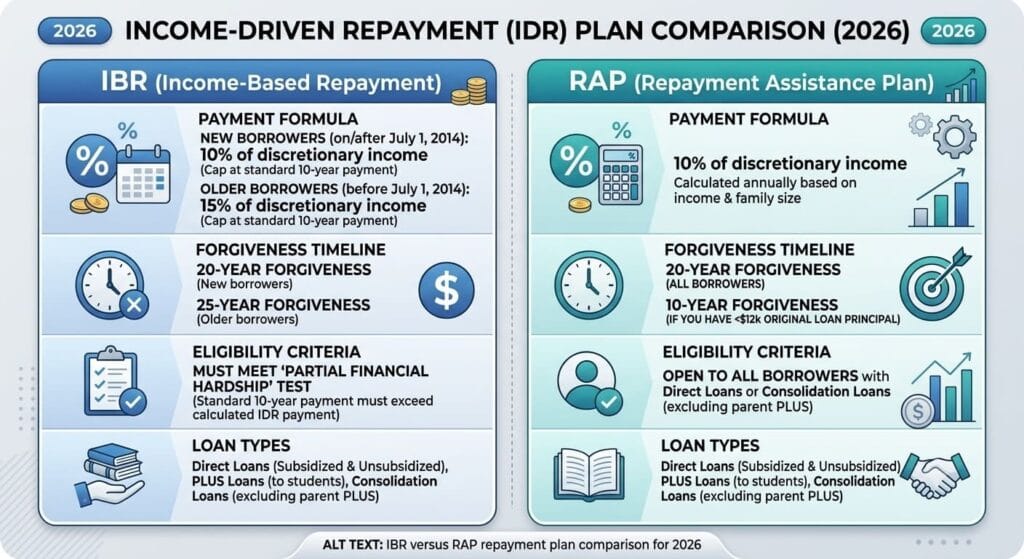
Sometimes, yes, but the exact number depends on your plan and when you borrowed. Under IBR, you get forgiveness after 20 years if you first borrowed on or after July 1, 2014. It’s 25 years if you borrowed before that. Under the new RAP plan, forgiveness doesn’t happen until 30 years. There’s no plan left that forgives anything sooner than 20 years unless you’re on PSLF, which forgives after 10.
What Actually Changed in 2026
Three things happened almost at once this year, and together they explain most of the confusion I hear from readers.
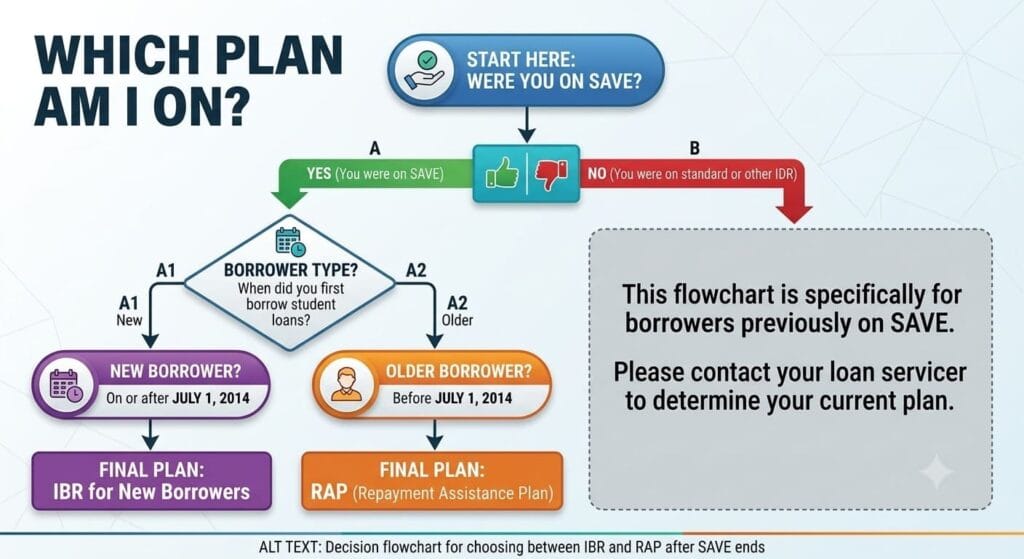
The SAVE plan is gone. A federal court vacated it in March 2026, and the Department of Education began notifying the 7.5 million enrolled borrowers in late March. If you were on SAVE, months spent in the administrative forbearance since August 2025 haven’t been counting toward forgiveness. Switching plans isn’t optional. It’s the only way to keep earning credit.
RAP launched July 1, 2026. It’s a brand-new income-driven plan created by OBBBA, and it’s the only income-driven option for anyone taking out a new federal loan after that date.
The tax-free window on forgiven debt closed. The pandemic-era exclusion that made forgiven student debt tax-free expired December 31, 2025. That means IDR forgiveness processed from 2026 onward can come with a tax bill, unless you qualify for an exception. More on that below, because it’s genuinely the part most guides gloss over.
Where things stand, plan by plan
| Plan | Monthly payment | Forgiveness timeline | Who it’s for |
|---|---|---|---|
| PSLF | Based on your IDR plan | 10 years | Government or 501(c)(3) nonprofit employees |
| IBR (new) | 10% of discretionary income | 20 years | Borrowed on/after July 1, 2014 |
| IBR (old) | 15% of discretionary income | 25 years | Borrowed before July 2014 |
| RAP | 1-10% of adjusted gross income | 30 years | New borrowers after July 1, 2026, or anyone who opts in |
| PAYE / ICR | 10-20% of discretionary income | 20-25 years | Existing enrollees only, phasing out by July 1, 2028 |
As of July 2026, per Federal Student Aid program rules.
Public Service Loan Forgiveness (PSLF): Still the Best Deal Going
PSLF cancels your remaining Direct Loan balance, tax-free, after 120 qualifying monthly payments (about 10 years) while you work full-time for a government agency or 501(c)(3) nonprofit. The average PSLF discharge has come out to roughly $78,000. Nothing else on this list gets close to that speed or that payoff.
To qualify, you need all four of these at once:
- Direct Loans only. You’ll need to consolidate FFEL and Perkins loans into a Direct Consolidation Loan first. Consolidating resets your payment count if you’re mid-way through.
- A qualifying employer. Government at any level, or a 501(c)(3) nonprofit, working at least 30 hours a week.
- A qualifying repayment plan. Any IDR plan works, including the new RAP. The standard 10-year plan technically counts too, but there’s usually nothing left to forgive by year 10 on that plan.
- 120 on-time, full payments, made after October 1, 2007, while you’re actually working for the qualifying employer.
One 2026 wrinkle worth knowing: starting July 1, the Department of Education can disqualify employers it finds were organized for a “substantial illegal purpose.” If you work for a smaller or newer nonprofit, it’s worth re-checking your employer’s status through the PSLF Help Tool rather than assuming last year’s certification still holds.
Certify your employment every year, not just at the end. It catches payment-count errors early instead of at the finish line. A denial at year 9 is a lot more fixable than one you discover at year 10.
Income-Driven Repayment Forgiveness: IBR vs. RAP
If PSLF doesn’t apply to you, income-driven repayment (IDR) forgiveness is the other main path. In 2026, it comes down to a choice between two plans that work pretty differently.
IBR: the faster path, if you can still get in
IBR caps your payment at 10% or 15% of your discretionary income (income above 150% of the poverty line for your family size) and forgives what’s left after 20 or 25 years. It’s only open to borrowers with loans disbursed before July 1, 2026. You also have to enroll before July 1, 2028, or it closes to you permanently.
RAP: the newer, slower, but wider-open option
RAP caps your payment at 1% to 10% of your adjusted gross income instead of discretionary income, waives unpaid interest each month so your balance doesn’t grow, and forgives the rest after 30 years. It’s open to everyone with eligible Direct Loans, but it’s your only option if you borrow anything new after July 1, 2026.
Say you’re earning $45,000 a year as a single filer. Under new IBR, your discretionary income works out to roughly $22,500. That’s $45,000 minus 150% of the poverty line, so 10% puts your payment around $187 a month. Under RAP, the calculation runs off your full $45,000 instead, scaled to your income bracket. For most people in that range, it lands somewhere between $150 and $250 a month, depending on the exact bracket cutoffs.
For most current borrowers who can still get into IBR before the 2028 deadline, IBR is the better deal. Ten fewer years to forgiveness is a big difference. RAP’s interest-waiver benefit mostly matters if your balance would otherwise be growing faster than you can pay it down. One detail catches people off guard. If you switch from RAP back to IBR later, your RAP months only count toward RAP’s own 30-year clock. They don’t carry over. It’s a one-way door, so get the choice right the first time rather than treating it as easy to reverse.
Is Student Loan Forgiveness Taxable in 2026?
It depends entirely on which program forgives your loan. PSLF forgiveness stays permanently tax-free under federal law, no matter the amount. Disability and death discharges are also permanently tax-free, thanks to a provision in OBBBA. IDR forgiveness (IBR or RAP) is the one that changed. The pandemic-era tax exclusion expired at the end of 2025. If your IDR forgiveness processes in 2026 or later, the IRS treats it as taxable income at the federal level.
There’s one real exception worth knowing about. If you’re insolvent at the moment of discharge, meaning your total debts exceed your total assets, that changes the picture. The IRS lets you exclude some or all of the forgiven amount from taxable income. It’s a narrow provision, and the calculation isn’t simple. If you’re close to your forgiveness date and think you might qualify, that’s worth a real conversation with a tax professional rather than guessing.
If you’re years away from forgiveness, this is genuinely worth planning around now rather than later. I ran a rough scenario through FinToku’s Federal Income Tax Calculator, adding a hypothetical $30,000 forgiveness as income in a single tax year. The bracket jump was bigger than I expected. Running your own numbers a few years out, even roughly, beats getting surprised by the bill the year it actually happens.
Other Forgiveness and Discharge Programs
A few smaller programs cover situations PSLF and IDR don’t touch.
Teacher Loan Forgiveness and Borrower Defense
Teacher Loan Forgiveness cancels up to $17,500 for teachers who work full-time for five consecutive years at a qualifying low-income school. Math, science, and special education teachers at the secondary level get the full amount. Other qualifying teachers get up to $5,000. It doesn’t stack with PSLF for the same years of service. If you’re planning to stay in education long-term, PSLF usually adds up to more total forgiveness.
Borrower defense to repayment applies if your school misled you or broke the law in a way that affected your decision to enroll, think false claims about job placement, accreditation, or cost. A major settlement, Sweet v. McMahon, cleared through the Supreme Court in February 2026. Automatic discharges went out to borrowers who’d attended specific listed schools and had a pending claim as of January 28, 2026. New individual claims now go through a stricter standard under OBBBA, with a higher burden of proof than the rules that briefly applied before.
Disability, closed school, and profession-specific programs
Total and Permanent Disability (TPD) discharge cancels your full federal loan balance if a qualifying condition prevents you from working. You can document it through a VA disability rating, a Social Security Administration determination, or a signed clinician certification. It’s permanently tax-free.
Closed school discharge applies if your school shut down while you were enrolled, or shortly after you withdrew without transferring your credits elsewhere.
Nurses, lawyers, and a handful of other professions also have their own repayment assistance programs. Some are federal, like the NHSC Loan Repayment Program, which pays up to $75,000 for primary care providers on a two-year commitment. Others are state-run. It’s worth checking your state’s education or licensing board if you’re in one of those fields, since eligibility and payout vary a lot by state.
How to Apply, Step by Step
Every federal forgiveness application runs through StudentAid.gov, and every one of them is free. Companies charging a fee to “process” your forgiveness paperwork aren’t doing anything you can’t do yourself.
- Check your loan type. Log into StudentAid.gov. Only Direct Loans qualify for PSLF and most IDR forgiveness. FFEL or Perkins loans need consolidating first.
- Pick your path. Government or nonprofit employer, full-time? Start PSLF. Private sector, or years already invested in repayment? IBR is your route, assuming you can still enroll before July 2028.
- Enroll in the right plan. Submit the Income-Driven Repayment Plan Request and consent to IRS income verification so you’re not uploading documents by hand every year.
- Certify annually, not just at the end. For PSLF specifically, submit the PSLF form every year or whenever you change employers.
- Track your count. Your qualifying payment total for each loan shows up in your Aid Summary at StudentAid.gov, so you can catch a miscounted payment early instead of discovering it at year 20.
- Watch for forbearance traps. Payments made during a forbearance generally don’t count toward your total, even if you’re voluntarily paying extra. That money doesn’t move your count forward.
Key Takeaways
- PSLF, IBR forgiveness, borrower defense, and disability discharge are all open and processing applications in 2026. No one cancelled forgiveness itself.
- The SAVE plan ended in March 2026 and RAP launched July 1, 2026, replacing it as the main alternative to IBR.
- IBR forgives in 20 or 25 years and closes to new enrollees after July 1, 2028. RAP forgives in 30 years but stays open to everyone, including new borrowers.
- PSLF forgiveness is permanently tax-free. If your IDR forgiveness (IBR or RAP) processes in 2026 or later, it’s taxable at the federal level, unless you qualify for the IRS insolvency exclusion.
- Every forgiveness application is free through StudentAid.gov. There’s no legitimate reason to pay a third party to file it for you.
Frequently Asked Questions
Who qualifies for student loan forgiveness? It depends on the program. PSLF requires a Direct Loan, a government or 501(c)(3) employer, and 120 qualifying payments. IDR forgiveness (IBR or RAP) is open to most federal borrowers who stay enrolled and make qualifying payments for 20 to 30 years, depending on the plan.
How will I know if my student loan will be forgiven? You confirm PSLF forgiveness when you submit your final PSLF form after 120 qualifying payments and it processes. IDR forgiveness is supposed to trigger automatically once you hit your qualifying payment count. Still, check your own qualifying payment total in your Aid Summary at StudentAid.gov. Don’t assume your servicer will catch it first.
Did Trump just approve student loan forgiveness? No new mass cancellation program was created. The current administration’s main change was OBBBA. It restructured the existing repayment and forgiveness system, ending SAVE and launching RAP, rather than approving a new forgiveness program.
Do student loans get wiped after 25 years? For some borrowers, yes. Under old IBR (loans from before July 2014), forgiveness comes after 25 years. Newer IBR borrowers get there in 20 years. RAP takes 30 years. PSLF is the fastest at 10 years, but only for public service employees.
Is student loan forgiveness taxable? PSLF, disability discharge, and death discharge are all permanently tax-free at the federal level. If your IDR forgiveness (IBR or RAP) processes in 2026 or later, it’s taxable federally, unless you qualify for the IRS insolvency exclusion.
Further Reading
FinToku’s blog is brand new, so there’s nothing else on-site to link to yet on this topic. In the meantime, these official sources are worth bookmarking directly:
- StudentAid.gov: PSLF Help Tool – check your employer’s eligibility and generate your certification form
- StudentAid.gov: Income-Driven Repayment Plan Request – enroll in IBR or RAP
- StudentAid.gov: Borrower Defense to Repayment – file a claim if your school misled you
- IRS Topic No. 431: Is canceled debt taxable? – the official rules on the insolvency exclusion
This article is for general informational purposes only and shouldn’t be taken as financial or tax advice. The income and tax examples above are illustrative, not a prediction of what you’ll actually owe. Before making a decision based on any of this, check with a qualified financial advisor or tax professional. This matters especially around switching repayment plans or the tax treatment of forgiveness. They can look at your specific loan history. You can also read FinToku’s full Financial Disclaimer.
If you’re a few years out from forgiveness, give FinToku’s Federal Income Tax Calculator a try to see what a tax hit might look like for you. It’s free and takes about two minutes.
Published by Saad Faisal for FinToku (fintoku.com). FinToku offers free, no-signup finance calculators and practical money guidance to help you make smarter financial decisions.
Published: July 12, 2026 | Updated: July 12, 2026