
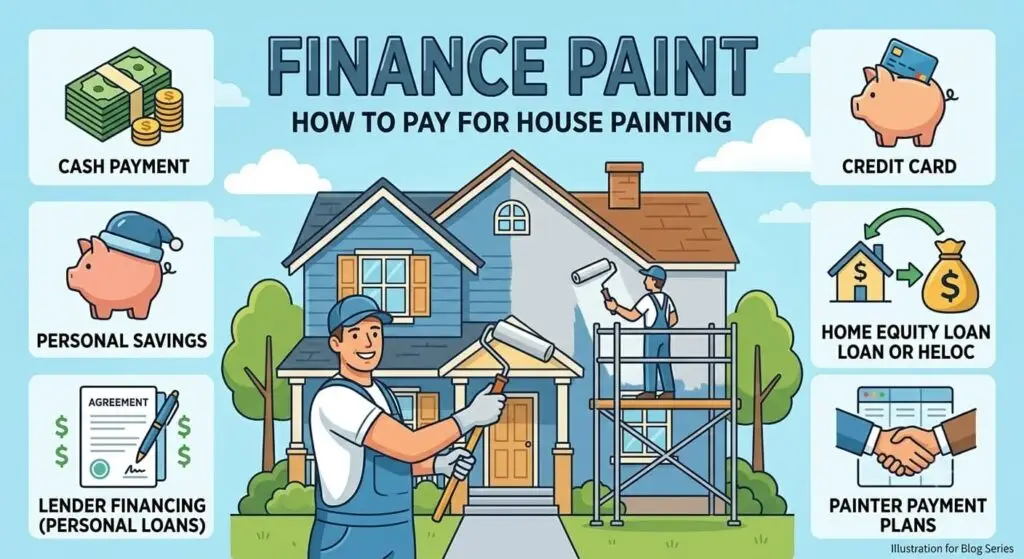
Here’s the direct answer: you can finance a house painting project through a personal loan, a home equity loan or HELOC, a contractor’s in-house payment plan, or an FHA Title I loan – and most homeowners with fair-to-good credit can get approved within a few days, sometimes instantly through a contractor’s financing partner.
One thing worth clearing up before we go further: if you’ve searched “finance paint” and landed on results about financing a paint job for your car, that’s not a typo on your part – it’s a genuinely confused search term, and I’ll untangle it below.
What Does It Actually Cost to Paint a House?
Before you finance anything, it helps to know what you’re financing. Exterior painting on an average single-family home in the US typically runs $3,000 to $8,500, and that climbs past $12,000 for larger or older homes with a lot of prep work. Interior painting for a full house usually lands between $2,000 and $6,000, depending on room count and trim detail.
A few things move that number more than people expect:
- Prep work. Scraping, sanding, and fixing rotted wood can add a real chunk of labor cost before a single coat goes on.
- Paint quality. Premium exterior paint can add $400-$800 over builder-grade options.
- Where you live. Labor in California, New York, and Massachusetts tends to run 20-40% above the national average.
- Height and access. A two-story house with scaffolding needs is not the same estimate as a single-story ranch.
Knowing this range matters because it tells you how much to actually finance – and I’d always add a 10-15% buffer for the exterior jobs especially, since hidden rot or siding damage under old paint is more common than you’d think.
Your Real Options for Financing a Paint Job
There’s no single best way to do this – it genuinely depends on your credit, how fast you need the work started, and whether you’d rather use your home as collateral or not. I ran my own numbers through FinToku’s House Painting Financing Calculator before writing this, comparing a personal loan against a HELOC side by side – it’s worth doing the same with your actual quote before you pick a route.
Personal Loans
This is the option I’d point most people toward first. You borrow a fixed amount, pay it back over 12 to 60 months, and the rate is locked in from day one – no surprises. Lenders like LightStream, SoFi, and Upgrade offer these with no collateral required.
APRs typically run 7% to 26%, and where you land depends heavily on your score. Above 720, you’re usually looking at the lower end. Below 640, expect the higher end and fewer lenders willing to approve you at all.
One habit that actually pays off: pre-qualify with two or three lenders before you commit to anything. Most use a soft credit pull for pre-qualification, so it won’t ding your score just to compare offers.
Home Equity Loans and HELOCs
If you’ve built up meaningful equity, this route gets you a lower rate – typically 6% to 10% – because the loan is secured by your house.
- A home equity loan gives you a lump sum at a fixed rate.
- A HELOC works more like a credit line you draw against as needed.
The tradeoff is real, though: your home is the collateral. Miss enough payments and you’re not just dealing with a bad credit mark, you’re risking the property itself. The Consumer Financial Protection Bureau’s HELOC guide is blunt about this: only take one out if you’re confident you can keep up with payments, since falling behind can mean losing the home. For a $5,000-$8,000 paint job, I’d honestly think twice before putting my house on the line just to save a couple points of interest – a personal loan’s higher rate might be worth the peace of mind.
Contractor-Offered Financing
Most painting companies now partner with a third-party lender to offer financing right at the estimate. You’ll recognize the pattern once you’ve seen a few:
| Contractor | Financing partner | Terms offered |
|---|---|---|
| CertaPro Painters (EZ Pay) | Acorn Finance or EnerBank | Loans up to $100,000, 2-12 year terms via Acorn; $1,000-$50,000 unsecured with 6-12 months no interest via EnerBank |
| ProTEK Painters (ExpressPay) | Regions Bank / EnerBank | No payments or interest for 12 months on approved credit, 100% unsecured from $4,000 |
| LoCOl Paint | EnerBank | 0% interest for 9 months, same-as-cash, with a one-time 5% admin fee on the project total |
These deferred-interest and same-as-cash structures can genuinely work in your favor if you pay off the balance inside the promo window. Where they bite is if you don’t. Per the CFPB’s own explainer on promotional financing, the giveaway is the word “if” – “no interest if paid in full” means deferred interest, which charges you retroactively from the original purchase date on the entire balance if you fall even a little short. A true “0% APR for 12 months” offer, by contrast, only charges interest going forward on whatever’s left. I’ve seen people get caught off guard by that difference, so read the fine print before you sign, not after.

FHA Title I Home Improvement Loans
Less well-known, but worth a look if your credit is fair and your equity is thin. Per HUD’s official Title I program page, loans up to $7,500 don’t require the property as security – anything above that does. Fixed rates apply, and there’s no strong equity requirement. It won’t cover a full high-end exterior repaint on its own, but it’s a real option for a smaller job or a partial project.
Credit Cards
A 0% APR promotional credit card can work for a small project – think a single room or a touch-up job under $2,000. The catch is obvious but people still get burned by it: if the balance isn’t paid off before the promo period ends, the rate can jump past 20%. Fine for a short-term bridge, risky as a primary financing plan for a full house.
Does Maaco Finance House Painting?
Short answer: no. Maaco finances car paint jobs and collision repair, not houses. It’s an auto body franchise, and its financing page (through the Driven Brands credit card and Synchrony) is built around vehicle repairs – promotional terms of 6, 9, or 12 months depending on purchase amount, plus a standalone EasyPay option.
If you searched “finance paint” hoping to cover your house and ended up reading about vehicle financing, that’s why – the search term genuinely overlaps both categories, and Google surfaces both. For your house, you’re looking at the personal loan, HELOC, contractor-plan, or FHA route above, not an auto body shop’s credit card.
How to Find House Painting Financing Near You
Searching “house painting financing near me” is actually a smart move, since local contractors often move faster and have more flexibility than a national lender’s online form.
A few places worth checking:
- Ask every contractor directly – “do you offer financing?” should be one of your first questions on any estimate call, not an afterthought.
- Check your local credit union – rates and approval flexibility are often better than a big bank’s.
- Look into state home-improvement loan programs – some states run their own low-interest options for weatherization or exterior repair.
- Ask your Chamber of Commerce or BBB for painter referrals that include vetted financing partners.
Improving Your Approval Odds
Your credit profile is doing most of the work behind the scenes here, whether you like it or not. A few things that actually move the needle before you apply:
- Pull your credit report and check for errors – it happens more than people assume.
- Get credit card balances under 30% of their limit if you can.
- Avoid opening new credit accounts in the 60-90 days before you apply.
- Consider a co-signer if your score is borderline.

Key Takeaways
- House painting financing typically comes from four sources: personal loans, home equity loans/HELOCs, contractor in-house plans, or FHA Title I loans.
- Exterior painting runs $3,000-$8,500 on average in the US; interior painting runs $2,000-$6,000.
- Contractor “same-as-cash” or 0% promo financing (like CertaPro’s EZ Pay or ProTEK’s ExpressPay) can charge interest retroactively if the balance isn’t cleared in time.
- Maaco and similar auto body shops finance car paint jobs, not house painting – a common source of search confusion.
- Personal loans typically carry 7-26% APR; home equity options run lower (6-10%) but put your house up as collateral.
Frequently Asked Questions
Can I get house painting financing with bad credit? Yes, but expect higher APRs, often in the 20-26% range, and fewer lenders willing to approve you. FHA Title I loans and contractor in-house plans tend to be more forgiving than personal loan lenders.
How long does approval take? Personal loans usually take 1-3 days. Contractor financing through a partner like Acorn or EnerBank is often instant or same-day at the estimate appointment. A HELOC can take 2-4 weeks since it involves an appraisal.
Is financing a paint job actually worth it? If your home genuinely needs the work – peeling paint exposing wood to moisture, for example – yes, since delaying usually means more expensive repairs later. If it’s purely cosmetic and you can save up in a few months without much cost, that’s worth weighing against paying interest.
Does a fresh paint job increase home value? Generally yes. Exterior painting is one of the higher-ROI home improvements at resale, since it’s the first thing a buyer sees.
Can renters finance a paint job? Usually no – most of these financing products are structured for homeowners, since the work is being done to an asset you own.
If you’re weighing a personal loan against a HELOC for this, it’s worth running both scenarios through the House Painting Financing Calculator before you commit either way – the difference in total interest paid over the loan term can be bigger than it looks on the monthly payment alone, and the calculator’s Compare tab lines up all three financing types (personal loan, HELOC, FHA Title I) against each other, plus a Deferred Interest tab if a contractor’s “same-as-cash” plan is on the table.
Disclaimer
This article is for general informational purposes only and shouldn’t be taken as financial or lending advice. The cost ranges, APRs, and contractor terms mentioned here are examples based on published rates at the time of writing – actual offers depend on your credit, lender, and location, and terms change often. Before signing any financing agreement, read the full terms (especially deferred-interest clauses) and consider checking with a financial advisor. You can also read FinToku’s full Financial Disclaimer.
By Saad Faisal · Published July 5, 2026