

I still remember the first time a friend of mine got turned down by three banks in a row for a car loan, then walked into a “buy here, pay here” lot and drove off the same afternoon. She was thrilled — until she read the fine print six months later and realized her interest rate was nearly double what her coworker paid at a credit union.
That’s the trade-off at the center of in-house financing. It’s genuinely one of the fastest ways to get approved for a car, a couch, or dental work when a bank says no. It’s also one of the easiest financing arrangements to get burned by if you don’t know what you’re looking at.
In-house financing is when the business selling you something also lends you the money to buy it, instead of sending you to a bank or credit union. The seller decides who gets approved, sets the interest rate, and collects your payments directly. You’ll see this most often at “buy here, pay here” car lots, but furniture stores, dental offices, and some home-improvement contractors use it too.
How In-House Financing Actually Works
Here’s the direct answer: you apply with the seller instead of a bank, they check your income and residency (often more than your credit score), they set the loan terms themselves, and you pay them back directly — usually in person or through an online portal they run.
Walk into a dealership that offers it, and the process usually looks like this:
- You pick out the car (or couch, or dental procedure).
- You fill out an application on the spot — no separate trip to a bank.
- The seller reviews your income, employment, and residency, and pulls your credit if they check it at all.
- They set the down payment, interest rate, and repayment schedule themselves.
- You drive off the lot (or start treatment) the same day, then make payments straight to the seller going forward.
That last step matters. With a bank loan, you owe the bank. With in-house financing, you owe the same company you just bought from — which is part of why the whole thing can feel so fast, and also why disputes over payments can get messier than they would with a third party involved.
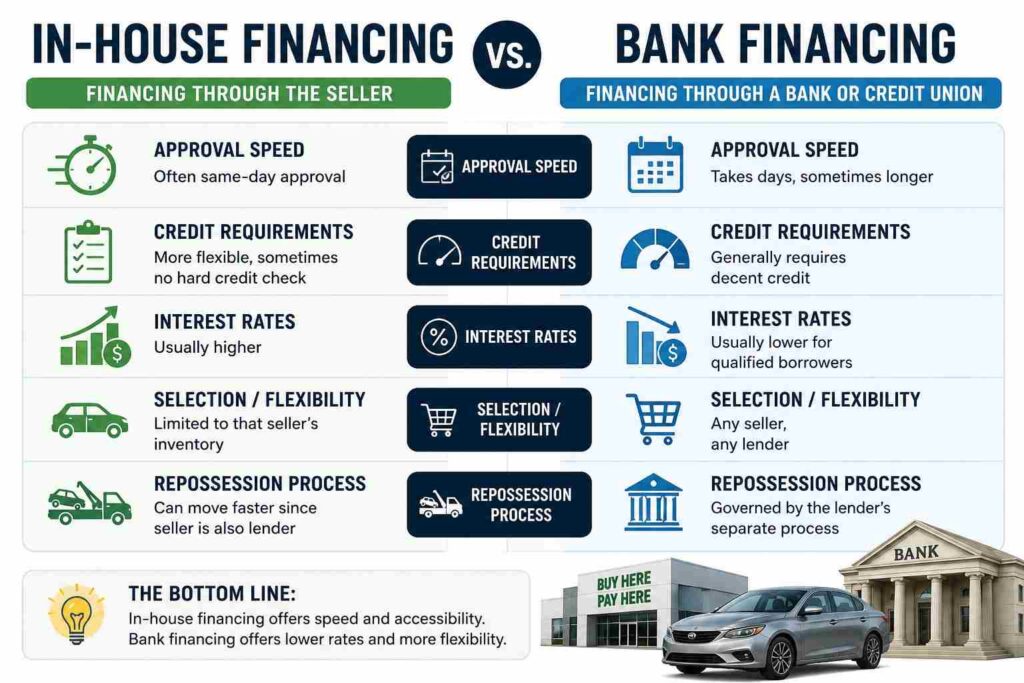
In-House Financing vs. Bank Financing
| In-House Financing | Bank / Credit Union Financing | |
|---|---|---|
| Who approves you | The seller | A separate bank or credit union |
| Speed | Often same-day | Days to a couple weeks |
| Credit score weight | Usually secondary to income/residency | Central to approval and rate |
| Typical interest rate | Higher | Lower, especially with good credit |
| Who you pay | The seller directly | The bank |
| Repossession speed if you miss payments | Often faster | Governed by more standardized bank processes |
If your credit is solid, a bank or credit union will almost always beat an in-house rate. This option earns its keep specifically for buyers a bank has already turned down.
What You’ll Need to Qualify
This is where in-house financing genuinely differs from a bank loan, and it’s the single most-searched question around this topic — so it’s worth being concrete.
Most in-house lenders ask for:
- A government-issued photo ID. Driver’s license, passport, or similar.
- Proof of income. Recent pay stubs, bank deposits, or benefit statements (some lots even accept SSI, VA, or gig income).
- Proof of residence. A utility bill or lease with your name and address.
- A down payment. Almost always required — the amount depends on the vehicle’s price and your income, not a fixed rule.
What they usually don’t require, at least not as a dealbreaker: a specific credit score, a debt-to-income ratio calculation, or a lengthy documentation package like a bank would want. That’s the appeal — and also the reason approval doesn’t guarantee you a good deal, just a fast one.
I ran a quick scenario through FinToku’s Car Payment In-House Financing Calculator before writing this, plugging in a $12,000 used car with a modest down payment. Seeing the total interest cost laid out next to the monthly payment made the trade-off a lot more concrete than just reading “rates are usually higher” — I’d genuinely recommend running your own numbers before you sign anything.
Who Offers In-House Financing
Auto dealerships — especially “buy here, pay here” (BHPH) lots — are the most common example, but you’ll also find it at:
- Furniture and appliance retailers
- Dental and medical practices, for procedures insurance doesn’t fully cover
- Some home-improvement and HVAC contractors
- A handful of jewelry stores, for larger purchases
The common thread: high-ticket items where a buyer might otherwise walk away rather than pay the full price upfront.
The Real Trade-Offs
Where it helps:
- Faster approval — often the same day, sometimes within minutes
- More forgiving of low or no credit history, past bankruptcies, or repossessions
- Everything happens in one place, with one application
Where it costs you:
- Interest rates typically run higher than a bank or credit union would charge — the CFPB notes that going straight to a bank or credit union is generally the cheaper route precisely because it skips the dealer markup
- Fewer choices on loan term length
- If you fall behind, the seller can often move to repossess faster than a bank would, since there’s no separate lender’s process to go through
None of this makes it a bad option — for a lot of buyers it’s genuinely the only door open at that moment. It just means going in with your eyes open pays off.
How to Spot a Bad In-House Financing Deal
A few things I’d treat as red flags if I were sitting across the desk:
- They let you drive off before the loan terms are finalized. A legitimate lender locks in the deal first.
- The dealer doesn’t report payments to credit bureaus. If on-time payments never show up on your credit report, you’re missing out on one of the few real upsides of this kind of loan — the CFPB has flagged that some buy-here-pay-here dealers report late payments but not on-time ones, which can hurt your credit without ever helping it. It’s worth asking upfront, in writing, whether they’ll report your payments at all.
- A phone call after the fact says your financing “fell through” and asks for more money or a higher rate. This is a known scam pattern — walk away.
- Vague or shifting answers about the total cost of the loan, not just the monthly payment.
Actually, let me back up on that last one — the monthly payment is the number every ad focuses on, and it’s the easiest one to get comfortable with even when the total cost is much higher than a bank loan would be. Ask for the total repayment amount in writing before you sign, not just what you’ll pay per month.
Key Takeaways
- In-house financing means the seller — not a bank — approves you, sets your rate, and collects your payments directly.
- Approval typically leans on income, employment, and residency more than credit score, which is why it works for buyers banks have turned down.
- Expect a higher interest rate and less flexible terms than a comparable bank loan.
- You’ll generally need a photo ID, proof of income, proof of residence, and a down payment to qualify.
- Refinancing with a traditional lender later is usually possible if your credit improves in the meantime.
Frequently Asked Questions
How does in-house financing differ from a bank loan? The seller acts as the lender instead of a bank, approving you and setting the loan terms directly. This usually speeds up approval but comes with higher interest rates and fewer term options.
Can I get in-house financing with no credit or bad credit? Often, yes. In-house lenders tend to weigh income and residency more heavily than credit score, though some do still check your credit report.
Can I refinance an in-house loan with a bank later? Generally yes, once your credit improves or you’ve built payment history. Refinancing can lower your rate or extend your term compared to the original in-house deal.
Do dentists and furniture stores really offer in-house financing? Yes — it’s most common at car dealerships, but dental practices, furniture and appliance retailers, and some contractors offer it too, usually for purchases insurance or savings won’t fully cover.
Is in-house financing the same as a “loan origination” process? Loan origination just refers to the steps a lender takes to process and approve any loan application — in-house or otherwise. In-house financing is one specific type of lending arrangement; origination is the process behind it.
Before you commit to anything, run your specific numbers through FinToku’s Car Payment In-House Financing Calculator — seeing the real monthly payment and total cost side by side is the fastest way to know if the deal in front of you actually makes sense.
Disclaimer
This article is for general informational purposes only and shouldn’t be taken as financial or legal advice. The loan amounts and rates I’ve used here are illustrative examples, not guarantees of what you’ll be offered. Loan terms, requirements, and typical rates vary by state, lender, and your individual credit situation — before signing any financing agreement, it’s worth comparing the offer against a bank or credit union quote and reading the full contract carefully. You can also read FinToku’s full Financial Disclaimer.